Brixham Stepping Out Part 1

A Monster Lobster and flying pigs along with the arrival of the railway and the telegraph, drunkeness, sobriety and war.
This is my second series of posts on Brixham. The first series was from a walk from Shoalstone to the Fish Market, in November 2020, that you can see here, while this series are from a walk taken in November 2024 which winds back and forth through the town, up and down the many flights of steps. Hence, Brixham Stepping Out.

The central car park leads you through the narrow lanes and alleys that lead to the harbour front. We'll see the harbour but only briefly as I've been there in the earlier series. These streets and alleys are part of working Brixham and all the more interesting for that. You won't find scented candles and sticks of rock down here.

In 1946 the Daily News carried an article on the Battle for Brixham. This battle was between holiday makers and the fishing trade. I would say that the battle turned out to be a draw if modern Brixham is anything to go by.
The battle was for the survival of Brixham as a fishing port, with the visitors intervening.
Thirty years ago there were 300 trawlers in Brixham's fleet. Twenty-five years ago 140. In 1932, 60. Now there are under 20.
Eight thousand trippers a day have crowded in, and it is easy to understand why Brixham's subtle quality gets under the skins of its visitors. Was there ever such a town ? Up the steps and down the steps-the labyrinthine alleys where you can step on a roof or, as they say here, spit down a chimney-the pervading essence follows.
Wherever you look, as Charlie says, there's something quiet and busy to see on the water below. No amusement parks and only one fun fair; one cinema and no theatre; but it doesn't matter.
Wilfred Hubbard has caused a stir by opening up a marine engineering shop in competition with the interlocking quayside companies and is doing well, they say.
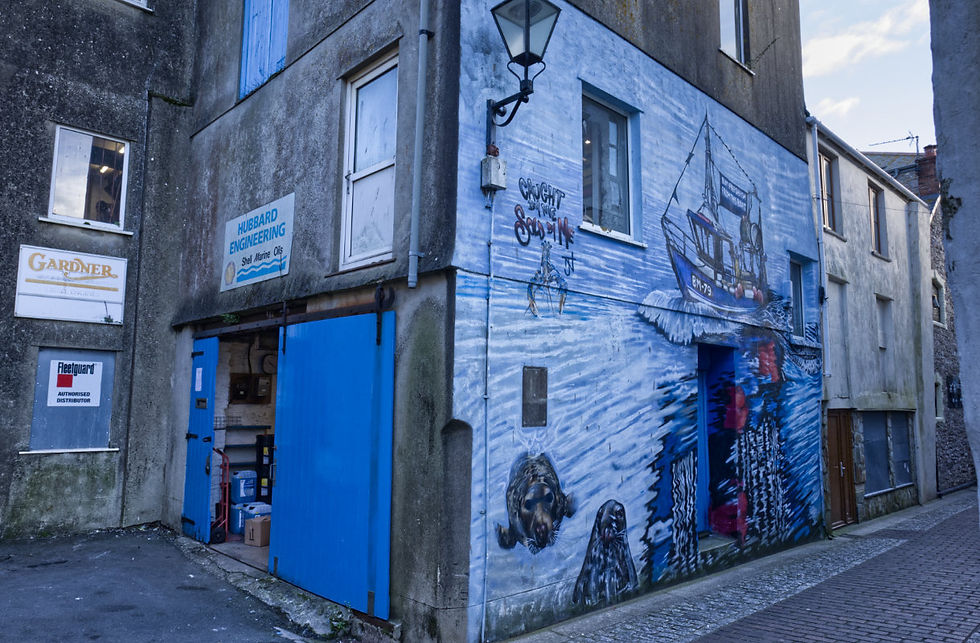
What you will find all over Brixham are murals, both plain and simple and also extraordinary. They are around every corner. Even on the side wall of Hubbard Engineering, still here seventy years later.
Western Times - Friday, 18 August 1922
MONSTER LOBSTER LANDED AT BRIXHAM.
A monster lobster caught in the trawl off Berry Head by the motor trawler "Ivy May," has been landed at Brixham. From the tip of its head to its tail it measured 19in., and from the extreme tip of its feelers to the tail the measurement was 37in. The length of the "killing" claw was 19in., with a girth of 13in. in the widest part. The head had a girth of 16in. The lobster, which weighed 11 lb., was the largest ever landed at Brixham.

In 1973 you could have an exotic New Year's menu as far away as Bristol that included the headlining Brixham Lobster. All of those courses and all of that Frenchified expertise for as little as £8.50 a head. I want to know what all the "many other surprises" were. I do remember Tornedos being on the menu at "Gourmet Night" in Fawlty Towers.


Sherborne Mercury - Monday, 18 October 1773
OCTOBER 10, 1773-
RAN away from his master, ARTHUR MADDICK, of Brixham, fisherman,
Thomas Thorn, his apprentice,
Aged about eighteen years, about four feet nine inches high, of a brown complexion, hath a speck in one of his eyes, which he received in the small-pox. Wore, when he went off, a reddish colour: beaver coat, a flowered linen waistcoat, and a pair of black plush breeches .- If the above apprentice will return to his master, he will be kindly received. If any person is known to harbour or employ him after this public notice, shall prosecuted as the law directs, by me.
ARTHUR MADDICK.

This is the old Market House now listed Grade 2 by English Heritage. It is believed to date from 1799.


In 1943 meat was rationed and heavily controlled, even for use in making pasties for war workers.
Western Morning News - Saturday, 21 August 1943
TO MAKE PASTIES
Meat Not Declared By Brixham Butcher
Percy John Johnson butcher, of St Mary's Square, Brixham was fined £5 and ordered to pay advocate's fee of £1 1s. at Brixham yesterday for a false statement as to amount of meat not taken up by registered customers on July 5.
Prosecuting for the Ministry of Food. Mr. C. Hamlyn Taylor said Mr. Evan Powell, Ministry inspector, found in the refrigerator two pieces of beef, 43 1/2 lb. weight, which had been left over from Saturday, July 3, for which no credit had been recorded for stock in hand. Defendant frankly admitted he had omitted to declare the stock in hand, attributing this to an oversight.
Defending, Mr. H. A. T. Coles said Johnson was responsible for supplying meat to a firm for pasties to be made for employees on war work Only a certain kind of meat suitable for mincing could be used for the pasties. Unless Johnson kept a certain kind of this mincing meat in quantities to supply 9s 2d. worth per day regularly he would not be able to supply the firm making the pasties. He treated the beef that had been allocated by him from day to day as part of his contract to supply. Mr. C. Hamlyn Taylor said the objection was not to defendant keeping the meat, but that he had not disclosed it.

Illustrated London News - Saturday, 22 September 1888
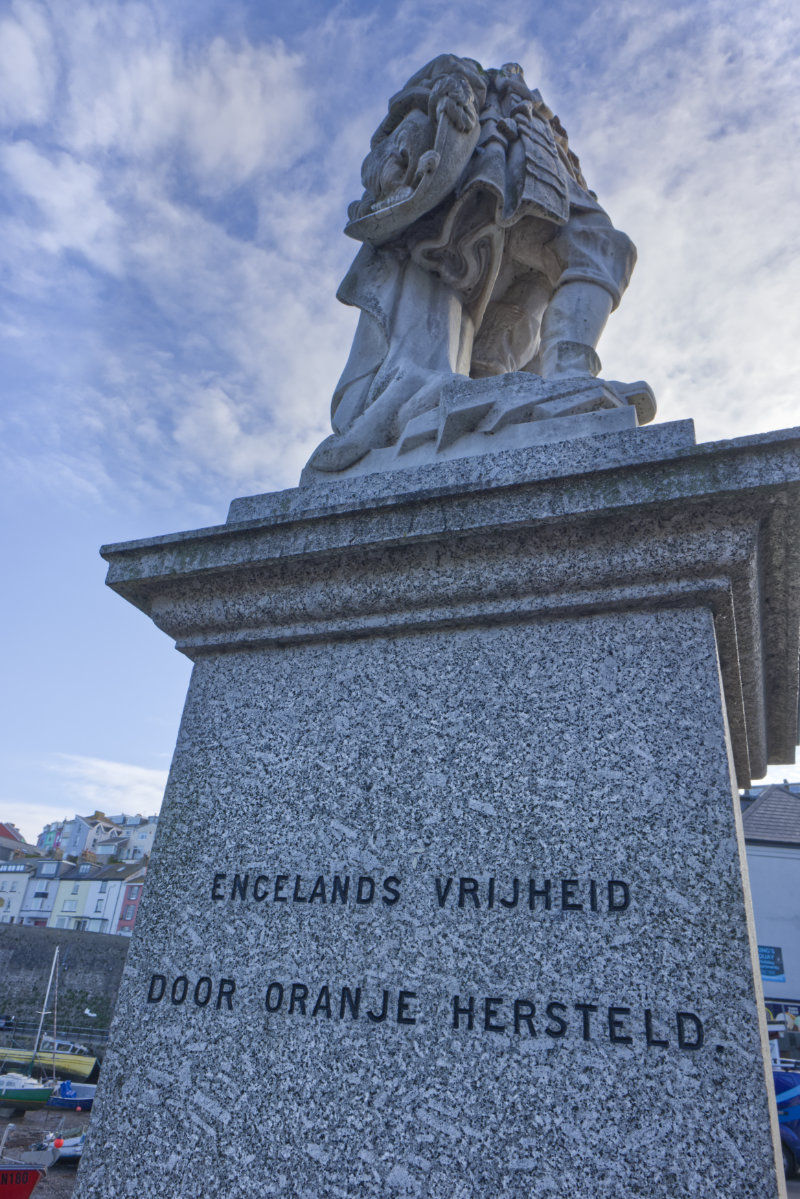
In furtherance of the movement to celebrate the bicentenary of the landing of Prince William of Orange in Torbay, a meeting was held on Sept. 18 at Brixham, Devon, for the purpose of obtaining support from that town to the fund being raised for a statue. Lord Churston presided, and it was stated that about £400 of the £1000 required had already been promised. Representatives of the Huguenot societies of London and the Protestants of Hull supported the object of the meeting, and a resolution was passed endorsing the action of the committee. The event will be celebrated on Nov. 5, and it is proposed to erect the statue on Brixham Beach, at the spot where the Prince landed.
Western Daily Press - Wednesday, 6 November 1889
STATUE TO PRINCE WILLIAM OF ORANGE.
The statue of Prince William of Orange, erected by public subscription, was unveiled at Brixham, Devon, yesterday. Baron Gevers, who represented the Dutch Minister, said the King of the Netherlands had taken a great interest in the movement, and the memorial would be an everlasting tie between the two nations.

There are still some businesses on the harbour front aimed solely at holidaymakers, like amusement arcades.

It was a very different world back in the 1800's and sailors went to sea for years at a time with no news reaching home. Here is an example of one such adventure from a ship that left Brixham in May 1800 whose captain took three years to return after escaping capture by the Spanish in Chile. Private ships carried "Letters of Marque" which was an official government license that authorized a private ship owner—known as a privateer—to attack, capture, or destroy enemy merchant ships and property during a time of war. They were dangerous times, and the average life expectancy of a sailor was mid 30's to mid 40's.
True Briton - Monday, 11 April 1803
BRIXHAM QUAY, TORBAY, APRIL 7.
CAPT. THOMAS BURROWS, of the Ship Redbridge, Letter of Marque, of London, armed with ten 12-pounders, and forty hands, sailed from Torbay the 3d of May, 1800, in ballast, destined for the coast of Peru, in the Whale Fishery, arrived on the coast of Chiloe the early part of January 1801, and after some time caught about one hundred tons of oil, during which her crew were so infected with the scurvy, that he had not hands enough left to work the ship. He was under the necessity of running in under the Island of St. Mary's (coast of Chiloe), to partly bury the people in new earth, to recover them of their disorder;
"Burying in new earth" (also known historically as an "earth bath") was an ineffective, superstitious medical treatment used in the 17th and 18th centuries to treat scurvy.
.....leaving no person on board but the said Master, his Mate, and three of the crew; while this was performing, a ship (which had been there for a similar purpose) sailed and fell in with two Spanish armed Ships, and informed them of the situation of the Redbridge, and also towed and piloted the Spaniards in ;- when on the 30th of December, 1801, the Britannia, of thirty guns, and the Castor and Pollux, of twenty-two guns, the two armed Spanish Ships, began to fire several broadsides at the Redbridge, although she did not, nor could make any resistance ; then boarded and took her, and carried her into Conception Port, and from thence they were sent to Lima, with all the sick crew imprisoned, pinioned in an unusual barbarous manner; and when their legs swelled out beyond their fetters, their only remedy or consolation was, to shift one leg in the other's fetter, and in this situation, it is much to be feared, the poor crew remain, as they were on the 16th of October 1802, although the Viceroy had prior accounts the Preliminaries of Peace were signed, but he would not listen to their repeated petitions.
Capt. BURROWs then, through the kindness of some Spanish Ladies ( whom he had previously taken and treated kindly), bribed -the centinels and got on board the Juliana, of Hamburgh (in disguise) lying there and bound home. Capt. WOLFFE kindly hid him, and being off Plymouth, very humanely ran in with the land, put Capt. BURROWS on board one of our Torbay Fishing Sloops yesterday, and last evening he was landed safe here, and to-morrow intends setting off for London, to the longing desires of his wife and family, who have thought them all dead.

This elegant building is on the corner of the Strand which runs along the quay. In earlier maps The Strand is called The Beach. My guess from old maps is that the name changed around the turn of the century. The area alongside the inner harbour was originally a tidal inlet and foreshore commonly referred to in early local maps and descriptions simply as the beach or Beach Road where boats were drawn up. As the town filled in the tidal valley to create the current town centre, harbour-side configurations, and roadways like The Strand, the older "Beach" designation for that specific stretch transitioned into the urban name used today.

Opposite the fish and chip shop is the Blue Anchor.
Western Times - Saturday, 20 January 1849
The Annual Meeting of the Brixham Ship-owners' Society, was held at the Blue Anchor, on Tuesday, when Mr. Danl. Dewdney was again elected president, and Mr. Tyler, vice-president. The sum of 10 was voted towards the funds of the Devon and Exeter Hospital, and the like sum to the Mariners' and Fishermen's Society. It was proposed by Mr. Wm. Kendrick, and seconded by Mr. P. Varwell, that a petition to the House of Commons, against repealing the Navigation Laws should be immediately prepared, which was carried.
It was to little effect and the Navigation Laws were indeed repealed. The laws in question had been what we would call protectionist and brought in under Oliver Cromwell in 1651. They limited trade into Britain where possible to British or colonial shipping so it's no surprise that the ship owners of Brixham were not happy.
Following closely behind the abolition of the Corn Laws, Parliament repealed the navigation laws to allow foreign ships full access to British and colonial ports. The move lowered shipping costs, stimulated international commerce, and solidified Britain's position as a global trading powerhouse.

Pubs were notorious dens of iniquity in the 1800's, I make no comment about pubs today. This article is particularly funny, as the police who were clearly checking on illicit activity in the pub, ended up cautioning the landlord for effectively denying them the chance to get their evidence.
Torquay Times, and South Devon Advertiser - Saturday, 9 September 1871
BRIXHAM OFFENDERS.
Edward Jones, of the Blue Anchor, who had been fined 13s. for refusing admission to the police, was cautioned ; Thomas Jackson, of the Dolphin, against whom three convictions were reported, had his license taken away ; Robert Lavers, of the London Inn, was cautioned; James Pearce, a beer-house keeper, and stated to be a feeble old man, had his license renewed for another year on the condition that when he gave up the license should die out ; and Richard Treble, of the Ring of Bells, had his license taken from him. The police-officer stated that every successive landlord of the last-named house had been convicted.

This mural features Brixham's historic trawler fleet and is by Plymouth based artist Mrs. Murals. I believe there are 6 murals by this artist in Brixham.
In 1793, communications and literacy were clearly such a problem that while England was at war with France a trawler captain from Brixham boarded a French ship off Start Point and sold them his fish. To be fair the war had only been going for four and a half months and there was no wi-fi in the Blue Anchor.
"...they were ignorant of the war. The Brixham trawler, after putting off from the Frenchman, made the best of his way into Torbay, which he compleated in about two hours; where he found the Alarm revenue lugger, and Ranger navy cutter, who slipped their cables, and
immediately proceeded in quest of her."
Whether the navy found the ship or the fish is not clear. A month earlier The Alarm had captured two French ships on the same day. The Chauvelin was a 10-gun French privateer with a crew of 54 men, captured by Alarm after a five-hour chase on April 27, 1793. The Enfant de la Patrie: A 6-gun French privateer was captured on that same day with the assistance of the British revenue cutter Swallow, which was sailing alongside Alarm. So it wasn't all bad news. However, a year later the Ranger met a serious foe, the 32 gun warship Railleuse, and was surrendered to the French.

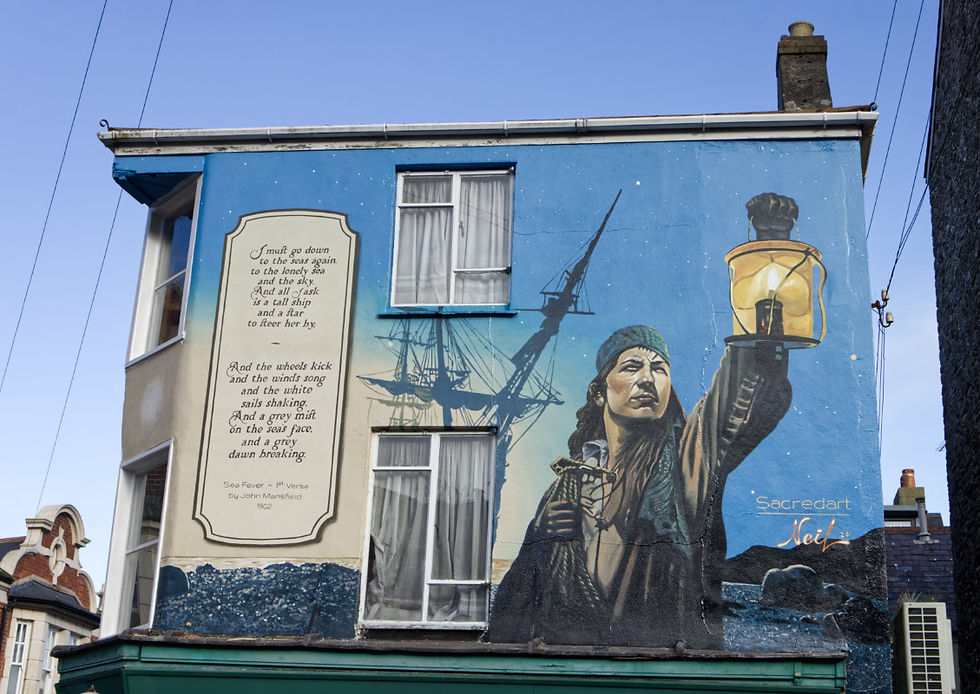
On the other wall of Hans Gifts is this dramatic piece by Neil Wilkinson Cave of Sacredart. It is based on the Masefield poem Sea Fever.
I must down to the seas again,
to the lonely sea and the sky,
And all I ask is a tall ship
and a star to steer her by,
And the wheel's kick and the wind's song
and the white sail's shaking,
And a grey mist on the sea's face
and a grey dawn breaking.
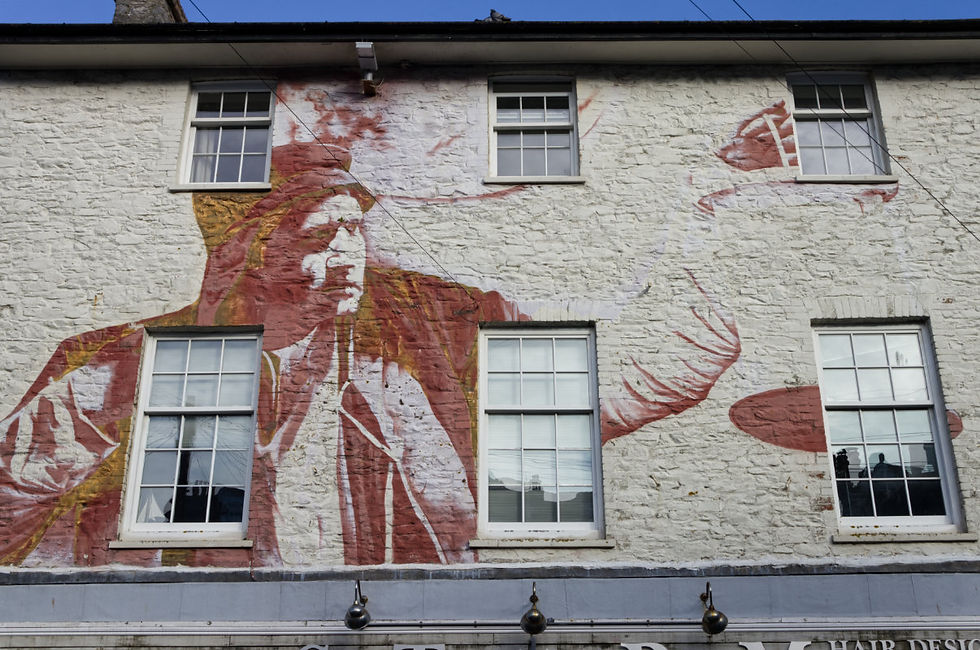
Next door to Hans Gifts is this very different mural. Above Storm Hair Design it features a pirate with a lantern.
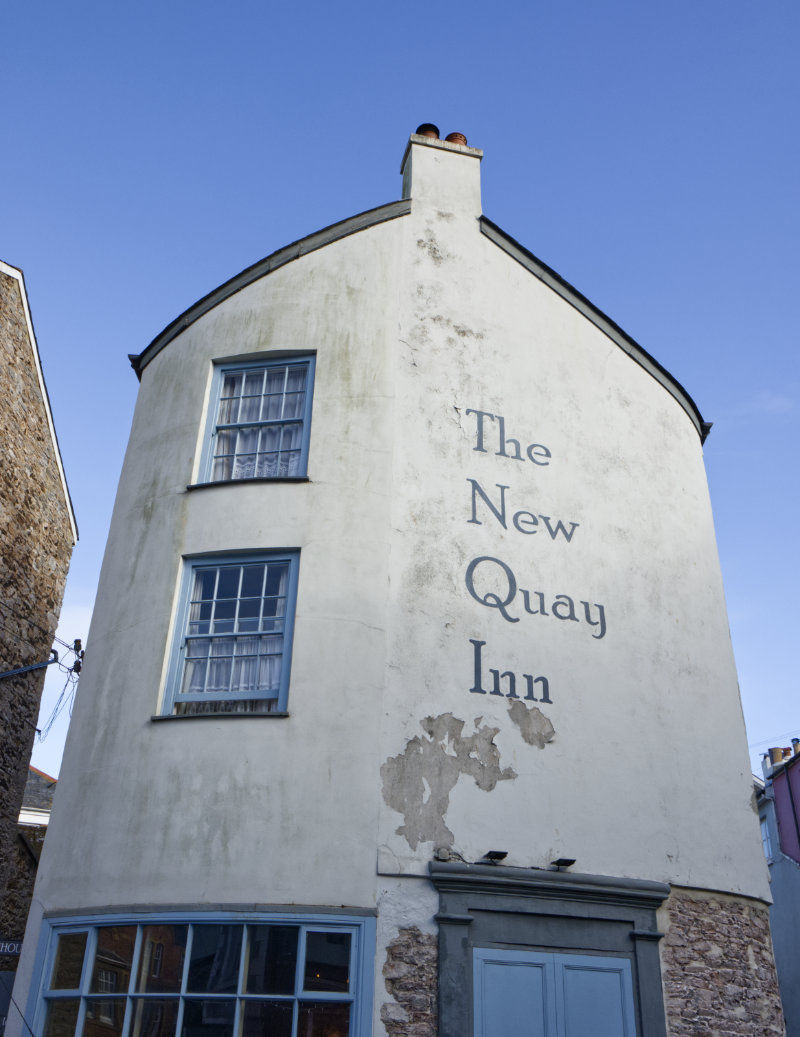
Next we come to the New Quay Inn. This is a Grade 2 listed building and has an unusual curved end, like the stern of a galleon. It is early 19th century. The "New" in the name suggests as it is very close to the harbour that this may nave been reclaimed land at the head of the creek, at the time that the beach became a quayside. Indeed there is a suggestion that there was a sail loft on the site before the pub, with parts of the building variously dating from 1780 to 1840.
Many old buildings in South Devon on sharp corners or junctions with narrow lanes, have curved walls, and it is thought that it was to help with horse drawn vehicles and their turning circle.
The New Quay Inn shares the title "Best Pub in Brixham" with all of the other best pubs of Brixham and who am I to argue.
It's almost like this blog I write has some sort of plan to it, rather than just making it all up as I go along. The next article I stumbled upon was this one that reaffirms what I said above about horse traffic.
Dartmouth & South Hams Chronicle - Friday, 6 January 1893
ACCIDENT .- A serious accident happened to a boy named Edmonds on Monday. He was passing the New Quay Inn, when a horse and cart belonging to Mr W. Veale came along in an opposite direction and crushed him against the side of the house. He was at once conveyed to the Cottage Hospital where his injuries were attended to, and he was afterwards taken home. His thigh bone was found to be broken, and he lies in a critical condition.

Opposite the best pub in Brixham, what would you expect to see? Temperance Place of course. All needs are catered for in Brixham.
Temperance Place in Brixham is a historic 19th-century residential terrace and stepped alleyway featuring Grade II listed fisherman's cottages built into the steep hillside above the inner harbour. The cottages (numbered 7–29 Temperance Place) and the accompanying Temperance Place Steps date back to a period of rapid population and housing growth driven by Brixham’s booming fishing and trawler industry.
Ironically, every article I could find about Temperance Place seemed to involve court cases which were the result of drunkeness.
This is my first set of steps in this series. On the right of Temperance Place is the famous "Ye Old Coffin House", which I forgot to photograph on the start of the walk, but this was a circular walk and ends back here, so I'll show you that in the final piece of this walk, along with some more murals in Fore Street.

EXETER TEMPERANCE SOCIETY.
The General Anniversary Meeting of the members and friends of the Exeter Auxiliary Temperance Society was held at Congdon's Subscription Rooms, on Tuesday evening last,
when there was a numerous and respectable attendance.
As early as 1834 a meeting was held in Exeter of The Temperance Society, at which mention was made of new establishments set up at Teignmouth and Torquay and one soon to be set up in Brixham.

When the Temperance Hall eventually arrived it had to be paid for and I love this article describing the charity bazaar. It is an exercise in genteel, antiquated and refined language that we will never see the like of again.
Western Morning News - Wednesday, 19 May 1869
TEMPERANCE BAZAAR AT BRIXHAM.
The social reformers of Brixham yesterday made another effort to Iiquidate the debt on the new Temperance Hall by a bazaar in the hall, and met with e gratifying success.
The hall originally cost about £1,000, towards which about £400 had been collected previous to yesterday. Brixham being a town of good standing in the work of social reform, the bazaar was treated rather as an occasion of public festivity than as an affair of one section of the community.
The inside of the hall presented an animated appearance; articles, serviceable and ornamental, were literally piled on the tables, and the stall-keepers' charms or spells compelled free investments.
In the afternoon the visitors flocked to the hall in large numbers, and business was brisk ; and, with the lively music from the piano at intervals, the bazaar was as attractive as art could devise.
The other entertainments included, refreshments, a display of "mechanical contrivances" and other works of national industry, a printing press producing copies of the Brixham Temperance Bazaar Gazette, a post-office with working models, and not forgetting stereotyphic views, in the charge of Mrs. Wicks.
For context, it was a brave new world and the first North American transcontinental railroad had just opened nine days before and the Suez Canal was to open in another six months.

Temperance Place steps themselves are Grade 2 listed by English Heritage. Long flight of steps leading up from King Street to Mount Pleasant Road. C19, partly rebuilt and restored in 1980s. Brick steps. Included for group value.
If you like long steep flights of steps you need to see my piece about Spion Kop in Salcombe.

The steps add to the normal height of the scaffolding to make the views on this construction site quite lofty indeed. No job for anyone scared of heights.

Property for sale in 1903 and it has a rain water tank and mains water too. It could be rented out for £39 per month in today's value.
Lot 2 .- A Freehold Cottage situate in Temperance Steps, near King Street, for the past 15 years in the occupation of Mr. Philip Weymouth, at 10s. per month; containing three rooms, washhouse, w.c. Fitted with local water connections, together with a large rain water tank, and has a fair size drying ground or garden plot adjoining.
At the top of Temperance Steps are great views of the northern slopes of Station Hill. Station Hill is a winding road going up through the town to where the railway station once stood. That road clearly existed before any thought of railways so can I find out what it used to be called?
Well, yes and no. It appears that before the railway arrived, that hilltop was called Furzeham Common and the winding road up had no name. The railway at Furzeham opened in 1868 and Furzeham Terrace, a row of houses, arrived in around 1851 or slightly earlier according to their first appearance in the census. The arrival of the railway speeded up development on top of the hill.
Sun (London) - Friday, 3 January 1868
BRIXHAM.
A short line of railway, 22 miles in length, from the Brixham-road station of the Dartmouth and Torbay Railway to Furzeham-common, Brixham, was formally opened on Wednesday. The railway was constructed by Mr. R. W. Wolston, for the benefit of the town of Brixham. The line passed through some heavy rock cuttings, and over embankments about 18ft. in height. The event was celebrated at Brixham by a dinner, at which Lord Churston presided. A handsome testimonial was presented to Mr. Wolston by the inhabitants in acknowledgment of the valuable services he had rendered the town by the construction of the railway.

Dartmouth & South Hams Chronicle - Friday, 13 February 1880
ELIGIBLE INVESTMENT.
BRIXHAM, DEVON.
TO BE SOLD by PRIVATE CONTRACT, all those FIVE FREEHOLD DWELLING HOUSES, situate at Higher Terrace, Furzeham Common, Brixham, in the respective occupations of Messrs. Williams, Clarke, Shears, Gill, and Peters.
The above Houses are quite new and most substantially built; are well supplied with a large
tank of water each, and being situate near the Railway Station, in the most healthy and pleasant part of the Town, fronting Torbay, are admirably adapted for Smack Owners and Skippers.
Each House contains Parlour, Kitchen, Washhouse, Drying-ground behind, Two good Bedrooms, and large Attic.
For further particulars, apply to Mr. JAMES MAUNDER, Builder. Brixham, or on the Premises.
Tenders, stating the price which will be given for each House, or any number of them, or the
whole in one lot, to be delivered to the undersigned, on or before the 9th day of February next.
The Vendor does not bind himself to accept the highest or any tender.
WM. P. SPARK,
1, New Road, Brixham. January 29th, 1880.

Turning left at the top of the steps and you are in North View Road, an accurate if uninspired name for an address. These houses first appeared in the 1891 census and the land was undeveloped in an 1869 map. The houses were definitely here in 1886 though, when new residents were complaining to the council that the bin men never came, some things never change. The bin men were at that Dickensian time described as "Scavenger Carts". The matter arose at the Town Board meeting.
Exeter and Plymouth Gazette - Friday, 5 November 1886
The Collector stated that several people at North View-road had refused to pay their rates, as the scavenger's cart rarely called that way .- Mr. Luscombe, being present, said the carts went into the district four times a week. Very few people came out to the carts, and they could not go over the ground twice.

The electric telegraph arrived in Brixham in 1852, when the Electric Telegraph Company extended its lines across Devon to connect local shipping ports and harbor towns. During the Victorian era, Brixham was a rapidly growing fishing hub. The town's fishermen and fish merchants needed a way to instantly communicate with large markets like London to check on fish prices and coordinate deliveries. Before the Torbay & Brixham Railway opened in 1868, the telegraph line allowed local businesses to secure deals while the fish were still being unloaded from the boats. AI overview.
Apparently pigs were seen flying in Brixham in 1915, at least according to some "Mischievous Brixham Boys". This was no laughing matter with the country at war.
Totnes Weekly Times - Saturday, 3 April 1915
MISCHIEVOUS BRIXHAM BOYS.
TELEGRAPH WIRES AND INSULATORS DAMAGED.
Several youths, were summoned at Brixham on Friday for breaking a number of insulators, valued at £1, on the Brixham Branch of the Great Western Railway. Two of the lads were not present, their mothers stating that they were at sea. Mr. J. I. Pengelly, prosecuting on behalf of the G.W.R. Co., said the Company had experienced considerable damage on the branch. In ordinary times it was inconvenient to have the wires cut, but at the present time when the railways were under State control, and required for national purposes, it made it all the more serious that the offence should have been committed. On this occasion it was found that the telegraphic fittings had been destroyed.
The boys had told a constable that they were throwing stones at pigs, but these animals were not usually found at the top of telegraph poles. Those insulators must have been wilfully damaged, as they were high up and out of reach, and he asked the assistance of the Bench to take such steps as would prevent these lads, and others, from repeating this offence.
All the lads pleaded guilty, except two, who were at sea, and the others admitted the
offence on their behalf. William James Honeywill, ganger, stated that sixteen insulators had been broken.
Each of the boys had to pay 2s. 6d. the Chairman telling them that they must not go on the railway.

As you can probably guess, my next piece will be going down steps this time.


Comments