Christ the King Plymouth

This is just a short post about a small unassuming but historic church in Plymouth. I have mentioned this church in passing, previously, in my series Plymouth Walk from 2022. That day, the church was closed so I wasn't able to see inside.
By chance on a recent walk along the Hoe at Plymouth, I noticed that the front door to the church was open so I sneaked in with my phone and just got a few poor quality shots. Only the lobby was accessible and a wrought iron screen prevented me from getting up close, so I may return in the future. For now this is just a taster of what is inside.

These are my exterior shots from 2022.

This church is historic because it was the final work of the architect Sir Giles Gilbert Scott. In fact, Scott finished the work in his hospital bed just shortly before his death in 1960. His most famous work was Liverpool Cathedral one of the largest churches in the world, which can accommodate 3000 worshippers, while this is probably one of his smallest, seating only 150.
You can see my post on Liverpool Cathedral here.

This church is described as Arts and Crafts Gothic Revival, and is a very late example of the style because of the age of its architect. It was opened in 1962 and was part of the post war rebuilding of Plymouth city centre, the most heavily bombed city for its size in Britain.
The prominent site on Armada Way near the Hoe was donated by the city and was an area that was heavily damaged in the bombing. It was paid for by a single private donation of £50,000 anonymously at the time, but now known to be by Mrs. Clare Rye. At today's value that is over £1 million. This small church is Grade 2 listed.
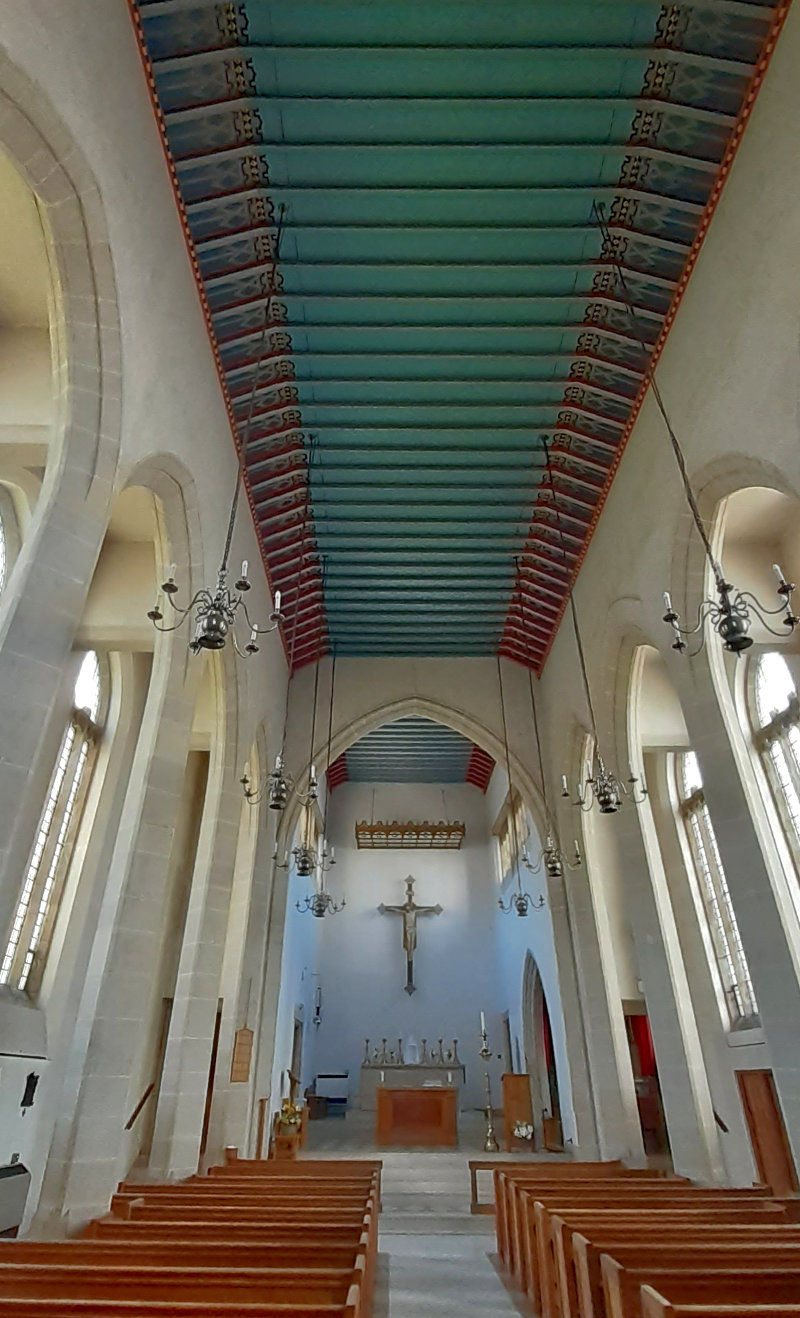
It was built as a chapel of ease for the cathedral and has a later added hall and presbytery, also paid for by Clare Rye and designed by Scott partnership, completed under the direction of his son, Richard Gilbert Scott. Today it acts as the University Chaplaincy.
Richard Gilbert Scott also designed churches, and one of my previous posts features his extraordinary Our Lady Help of Christians church in Tile Cross, Birmingham.

At the west end of the north aisle the baptistery, retaining the font in its original location, with sunken floor. Tapering octagonal polished stone font with oak cover.

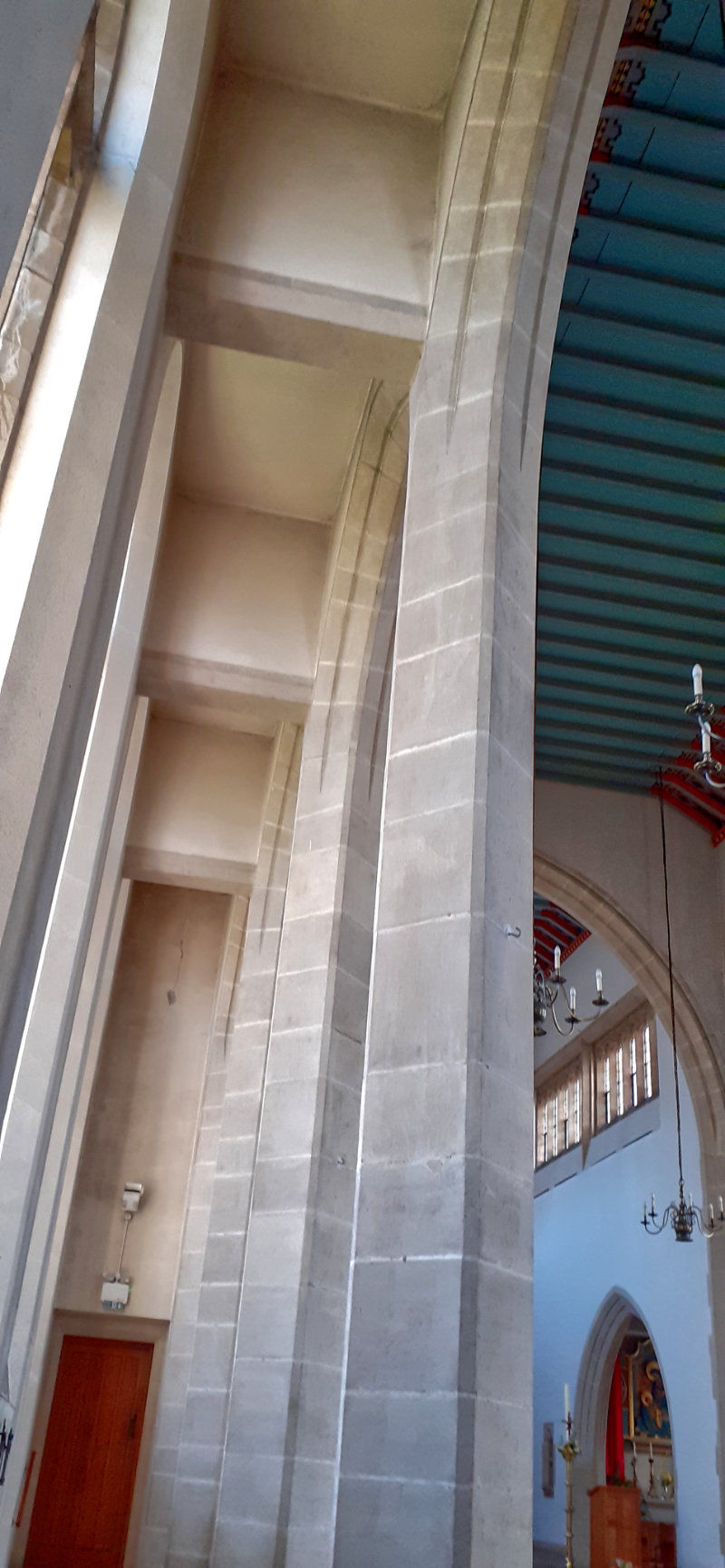
The interior is one of particular quality and refinement, with an effortless manipulation of space that creates an impression of scale in what is actually a modest-sized church. Plastered white walls. Over the nave, the low collars to the rafters in the roof create an almost flat effect, with polychrome detail. Simple incised Gothic arcades without mouldings or capitals continue down as piers, lozenge-shaped on plan, with octagonal bases. The aisles are of equal height, creating the effect of a hall church, and, as so often with Scott’s church designs, are built as narrow circulation passages rather than for congregational seating.
Pale coloured Cathedral-type leaded glass gives an even light to the well-lit interior. Fine original oak pews and brass chandeliers to the nave, woodblock floor with paving to the alleys. Simple wooden oak gates and communion rails at the chancel arch (recently unsympathetically adapted). The east wall is dominated by a large polychrome Crucifix and altar canopy. A rich brocade or curtain originally hung from the canopy as a backdrop to the Crucifix, but this was removed and not reinstated after recent redecoration. Polished marble high altar raised three steps above the rest of the sanctuary and marble forward altar below. Black and white floor slabs arranged diamond-wise. Taking Stock

The Guardian - Sat 16 Nov 2019
Conserving Plymouth: the city that dared to dream
It’s a recurrent yearning, after an urban catastrophe, to rebuild better than before, to take the opportunity to clear away the mistakes of the past. Phoenixes tend to get mentioned, and their well-known ability to rise from ashes. Often it doesn’t work out as planned.
Plymouth, though, lived the dream. It rebuilt following a plan that was drawn up while the war that devastated its centre was still raging. “Out of the disasters of war,” it was declared, the plan would “snatch a victory for the city of the future”.
Plymouth was as hard hit by the blitz, in proportion to its size, as any city in Britain, losing 1,000 civilians and suffering a never-reported number of military and naval deaths. Its centre was so badly damaged that it was fenced off from public view, like a racehorse about to be put down, lest citizens be demoralised by the sight. But even as the rubble was being cleared, a new and orderly plan was prepared by Patrick Abercrombie, the leading planner of his day, and the city engineer, J Paton Watson.
The new centre was laid out on a grid of right-angled streets. Traffic was consigned to a ring road, leaving Armada Way and its tributaries free for pedestrians. New buildings were clad in Portland stone. Art was integrated into the architecture, and the design of landscape and street furniture were harmonised with the buildings. The plan, following the orthodoxies of the time, consigned activities to different zones – commercial, cultural, residential. There is, curiously, an ecclesiastical quarter, in which are gathered the places of worship of different denominations.
The architects employed in the early phases were not so much young radicals as established names striving to move with the times. The last work of Giles Gilbert Scott, designer of red telephone boxes and Liverpool’s Anglican cathedral, is a Catholic church in Plymouth.


Comments