Crownhill Fort, Plymouth

Plymouth is an English city in the south west of the country strategically situated on the English Channel in a position that serves as a sentry post for shipping, travelling from the Atlantic to the North Sea. It didn't just protect England it protected the main route to London by sea. The Spanish Armada famously met it's first resistance right here.
Plymouth Devonport remains the largest operational naval base in western Europe and was originally founded as a Royal Naval Dockyard in the 1690's under King William III.
This post is about a particular military installation built during the 1860's, Crownhill Fort, which strangely is north of the city and well inland. Why would anyone have built such a formidable structure in this seemingly remote spot well away from the English Channel and the Devonport Dockyard?

This is the only entrance to the structure which by my reckoning is larger in diameter than the Colliseum in Rome. It was built on a massive scale to defend the nearby dockyards, but thousands of people drive past it every day, mostly not seeing any sign of it or realising it is there. Most of the structure is below ground level, for a reason. As you can see from the entrance, no expense was spared.

It is surrounded with a dry moat as its first line of defence and heavy gun positions cover that moat, should anyone get that far. Crown Hill Fort though is not alone, it was only one of a series of ten such forts built in an arc around the north of the city. It was one of the main forts in the series and the one that is in the best condition today, mainly because it was used as recently as 1985. There were 2000 men working here when it was under construction, moving all of the earth by hand.

This map, below, on display inside the fort, gives a very clear explanation of why it was built. Plymouth Sound is a Ria, a flooded river valley where four rivers converge. It forms a deep water inlet and one of the world's largest natural harbours. This makes it the perfect home for a world scale navy, but also makes it vulnerable to attack. Over the centuries many military defences were added at strategic points which had all the entrances well covered. You can see them on this map.
Henry John Temple, 3rd Viscount Palmerston, known as Lord Palmerston, was an Anglo-Irish nobleman and statesman who was Prime Minister of the United Kingdom from 1855 to 1858 and from 1859 to his death in 1865. Crownhill Fort is known as a Palmerston Fort.
Under Lord Palmerston the British government reviewed all of its national defences as a result of the ambitions of the French Emperor Napoleon III. New technology in ships and armaments increasingly worried politicians about the security of sites like Devonport Dockyard. In 1854 France was a British ally when both armies took the Russian naval base of Sevastapol by cutting it off by land, during the Crimean War. This was a wake up call, when only a few years later, France was no longer an ally, but a threat. The result was the largest upgrade of Britain's defences in history. This ring of forts north of the city of Plymouth, was the vulnerable back door to the dockyard. Napoleon only had to invade a few miles up the coast with his army and then walk through that undefended back door.

In May 1868 the forts were still under construction and there was much discussion about the cost and effectiveness of the plans. Palmerston was now dead, and were they really neccessary?
Morning Herald (London) - 22nd May 1868
......There are ten forts, all of them of the second or third class of permanent earthworks, except Crown-hill, which is about the same size as Staddon. They are all in a half-finished state, and will not be completed until 1870.
Half a mile from Bowden to the NW is Crown-hill Fort, which is the key of this line of defences, and will rival or surpass Staddon. Its position is more important and formidable than that of Staddon, for it looks down into a very deep ravine, which is so completely commanded by it that the enemy would have to begin their sap a long way off. The ditch is also eighty feet deep, and the fire of Crown-hill would flank the defences on both sides of it, and cross fire with them. There is a considerable reservoir of water within the works from which Plymouth is supplied, and two streams run through the northern outworks, and besides this there are springs of water 60 feet deep. Three-quarters of a mile due west of Crown-hill is Woodland, and half a mile from that in the same direction is Knowles.

....It must be particularly remembered that the plan of these defences is that of a fortified camp. It is supposed that besides the 15,000 men required to garrison the forts, there would be from 50,000 to 70,000 within their circle. As the whole ceinture of the forts will be connected by a military road and breastwork, it would be easy for such a force to prevent an army three times more numerous from passing between the forts. Now, the Volunteers and Militia of Cornwall and Devon would, no doubt in time of war, easily make up a force as numerous as that we have mentioned, and we do not believe that any army that could be landed in England by any Power, or combination of Powers, would be able to make themselves masters of the Plymouth defences with even 40,000 men encamped within them. The question for the public now is-Will they have those defences completed, and the three towns made safe for ever, at the expense of another quarter of a million, or, at the outside, half a million, or will they uselessly throw away the vast sum that has already been spent ?

By 1869 estimated costs for the forts had risen. Although original estimates had been nearly £12 million, the plans were adjusted downwards until projected costs ended up at around £6.5 million. By 1869 costs were calculated at nearly £8 million, mostly due to unforseen consequences, such as more difficult than expected construction of foundations and increased land costs. This amounts to £63 million today, although, today the land would be far more and labour costs would bear no comparison and that is before you consider factors like modern health and safety in construction. You would probably be looking at costs above a £ 1 billion in reality.
In 1861 though it was all just rumours and the only signs of what was to come were aquisitions of land by the government. The Defence Act of 1860 had been published with maps showing the land grab.
Morning Chronicle - Monday, 23 September 1861
Knackersnowle is a very important point. It lies both sides of the great high road from Plymouth to Tavistock, and it is clear, from the extent of land taken absolutely by the Government, measuring five-sixths of a mile from north to south, and rather more than half-a-mile from east to west, that some extensive works will be constructed here.
Nearly the whole village is coloured with the ominous pink. One little spot in the heart of the village, and containing the Episcopal Chapel, police-station, and a few houses, is tinted green ; but the rest of this little colony, extending from the Wesleyan meeting-house on the west side of the turnpike-road, and a field south of this on the east side, including the First-and-Last Inn, Bulley's coach-factory, Providence Chapel, the Crown-hill Reservoir, and Plymouth Corporation Waterworks, and the whole of the land each side of the road for half-a-mile beyond the cross-road to Tamerton, are all taken by the Government, and will cost the nation rather more than it will like to pay.
The article noted that the smallness of Devon's fields at that time meant that the land grab included 1167 fields, which is another indicator of the scale of the project.

Here is a diagram of the fort and thanks to the measuring facility on Google Earth I can tell you that the outer walls are at their widest, a diameter of 255 metres or 837 ft. The Colliseum in Rome at its widest point is a diameter of 190 metres or 624 ft. The famous Tower of London is only 10 metres wider at its widest point, so that gives some appreciation of what the scale of this project was, especially considering that there were nine other forts in this line, plus multiple other forts on the waterfront like Tregantle fort in Cornwall on the other bank of the Tamar.
Today the fort is in the care of The Landmark Trust and as a result you can actually rent out the officers quarters for a holiday if you wish. There is limited access to the fort in normal circumstances unless you attend one of the special guided tours which are well worth doing.
As I write this I could book two nights in an apartment that sleeps 8, at a cost of £744.

The apartment you book will be a lot more comfortable than this. This is a cell in the detention block next to the Guard House.
Western Morning News - Thursday, 23 March 1871
Gilead McLean, an artilleryman, was yesterday fined by the Plymouth magistrates £5 and costs, or six weeks imprisonment for being drunk and assaulting the police. He had been previously fined for a similar offence. On hearing the decision, the prisoner swooned, and had to be carried to the cells.
Assaulting the police was an expensive business. An artilleryman could expect a shilling a day in pay (about £3.00 today). A £5 fine would be the equivalent of £313 today or 100 days pay. No wonder he "swooned" and had to be carried back to his cell.

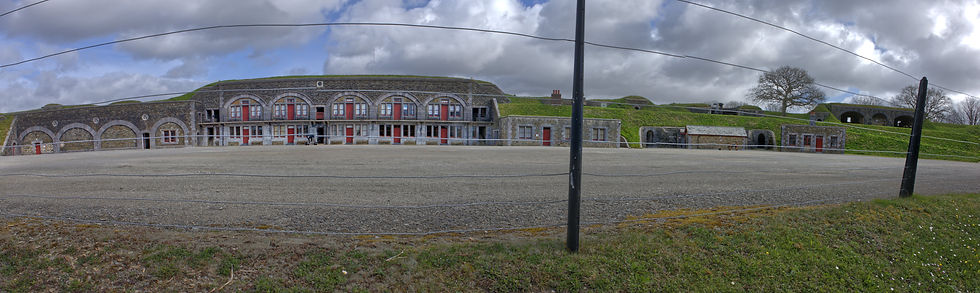
If you managed to get through the first gate of the fort you then became vulnerable to the next line of defence, another dry moat and another gate, which would have been heavily defended. Today this second line of defence which was the officers quarters are where you might spend your holidays.

This is an interesting article revealing that whole families were at home in the fort, not forgetting the vital trumpeters. I would have thought the inclusion of trumpeters amusing had I not recently seen a TV programme where their role along with that of drummers was explained. Ordinary soldiers were given much of their information and many instructions from drum and trumpet announcements. There were no PA systems back then and a noisy fort the size of Crownhill would have needed loud and clear communication.
Western Morning News - Thursday, 15 March 1877
The Assistance, troopship, Capt. Prattent, arrived in Plymouth Sound yesterday morning from Sheerness, and transferred to the Perseverance, tug, a portion of No. 3 battery depot brigade Royal Artillery, under the command of Major R. O'Hara and Lieut. Tydd, and consisting of 7 sergeants, 4 trumpeters, 62 rank and file, 8 women, and 19 children, all of whom were landed at Devonport Dockyard, whence they proceeded to Crownhill Fort, there to be quartered. The Assistance left in the afternoon for Queenstown.
In the Royal Artillery, trumpets and bugles were the primary tactical communication channels used to transmit orders across noisy, chaotic battlefields and organize daily life in camp. Because artillery units operated alongside mounted cavalry and infantry, their communication system was unique: trumpeters typically carried both a trumpet and a bugle to deliver commands optimized for different tactical environments.
Every message began with a unique Regimental or Battery Call. This alerted specific troops to pay attention and ignore calls meant for other regiments sharing the same field. The
duty call immediately followed the identity call, dictating the actual tactical or routine manoeuver.
AI Overview

If you had breached both lines of defence you would then have to mount these steps leading out into the central parade ground where there was no cover and you would have been surrounded by a 360 degree range of heavy guns.
By 1875 there was still finishing off to be done on the fort.
Western Morning News - Saturday, 24 July 1875
WAR DEPARTMENT CONTRACT
Notice to Builders .- TENDERS are required for the Execution of Sundry Services to COMPLETE the NORTH CASEMATES, &c., at Crown-hill Fort, near Plymouth.
Persons desiring to tender for these works must leave their names at this Office on or before Tuesday, 27th July, 1875, and pay the sum of half a guinea for the bills of quantities, which
will be forwarded to each person as soon as prepared by the Government Surveyor.
The Secretary of State does not bind himself to accept the lowest or any tender.
A. H. FREELING. Colonel Commanding Royal Engineers, Western District.
Royal Engineer Office, Devonport, 13th July, 1875
A casemate is a fortified, vaulted chamber or armored structure—such as a gun emplacement, defensive bunker, or ship compartment—designed to protect personnel and artillery while allowing weapons to fire through an opening or embrasure.

Limestone was quarried just outside Plymouth. A distinctive pink-veined limestone was chosen for detailed stonework, including the quoins (corner stones), mullions, voussoirs (arch stones), and window sills.

Crownhill Fort is designed for all round defence, with each of its seven sides having massive ramparts and being surrounded by a deep ditch. All sides were also protected by gunfire, with the fort having around 350 built-in rifle loopholes. It was designed for an armament of 32 guns on the ramparts and 6 mortars sited in two mortar pits to the south west and north west of the Parade Ground. A year later, in 1864, Russian commander General Todleben was shown the building works, and he complimented them. Wikipedia
When the fort was built, nobody was expecting invading Scots soldiers, they had only prepared for the French. Nobody planned for local villagers having to seek safety inside the forts, but with enough drink available anything can happen.
St James's Gazette - Monday, 7 September 1885
MILITARY RIOT.
A military riot occurred at Knackernowle, Plymouth, last night. A body of Highlanders, thirty in number, made an onslaught with belts on a dozen Artillery Militiamen. The village policeman interfered, but was savagely assaulted, and, with the artillerymen, received severe injuries. The Gordon men then took possession of the village and behaved in the most disgraceful way. Several of the inhabitants made off to the adjacent forts, and Lieutenant Steele was immediately ordered to go with a force of fifty soldiers to quell the disturbance. On getting towards the village he threw his men out in skirmishing order and succeeded in catching fifteen of the disturbers. They were conveyed under picket to the Crown-hill fort and there confined, but even then some of them continued their uproar, smashing windows of cells and injuring themselves. There was great excitement in the neighbourhood, the chase across the fields which was joined in by soldiers and civilians being watched by hundreds of persons.
Another article in the Tavistock Gazette has it that the Gordon Highlanders had mixed with a party of local militia all of whom had been drinking. The Scots had commenced calling the locals names wherupon a fight, of course, ensued. When the troops from Crownhill arrived, the Highlanders "ran in all directions". After they were imprisoned the chaos continued as one Highlander "thrust his hand through a pane of glass with such force that he was at once removed to the hospital". The Highlanders had "annoyed several shopkeepers" and one "stole a pound of butter". "All of them were mere boys".

Gunner Long meanwhile appeared before a Court Martial in 1889 only admitting to four out of five of his charges.
Western Daily Mercury - Friday, 29 November 1889
MILITARY COURT-MARTIAL.
Gunner C. Long, of the Depot Western Division Royal Artillery, stationed at Crownhill Fort, was tried by a district court-martial, of which Major S. Tyers, R.M.L.I., was president, at Government House, Devonport, yesterday morning. Prisoner was charged first with disobeying in such a manner as to show wilful defiance of the orders of his superior officer, in declining to fall in on parade when ordered to do so ; second, resisting an escort whose duty it was to have him in charge; third, losing by neglect his regimental clothing; fourth, when a prisoner escaping at Crownhill ; and fifth, wilfully injuring public property-the prisoners' cells at Crownhill-to the value of 9s. 9d. The prisoner pleaded guilty to the first four charges, but not guilty to the fifth. Major and Adjutant Norton, depot battery Western Division Royal Artillery, prosecuted. The finding of the Court will be made known in the ordinary course.
So why did Gunner Long admit to four offences but not to the fifth. In fact the court ended up finding him innocent of the fifth charge of damaging the cell door when he escaped. The reason? In court he claimed that he was in the cell with other prisoners. They had broken down the door and had encouraged him to escape while they remained in the cell. The court believed his claim, presumably because he had honestly admitted to all of the other offences.


Naval & Military Record and Royal Dockyards Gazette - Thursday, 22 July 1886
The 3rd Brigade Western Division Royal Artillery, Lieutenant-Colonel W. Anthony Jones commanding, having undergone their annual training at Crown-hill Fort, Plymouth, were on Thursday inspected by Colonel W. Newman, R.A., commanding Auxiliary Artillery Western Division, who expressed himself highly gratified at the appearance and steadiness of the men on parade, at the admirable manner in which the rooms and kits were kept, and with the exemplary conduct of the artillerymen during the whole time they had been out training. During this period the brigade have done good and useful work in mounting platforms, carriages, and guns in the forts forming the north-eastern defences of Plymouth.

The strange case of the "incorrigible and worthless" Gunner George, or was it Gunner Church? He was charged with both absconding and fraudulently enlisting. Doesn't the second crime negate the first? He claimed he was "recruited while drunk". Was he called Church or George? If he did fraudulently enlist was it then possible to abscond?
Naval & Military Record and Royal Dockyards Gazette - Thursday, 2 September 1897
Gunner William Church, R.A., was charged with absenting himself without leave when proceeding on August 5th from Cardiff to Crownhill Fort, Plymouth, and absconding until aprehended by the civil power on August 14th; also with fraudulent enlistment on July 13th, not having stated that he was discharged from the Royal Artillery in January, 1894, as being incorrigible and worthless .- Prisoner pleaded guilty to the first offence, and not guilty to having fraudulently enlisted .-
Corpl. Lyons, R.A., identified prisoner as Gunner William George, who was discharged from the Royal Artillery in January, 1894, as incorrigible and worthless .- Lieut. Smith, R.A., prosecuting officer, produced prisoner's written confession of the offence .- Prisoner stated that he was working in a pit in the Rhondda Valley, and all the men went by an excursion to Swansea. They returned on the same day, and he was drunk. He went that night to a public-house, where a recruiting-sergeant was staying, and on the following morning the recruiting-sergeant told him he had enlisted in the Royal Artillery. He was not aware that he had enlisted, although he must have done so when drunk, and not knowing what he was doing. When ordered to go to Crownhill he knew very well it was no use his going there, as they were sure to find out that he had been discharged from Crownhill .- Prisoner was found
guilty of having fraudulently enlisted .- Lieut. Smith stated that the prisoner had not previously been convicted, according to his present attestation papers. Sentences in both cases will be made known in due course.
What appears to have happened is that Gunner George blotted his copy book first time around at Crownhill and ended up down the mines in South Wales. To escape the mines it seems he enlisted again under the name of Church only to have the great misfortune to be sent back to Crownhill, of all possible destinations, for a second time, where he was already well known.

It wasn't all hard work at Crownhill, there was fun and entertainment to be had too.
Naval & Military Record and Royal Dockyards Gazette - Thursday, 12 November 1896
The first of the winter series of concerts was held in the recreation-room, Crownhill Fort, on Friday evening; and its success augurs well for the future. Capt. Baldwin, R.A., presided over a crowded audience. A cleverly played violin solo by Bombardier Cleaver, to pianoforte accompaniment, was the first item on the programme, and elicited hearty anproval. Songs followed from Sergt. Webber, Sergt. Farthing, Corporal O'Neill, and Gunner Hill, and each effort was deservedly applauded. A duet by Gunners Hill and Hickie was also a capital turn and much appreciated. In the second part, Sergts. Webber and Farthing, Corporal O'Neill, and Gunner Hickie were again to the front with some very good songs, all of them thoroughly well sung. As usual Sergt. Webber and Corporal O'Neill sustained the comic element in a capable manner, while Sergt. Castle efficiently accompanied throughout.


In the late 1890's new barracks were added at Crownhill. The original purpose of the fort, threats from France, were no longer a factor, and the fort gradually became a military base rather than a front line fortification.
Southern Daily Mail - Wednesday, 2 March 1898
A board of officers yesterday inspected the new barracks which have been erected at Crownhill, near Plymouth. Only a few buildings are at present taken over. The Crown-hill Fort, which up to the present has been occupied by artillery, will be given over to the infantry, the artillery removing to Plymouth citadel.

The 1880's and 1890's saw the fort used primarily as a training hub for local volunteer forces. By the time of the First World War it served as a recruitment and mobilisation centre for troops deploying to Africa and Turkey. At the end of The Great War it was used for demobilisation.
In the early 1920's in the inter war period it was a base for the newly created Royal Corps of Signals and it was re-fortified in time for the Second World War, with anti-aircraft guns and other up to date technology.
In the 1950's the fort was fitted with a gun operations room and it became a headquarters for the Plymouth Garrison and Commando Base. It later housed the 59 Independent Commando Squadron (Royal Engineers) which as recently as 1982 provided logistical support for the Falklands Campaign. It was decommisioned in 1986.


The fort was purchased in 1987 by The Landmark Trust who restored its late Victorian layout.

Naval & Military Record and Royal Dockyards Gazette - Thursday, 21 September 1899
Private Chas. E. Cattle, 1st Worcestershire Regt., pleaded guilty to resisting an escort at Crownhill Barracks, on the 6th inst., when being marched to the guardroom for drunkenness; and also to attempting to kick Sergt. J. Warne, who was assisting to confine him in the guardroom .- Prisoner said he was drunk at the time, and did not know what he was doing .- He was found guilty.

A great Victorian saying had it that "The Devil makes work for idle hands". Keeping men busy and minimising their drinking was probably one of the biggest problems in the army.

Naval & Military Record and Royal Dockyards Gazette - Thursday, 14 February 1895
The Army Temperance Society held one of its most successful meetings at Crownhill Fort, Plymouth, the Rev. Hardy presiding. Among the ladies and gentlemen who assisted were Mrs. Bingham, Mrs. Travers, and Capts. Swayne and Braithwaite, S.L.I. The programme included several well known songs, Mrs. Bingham's "Killarney " and Mrs. Travers's "Venetian boat song" being especially appreciated. Capt. Braithwaite's songs elicited great applause, as also did those of Capt. Swayne. Two recitations were given by Br. McCullough and Qr . Mr .- Sergt. Thompson. A very pleasant evening was brought to a close by Mrs. Mansel (wife of the popular major), who presented the first two awards won by members of the society to Sergt. Ritchie and Br. O'Neill. After a vote of thanks to the visitors, the meeting closed with the National Anthem.

When the men weren't being discouraged from drinking, they were being encouraged in their smoking. Who knew there was such a phenomenon as "Smoking Concerts"? It seems Smoking Concerts were exclusively male only events where it was deemed to be acceptable to smoke during the perfomance as ladies were not present. Who could have resisted the opportunity for a "quick drag on a fag" while watching Gunner Moore on his concertina?
Naval & Military Record and Royal Dockyards Gazette - Thursday, 25 June 1896
Entertainments.
SMOKING CONCERT AT CROWNHILL FORT.
The third of a series of smoking concerts was held in the recreation-room, Crownhill Fort, under the patronage of Maj. F. E. Kent and officers af the depot company. The room was crowded to excess, and among those present were Capt. BALDWIN (chairman), and Lieuts. Alexander and Sherer. The staff of the Mid-Ulster Artillery, stationed at Fort Agaton, were also present at the invitation of the depot non-commissioned officers. No expense or pains was spared by the promoters to provide an entertaining programme, the excellence of which was recognised in a marked manner by the hearty and unstinted applause of the audience.
A well-played selection on the concertina by Gunner Moore opened the concert, and was thoroughly enjoyed. Some of the latest songs were sung (in character) by Sergt .- Instructor Webber and Corporals McCullagh and O'Neill with great success ; while well-known sentimentals were forthcoming in Lieuts. Alexandler and Sherer, and Gunners Hill and Baxter. Lieut. Alexander further added to the pleasure of the evening by playing two choice selections on the banjo, with pianoforte accompaniment. The length of the programme did not admit of many encores, but the audience would not be denied one from Lieut. Sherer, and Webber and O'Neil. Sergt. Castle proficiently accompanied throughout, and the singing of the National Anthem brought to a close a very pleasant evening.

Crownhill because of its location did not see much action during the First World War. It was primarily a barracks which also housed a YMCA, which offered rest and recuperation for the men on their free time. It was still heavily armed though.

There is a collection of armaments through the ages installed there today which gives a good idea of what service life was like and the barracks are furnished in different periods.

During World War II, Crownhill Fort served as a vital staging, storage, and accommodation site in the lead-up to the D-Day landings in June 1944. The fort housed and assembled Allied service personnel preparing for the cross-channel invasion, and vehicles, raw materials, and invasion equipment were stored and processed at the fort before being moved down to waiting ships in the Plymouth dockyards.

Western Evening Herald - Tuesday, 30 May 1995
The Last True Fort
You can march across the parade ground and imagine life in the handsome barracks, designed for up to 300 men. Covering 116 acres and surrounded by a broad deep ditch hewn from bedrock, the fort appears from only a short distance to be nothing but a forested hilltop.
There are, however, four fighting levels with placements for 32 cannons and six mortars, nearly a half mile of tunnels and accommodation for 300 soldiers and officers concealed within it.

Tunnels lead from the parade ground through the ramparts to each caponier, the enclosed rifle gallery
along the north face, and to the two mortar pits at the south west and north west corners. There are 350
rifle loops around the fort.

Designed as a polygon, the fort is surrounded by a ditch which itself was protected by caponiers - powerful structures which provided flanking fire across the ditch. Many
of these caponiers are open to view, some with canon.

One of the so-called 'Palmerston Follies', Crownhill Fort has great importance today as the last of this country's true castles. Many of Plymouth's other forts have been converted or destroyed. Only Crownhill has survived in anything like its original form.


Comments