Hisley Bridge

Hisley Bridge on Dartmoor is a picturesque, medieval packhorse bridge crossing the River Bovey in Hisley Woods near Lustleigh, known for its classic stone arch and tranquil woodland setting. Built before 1840 for trade via horse, it offers a glimpse into Dartmoor's past and is accessible via routes from Drakeford Bridge.

This visit was on a beautiful hot summer's day, which was the perfect time to do a riverside walk through woods. Park at Drakeford bridge car park and cross the old narrow road bridge over the river Bovey. You can take a slight diversion by following the road to the right only about a hundred metres to see a railway viaduct of a disused railway line that originally ran from Bovey Tracey to Moretonhampstead.
Double back to the road bridge and now take the left fork instead and a little further on a footpath can be accessed through a farm gate. Cross this small field back to the river bank and then follow the river all of the way to the old packhorse bridge.
The bridge was repaired in the early 1960's.
Express and Echo - Monday 11 March 1963
RAMBLING CLUB
VISIT BRIDGE
The Dartmoor section of the Exeter Rambling Club combined with the other members in a long ramble in the Bovey Tracey-Chudleigh area.
Arriving at Drakeford Bridge the direct path to Lustleigh was left, and a detour made by path along the River Bovey, until the old Manaton road was reached. This led the party to the lonely old Packhorse Bridge recently repaired at the instigation of the Dartmoor Preservation Society.

Back in the 1790's maps still showed this bridge as part of a road network, albeit these were roads for feet rather than wheels.
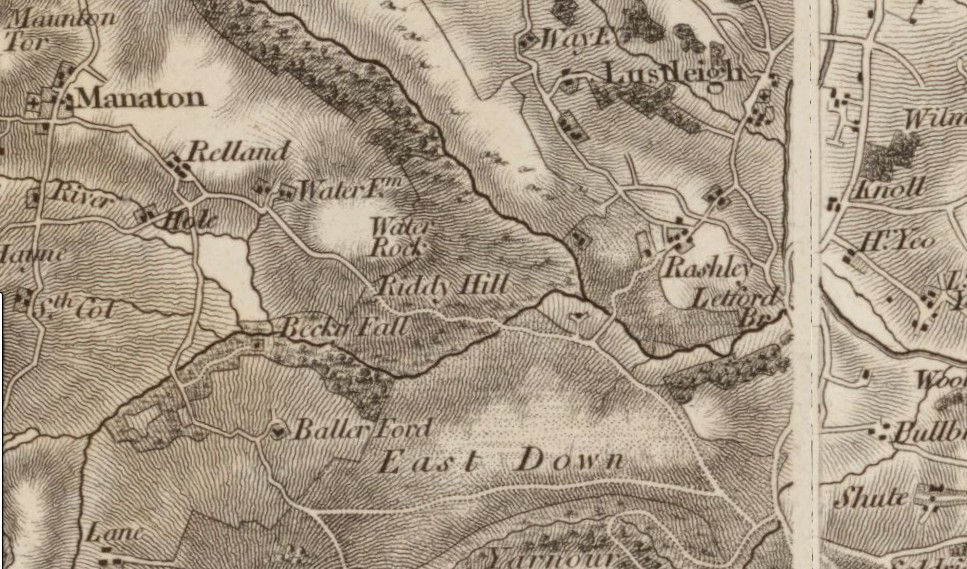
By the time of the first tithe map of the early 1830's the bridge already appears marooned. Hisley woods are shown on the right but the tracks are missed out. It's probably because they were not considered important enough in the context of the tithe system.

Cross the bridge and the T junction is the old Manaton Road which is now just a track, turn left and follow the old Manaton Road.
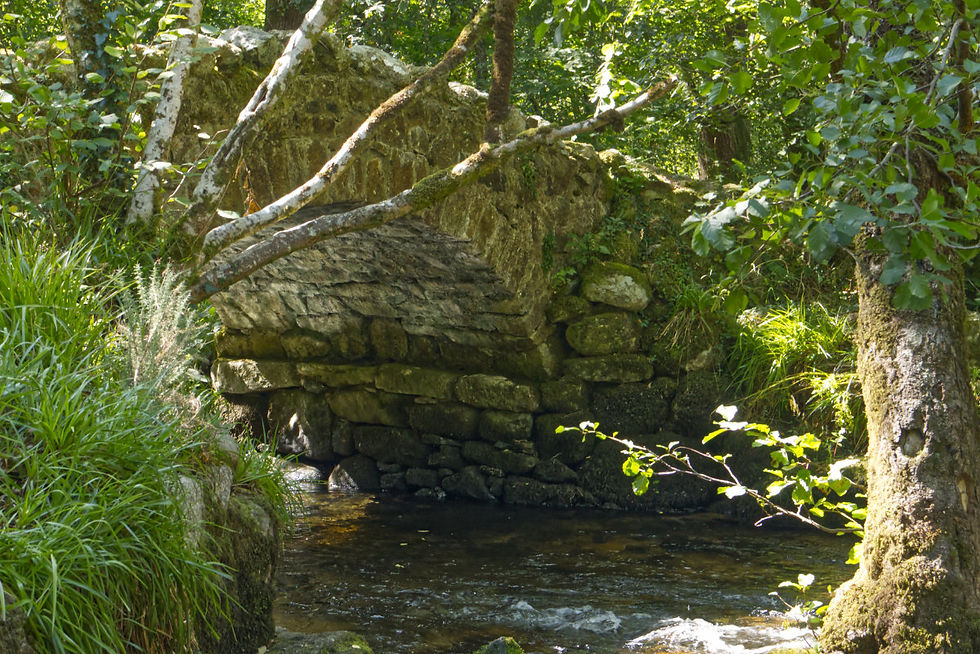
Around the time of the tithe map this simpler map still shows an access track.

By the turn of the 20th century though the routes have become a double broken line.

By the early 1900's the track headed south east is now marked as a mere footpath. This was the path taken on this walk.

Walk Long the old Manaton Road for about a quarter of a mile until you come to a track junction in a small clearing. By now you have climbed up into the woods. Turn left and there are two options her, down a steep path back to the river or an upper level path through the woods. We chose the steep descent back to the river.

Later into the 20th century and all we have are footpaths, which is the only way to access the bridge today.


The approach to the bridge on both sides is protected by massive boulders forming a sort of giant cobbled approach. These would have protected the bridge during flash flooding. The river Bovey descends quickly from Dartmoor higher up, and Dartmoor forms a large water shed that attracts much rain.


On the side that meets the old Manaton Road a post has been inserted at some point, to prevent any attempt by vehicles on that track from crossing the bridge. The parapets of the bridge are low which is common for packhorse bridges.

The packs on packhorses were very bulky and higher parapets would have restricted access especially by animals passing each other in opposite directions.
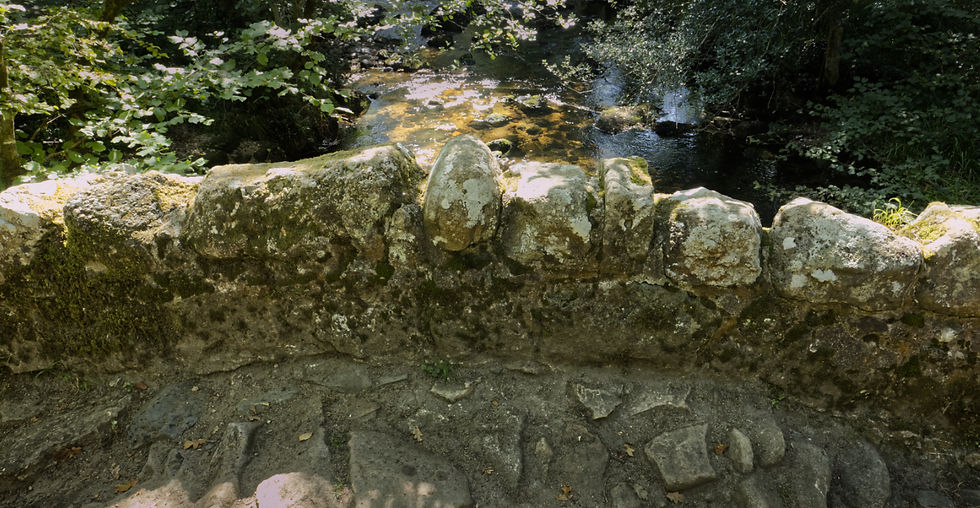
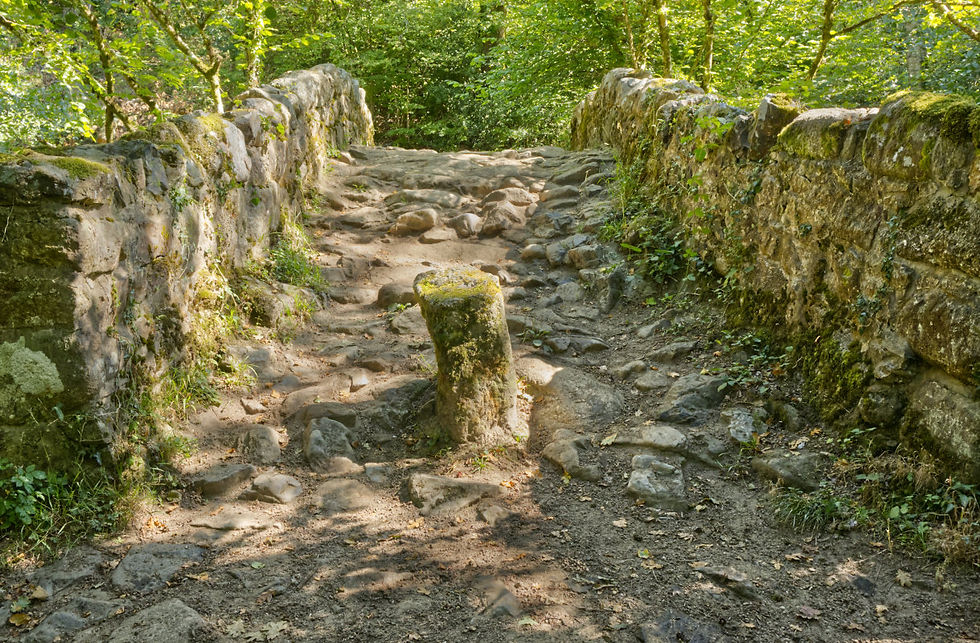

Follow the river, now on the south side, until you emerge back in the car park at Drakeford bridge.

As an unconnected aside I found this interesting sign of the times past when researching Hisley, looking for any articles about the bridge. What I did find was an apology, and I mean a real apology, not the non-apologies we see today from those who have done wrong, like our formerly great BBC, who when they are forced, as is usually the case, to admit wrongdoing we get the now familiar, "sorry for any offence you took", or the "sorry but it was just an accident". The entire West Country of England read this "mea culpa" back in 1834 and were left in no doubt at all.
Western Times - Saturday 05 April 1834
NOTICE.
WHEREAS, I, the Undersigned GEORGE WILLS, of LOWER HISLEY, in the Parish of LUSTLEIGH, in the County of Devon, Yeoman, did on WEDNESDAY, the 19th of Feb. last, in a public company assembled at Mr. SALTER'S, the Seven Stars Inn, in the Town of Newton Bushell, violently abuse and insult Mr. GEORGE NOSWORTHY, of WARMPITT, in the Parish of Bovey Tracey, and in such abuse did use certain expressions and insinuations injurious to his character, and he the said GEORGE NOSWORTHY, having commenced an Action at Law against me for the same, but having agreed to stay further proceedings on my publicly retracting such words and accusations, and paying all expences - I therefore do agree to pay all and every expence incurred in the said action, and also express my sorrow and contrition for the unmanly conduct which I was guilty of, and that the said GEORGE NOSWORTHY may print and publish this declaration in any Newspaper or Newspapers, and otherwise, in order to destroy any impression which my abuse and accusations may have made on any person or persons injurious to the reputation of the said GEORGE NOSWORTHY ; and I furthermore do declare, that I had no grounds whatever on which I made such accusations and assertions at the above mentioned or any other time, but that it arose entirely from my passion and ill behaviour.
Witness my hand, this Eighteenth day of March, One Thousand Eight Hundred and Thirty Four,
GEORGE WILLS.
(Witness,) O. GIDLEY.


Comments