Odds and Sods February 2026

Here is February 2026 and a memorable time it has been. This is a selection of very varied February photos. An historic Saxon church and some fascinating naval history too. Heroic deaths, an historic duel, ancient ship's timbers, cannons, longbows, deserted railway stations and World War Two defences thrown in too.
The most significant event was the washing away of the coast road in Start Bay by two successive easterly storms only a week apart. Nothing to do with "Climate Change", just a man made disaster of epic proportions dating back a hundred years to the removal of hundreds of thousands of tons of sea bed sand to build the naval dockyards at Plymouth.
At the moment we are still waiting to hear if the money will be made available to repair it, or if we have to step back 150 years and start to use packhorses again. More on that history here.


St Mary, Breamore is one of the most famous and important Saxon churches in England, notable for its many Saxon details which I will cover in a separate post. This church is thought to have been founded in the year 980, just the three digits.
The King would have been Ethelred the Unready. He might have been unready but he also goes down in history as a King made twice. He was forced out of office by the imaginatively named Sweyn Forkbeard of Denmark and then restored by the English nobility a year later. Only two other Kings have this royal record, Henry VI and Edward IV, who were also deposed and then restored.

Whatever you do, if you visit Breamore, "Avoyd Fornication".

Funeral Hatchments: The church holds one of the largest collections of funeral hatchments (coats of arms of noble families) in any English parish church, primarily located on the north side of the tower and dedicated to the Hulse family of Breamore House.
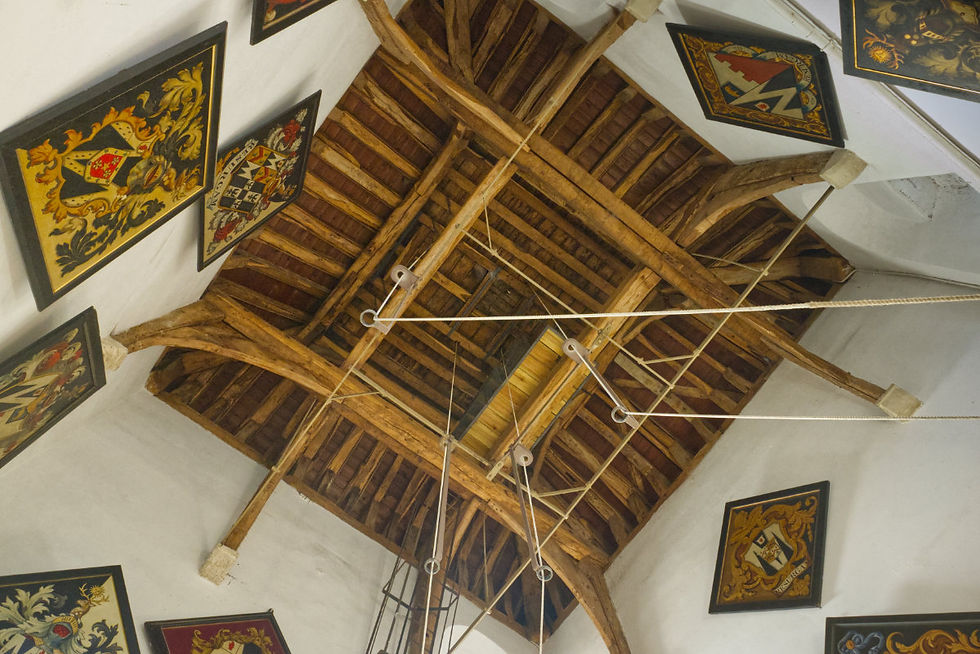
12th-Century Corbel Heads: The church tower is supported by 12th-century stone corbels, two of which are carved with faces. One of these is believed to represent a "Green Man," a common medieval motif.

A segway now, to a later carved head. This one is at Portsmouth Historic Dockyard Museum and is part of their ship's figureheads display. This one is from 1824 and features an imaginary Indian Prince and featured on the prow of HMS Asia. It was carved by a local wood carver in Bombay as it was then called for the ship also built in that British port and was carved out of local teak. Scientific research indicates that between 45 and 50 different colour schemes were used during its lifetime. It probably needed a new paint job after this battle.
Englishman - Sunday 16 December 1827
BATTLE OF NAVARINO.
Admiral Codrington issued a General Order, dated on board H.M.S Asia in the port of Navarino, 24th Oct. 1827, for the purpose of returning his most cordial thanks to his noble colleagues, the two Rear Admirals, for the able manner in which they directed the movements of their squadrons; & to the whole of the officers, seamen, and marines, employed in the United Squadrons, the high sense he entertains of their gallant & steady conduct on the 20th of that month, by which they so bravely completed the destruction of their opponents. He adds his persuasion, that there is no instance of the fleet of any one
country shewing more complete union of spirit and of action than was exhibited by the squadrons of the Three Allied Powers in this bloody and destructive battle, in which the whole Turkish and Egyptian fleets have paid the penalty of their treacherous breach of faith.
The boasted Ibrahim Pacha promised not to quit Navarino, or oppose the Allied Fleet, and basely broke his word. The Allied Commanders promised to destroy the Turkish and Egyptian fleets, if a single gun were fired at any of their flags ; and, with the assistance of the brave men whom they had the satisfaction of commanding, they have performed their promise to the very letter. Out of a fleet composed of eighty-one men-of-war, there remain only one frigate and fifteen smaller vessels in a state ever to be again put to sea. Such a victory cannot be gained without a great sacrifice of life, and the Commander in-Chief has to deplore the loss of many of the best and bravest men whom the fleet contained. The consolation is, that they died in the service of their country, and in the cause of suffering humanity.
I hadn't heard of the Battle of Navarino which it turns out was a battle for Greek Independence. The British sailors who died for Greek freedom would have been galled to find that British visitors today, going to see the fort built by the British in Corfu have to pay full price for entry while visitors from the Greek's EU counterparts, countries that didn't even exist back then, get in at half price. And no, I'm not going to let that one go.

This unassuming rowing boat, albeit brightly coloured and gilded is a bit of a showstopper when you learn what it is.
This is The Royal Barge of 1670, which is quite remarkable. King Charles II sat in this very barge when visiting his fleet. He was a keen sailor and took a personal interest in his navy. It is the oldest Royal Barge in existence and has been restored to its original appearance. It flies a replica Standard of the King in its bows.
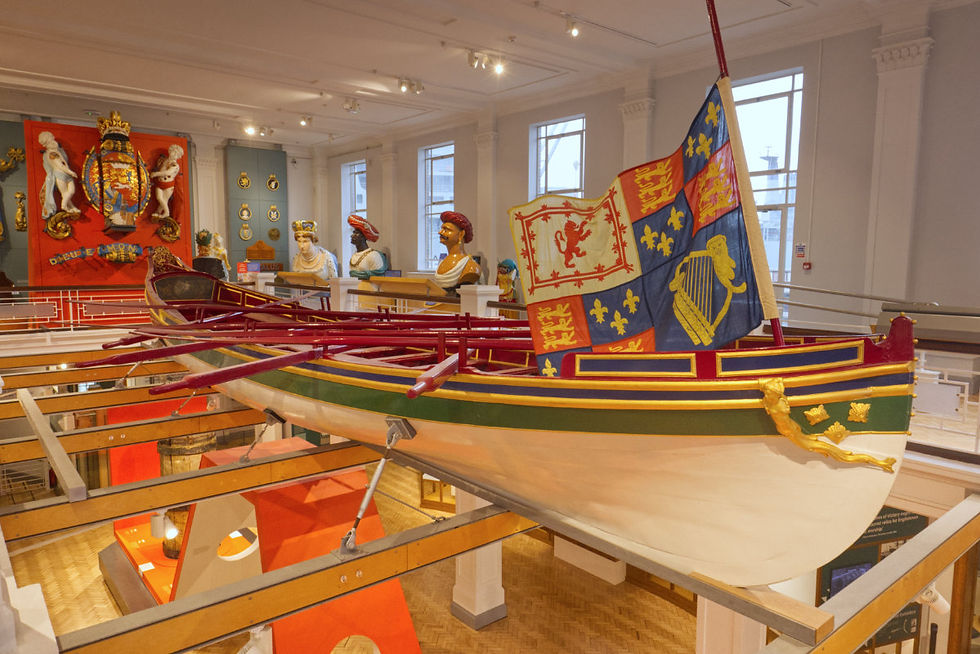
This figure head is far more glamourous and was the crowning glory of HM Yacht Victoria and Albert II. It was the second steam propelled paddle royal yacht, launched in 1855. It was partly designed by Albert himself and therefore a favourite of Queen Victoria. It was finally broken up in 1904. It features the Coats of Arms of the Queen on the left and the Prince on the right. The bow decoration of HMY Victoria and Albert features the royal arms instead of being a traditional animal or person figurehead; a shield bearing arms was the most popular choice for royal yachts.

HMS Victory is a 104-gun first-rate wooden sailing ship of the line. With 248 years of service as of 2026, she is the world's oldest naval vessel still in commission. She was ordered for the Royal Navy in 1758, during the Seven Years' War, and laid down in 1759.
Currently undergoing restoration, until 2032. During this restoration various parts as they are accessible, can be visited. The outside view of the exterior timber work has only just been made accessible on a scaffolding structure.

It is possible to watch the restoration in action.

The ship is made of wood and designed to be supported in water, afloat. Consequently, in a dry dock, much stress is placed upon the hull which would crush under its own weight, unsupported.
Between 2017 and 2020, 134 "Smart Props" were installed to support its 2200 tonnes, not including the tourists like us who were allowed inside. Each prop can be individually controlled at its specific location, allowing the ship to "float" once more.
Not only this, the props had to also protect the dry dock itself. Dry dock 2 is a scheduled ancient monument and is itself 220 years old.

This is a section of the original foremast of Victory and that hole through the middle was punched out by a cannon ball. This happened during the Battle of Trafalgar. When the ship was repaired after the battle, this souvenir was given to the Duke of Clarence who became King William IV. It was originally displayed by the King at Windsor Castle where it acted as a plinth for a bust of Nelson.

It’s hard to imagine now as you traverse the wooden walls and decks, but 820 men were onboard at Trafalgar, including Nelson and Captain Hardy, the flag captain of Victory.
Through the windows of the captains quarters, one could see on the day that we visited, one of the newest ships of the Royal Navy, the aircraft carrier HMS Prince Charles.

Prince Charles was in dock for servicing.

The prow of the Victory was the only part of the exterior uncovered on our visit. The Battle of Trafalgar (21 October 1805) was vital because it secured a decisive British naval victory, ending Napoleon Bonaparte's ambitions to invade Britain and establishing British naval supremacy for over a century. Admiral Lord Nelson’s tactical triumph destroyed a significant portion of the combined French and Spanish fleets, removing any immediate threat to Britain at sea.

Two important events from the battle of Trafalgar are marked onboard, most prominent is the plaque marking the spot where Nelson first fell while pacing the Quarter Deck. Secondly, deep in the bowels of the ship, a solitary lamp marks the spot where he finally died three hours later on the Orlop deck.

Star (London) - Thursday 07 November 1805
The ever to be lamented death of Lord Viscount NELSON, Duke of Bronte, the Commander in Chief, who fell in the action of the 21st, in the arms of victory, covered with glory, whose memory will be ever dear to the British Navy, and the British Nation, whose zeal for the honour of his King, and for the interest of his Country, will be ever held up as'a shining example for a British Seaman, leaves to me a duty to return my thanks to the Right Hon. Rear-Admiral, the Captains, Officers, Seamen, and detachments of Royal Marines serving on board his Majesty's squadron now under my command, for their conduct on that day ; but, where can I find language to express my sentiments of the valour and skill which were displayed by the Officers, the Seamen, and Marines in the battle with the enemy, where every individual appeared an Hero, on whom the glory of his country depended! the attack was irresistible, and the issue of it adds to the Page of Naval Annals a brilliant instance of what Britons can do, when their King and their Country need their service.
I am, Sir, etc. (Signed) C. COLLINGWOOD
Next door to Victory sits the Mary Rose, a much earlier ship belonging to Henry VIII which sat at an angle on the seabed for nearly 500 years.
The Mary Rose was a carrack in the English Tudor navy of King Henry VIII. She was launched in 1511 and served for 34 years in several wars against France, Scotland, and Brittany. After being substantially rebuilt in 1536, she saw her last action on 19 July 1545. She led the attack on the galleys of a French invasion fleet, but sank off Spithead in the Solent, the strait north of the Isle of Wight.
After she sank she tilted over on to one side, burying half the timbers in the silt which preserved her. Under the seabed scattered around her lay over 19,000 items which were also preserved in silt. The ship and her artefacts now sit in a wondrous, purpose built museum which has set what remains of the ship level again. Revealing her deck layers.

As you ascend the different "decks" of the museum, the objects from those decks are displayed next to the walkway that overlooks the ship.
This is a rare forward facing gun positioned at the front of the aftercastle on the widest part of the ship. It fired at a slight angle to avoid the forecastle. It could not be placed at the front of the ship, but a gun that fired forward was vital as most of the guns fired from the sides offering no protection from a frontal attack.

To demonstrate the vast variety of items rescued from the seabed I contrast this set of bone carved dice which are about half a centimetre across with the massive canon above. Imagine finding these on the seabed after 500 years.

These "sticks" were the reason Britain punched above its weight in battles back then. They are described as the "Medieval machine gun". These are English Longbows and they were stored in the ship in crates, disassembled and ready for battle in minutes. Accurate over 200 metres an English archer could shoot over 12 arrows a minute. Every man in England, by law had to be able to wield one of these and be skilled at using it. Every village in the South Hams, in Devon, has an area called "The Butts", and these were the long narrow fields where men practised their archery.

On the Mary Rose, 138 complete longbows and 2000 arrows were discovered. This small piece of cow horn is a nock and only one survived. It demonstrates how the string on the bow was attached to either end of the bow. "Nock," referring to the notch on an arrow or bow, originated in the late 14th century as Middle English nocke or nokke.
So significant was the English archer and longbow in battle that during the Hundred Years War the French threatened to cut off the index and middle fingers of any captured soldiers. The now rude V-sign or two-finger salute still in use, supposedly originated from victorious English archers waving their intact fingers at the defeated French.

This ordinary looking tomb hides an interesting historic event. Inside the tomb is James Alexander Seton who will forever hold an ignominious record. Seton was the last Englishman in England to die of his wounds caused in fighting a duel.
In 1845 a public quarrel where insults were thrown could still result in death. Seton, it seems had his eye on a married woman and literally diced with death, dancing with Isabella Hawkeye. Isabella had already been warned by Henry Hawkeye, her husband, and a Royal Marine, to keep away from Seton. On the 19th of May 1845 there was a ball held at the King's Rooms in Southsea near Portsmouth. Seton made the fateful error of dancing with Isabella.
Henry Hawkeye openly insulted Seton calling him a "Blaggard and scoundrel". The next morning Hawkeye was challenged to a duel. The same day Hawkeye bought a set of duelling pistols and practised his aim at a shooting gallery. Later that day on a nearby beach both parties arrived, with no official witnesses, as duelling was by now illegal. At fifteen paces each Seton missed and Hawkeye's gun failed to fire. Tradition dictated that at this point honour was served and the dispute could have been ended. Hawkeye, however, insisted on a second round. Seton was hit in the leg, a wound that today would have been successfully treated, but this was 1845. Although he was operated on he died two weeks later after his wound became infected.

Duelling was technically illegal in the UK for centuries, as killing an opponent was considered murder, but it was rarely prosecuted until the mid-19th century. Strict military bans in 1844 and changing social views effectively ended the practice.
The tomb is in St. Mary's church Fordingbridge and this is one of its more modern stained glass windows. More on the church in a later post.

This small rural railway station served the village of Breamore for 98 years. The last train pulled out in 1964. Two miles of the track bed now serves as a footpath while the station is still intact and part of the Railway Hotel Fordingbridge.

This grand arch, marks a former private estate, but is in fact a public road, along which anyone can travel. This is a gatehouse at Fonthill Bishop in Wiltshire. You can actually stay in the accomodation built into the gatehouse.
This is a Grade 1 listed building. It was built in about 1756 for William Beckford.

In 1822 the contents were up for sale. Beckford spent the equivalent of millions on avidly collecting art and furniture after building his palace.
Shrewsbury Chronicle - Friday 27 September 1822
VISITS TO FONTHILL ABBEY.
This extraordinary and magnificent structure, which is said to have cost nearly a million of money (£116,000,000 today), was begun in 1796; and during the tune of its erection, until the last month, was hidden from the approach and observation of all persons, except the Workmen. During the short time the Abbey has been permitted to be exhibited, upwards of 10,000 persons have gone to view this wonderful fabric and its truly gorgeous Contents. Among those persons are many who have made the grand tour of Europe ; and it is admitted by all, that no modern Gothic building in the world will for a moment bear a comparison with Fonthill Abbey. The visitors on one day amounted to upwards of 600, at one guinea each, including a catalogue. Besides his Royal Highness the Duke of Gloucester, there were many personages of rank and distinction. The 1004 articles offered for sale by Christie, on 1st Oct. and 8 following days, will, at their removal from the mansion, be scarcely missed ; so great is the profusion of embellishment which the interior of this structure exhibits to the eye of its enraptured spectator.
THE NEW ABBEY.
Passing through an arched Gateway, designed by Inigo Jones, in a classical yet rustic style, with a grotesque head in the centre of the arch, the visitor enters the old park, and, traversing that, the inner grounds which are about seven miles in circumference. These are so ingeniously laid out, that a ride of twenty seven miles may be enjoyed without retracing a single path or walk into which they are arranged, each with characteristic differences of tree, shrub, and flower, from the hardiest British plant to the rarest exotic.
On Saturday week, a lady, handling a piece of china, which, probably, she had no right to touch, unfortunately let it fall, and broke it. A demand was made upon her for £40 (£2300 today), which she had not cash enough to pay ; she was therefore detained until some gentleman became bound for the payment,-DEVIZES GAZETTE

Donyatt is an ancient village with history dating back to to at least 725, when it was recorded as Dunnyete, meaning Dunna's Gate. Today it is more famous for its small former railway halt.

The Taunton Stop Line was a World War II defensive line in southwest England. It was designed "to stop an enemy's advance from the west and in particular a rapid advance supported by armoured fighting vehicles (up to the size of a German medium tank) which may have broken through the forward defences." Aside from the obstacles created by canals, rivers and railway embankments, by early 1942 the line was defended by 309 light machine gun pillboxes (typically for the Bren gun), along with numerous anti-tank obstacles in the form of concrete posts, cubes and pyramids.

Donyatt had a small halt along the Chard Branch Line just before Ilminster, which served the local community, it was constructed from sleepers laid horizontally and pegged together to form a basic platform structure, a small over canopy "shed" served as a shelter during the winter months, access to the platform was gained by crossing over the bridge and accessing an inclined path. The Halt is next to some World War II defences used on the Taunton Stop Line, with anti-tank traps around the station.
A small statue graces the former platform today, which represents Doreen Ash an evacuee child who was placed at a home nearby during the war.


Comments