Odds and Sods March 2026

So to March 2026 and it was a huge contrast with January and February, and the torrential rain that lasted for weeks. March was mostly beautiful, dry, and sunny. It was also one of the best years that I can remember for Camellias and what better place to see them in profusion than Devon and Cornwall. This one was in a small park in Babbacombe where I did my latest photo walk which will result in a Babbacombe Series soon.

A short break in Cornwall started at Trelissick house and gardens run by The National Trust.
Trelissick is set on its own peninsula, with panoramic views over the Fal estuary. You can explore the meandering paths through the garden, leading to exotic plants and herbaceous borders bursting with colour.
It is the classic country estate that started as a grand farm business and ended up with delusions of grandeur. If you have visited National Trust properties before you will know what I mean. Behind the stuck on Greek Temple is a former small humble farmhouse.

Trelissick, first recorded in 1275, means "Leidic's farm". The house was designed around 1750 by the paternal grandfather of Humphry Davy for John Lawrence and remodelled in the 1820s by Thomas Daniell. It was further extended in the late 19th century. It is Grade II* listed.

The estate has been in the ownership of the National Trust since 1955 when it was donated by Ida Copeland following the death of her son Geoffrey, on the understanding that the family could continue to reside there.

Many of the species that flourish in the mild Cornish air, were planted by the Copelands including hydrangeas, camellias and flowering cherries, and exotics such as the ginkgo and various species of palm. They also ensured that the blossoms they nurtured had a wider, if unknowing audience. Mr Ronald Copeland was chairman and later managing director of his family's business, the Spode china factory. Flowers grown at Trelissick were used as models for those painted on ware produced at the works. Wikipedia


A main road cuts through the estate leading to the King Harry Ferry which takes you across the Fal estuary to the Roseland peninsula.
The King Harry Ferry Bridge is a vehicular chain ferry which crosses the Carrick Roads reach of the estuary of the River Fal in Cornwall, England, UK. The ferry crosses between the parishes of Feock and Philleigh, roughly halfway between the city of Truro, the lowest bridging point on the estuary, and the town of Falmouth, at the estuary's mouth.
It is likely that there has been a ferry of some description at the King Harry Passage for centuries, but there are conflicting stories about the origins of the name. One such story is that King Henry VIII spent his honeymoon with Anne Boleyn at St Mawes, and signed a charter for the ferry on this site. A more likely origin lies in the fact that a small chapel formerly stood on the Philleigh side of the passage. All that remains of this today is a small pile of stones, but is mentioned in 1528 as "The Chapel of St. Mary and King Henry", commemorating King Henry VI, murdered in 1471.

Once you cross to the Roseland Peninsula you can find the "most beautiful churchyard in England" according to John Betjeman. This tiny church has the very special Grade 1 listing from Historic England. I will be doing a separate post about the church covering it in more detail.
The church is considered to have been founded around 550 AD in honour of St Just the Martyr. For the first 400 years, it was served by the Celtic clergy from the adjacent cell of Lanzeague. Around 950 AD it was taken from the Celtic Church by the Bishops of Cornwall, Crediton and Exeter. In 1140, the church was given by Robert Warelwast, Bishop of Exeter to the Canons of Plympton Priory, and served by their vicars. In 1189 the patronage was recovered from the Priory by John le Sor, Lord of Tolverne, and from that date the incumbents have been Rectors.

It has some beautiful stained glass, including a set of windows that feature flying birds.

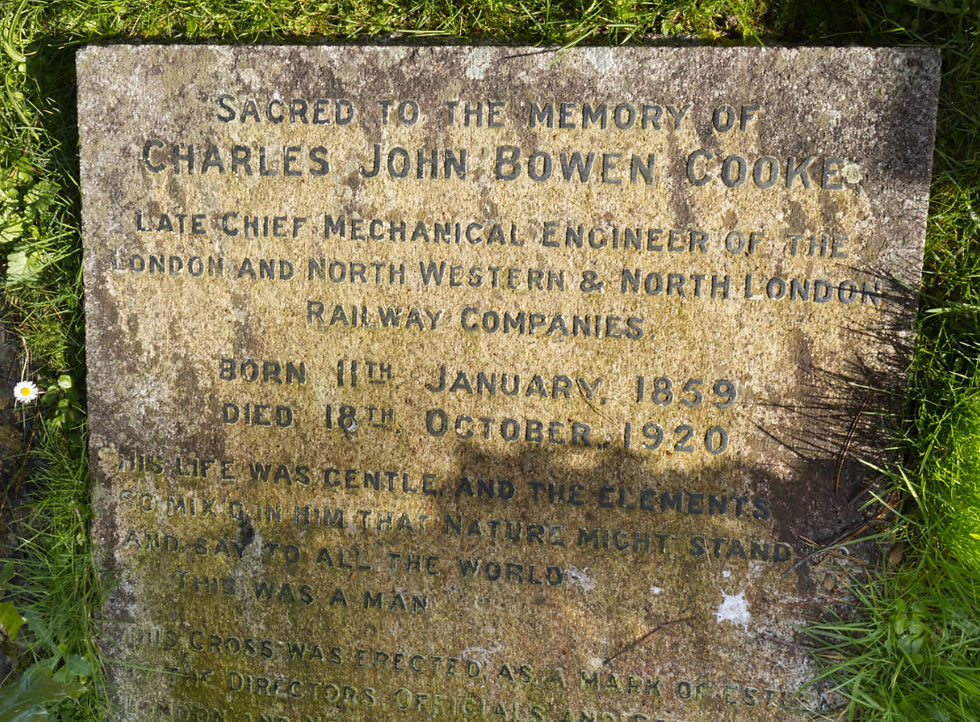
In a prominent waterside spot is the grave of Charles John Bowen Cooke a renowned mechanical engineer of the London and North Western Railway. Whilst CME of the LNWR he was responsible for the introduction of several new locomotive designs, including the George the Fifth and Claughton classes. He was appointed a Commander of the Order of the British Empire in the 1918 New Year Honours for his efforts during the First World War.
The verse on the headstone raised enough questions that I had to find out more.
"His life was gentle, and the elements
So mix'd in him that
Nature might stand up
And say to all the world 'This was a man!'"
This "famous quote" that I am now familiar with, is from William Shakespeare's Julius Caesar (Act 5, Scene 5), spoken by Marc Antony to eulogize Marcus Brutus. It describes Brutus as a balanced, noble, and honourable man—the only conspirator whose motives were truly for the common good, rather than envy of Caesar. "Elements" refers to the classical four elements (earth, air, fire, water), suggesting a perfect balance of temperament.
Cheshire Observer - Saturday 30 October 1920
The Funeral,
A Setting of Simple Grandeur.
The funeral of the late Mr. C. J. Bower Cooke C.B.E., Chief Mechanical Engineer, L. and N .- W. Railway, Crewe, took place on Friday, at St. Just-in-Roseland Cornwall.
The cortege loft No. 2 Bank Place, Falmouth, the residence of Dr. Dudley Harris (son-in-law), at 12.30 noon, the coffin being carried by eight bearers to the Custom House Pier, and placed in a small boat attached to a tug, for conveyance to St. Just. The mourners were conveyed by the steamer Roseland and followed in the wake of the tug boat.
A beautiful wreath of blue flowers, made in the form of & cross, from the family, was placed on the coffin, and surrounded by other wreaths, the remainder being distributed over the steamer in every available space. The vessels then slowly sailed across the calm blue waters of the bay, to the quiet creek of St. Just. On the inside of this creek is situated the Church of St. Just-in-Roseland, where the interment was to take place. During the passage across the, water, the sailors fishing and dredging in the harbour stopped from their toil, standing bare headed, and at the salute. On arrival at St. Just, the disembarkation was made by boat from the steamer to the beach, the mourners being met by clergy and others.

On our way back from Cornwall we made a quick flying visit to Kingsand and Cawsand. These are two villages become one. They were originally two different sides of a county boundary. The Devon Cornwall boundary came right through the middle of this cottage and it is still marked today. However, that county boundary is now several miles away as it was moved to the river Tamar.
You can see my original post on Kingsand and Cawsand here.

Caerhays Castle is a semi-castellated country house built in 1808, 0.5 mi (0.80 km) south of the village centre, St Michael Caerhays, Cornwall, England. It overlooks Porthluney Cove on the English Channel. The garden has a large collection of magnolias.

It also has many Camellias and Rhododendrons.


Back to the park in Babbacombe and my photo walk, and this ornamental folly is in the park. It is a "Sun Temple".

This park is a bit different to a normal urban park. Don't bring your kids or your dogs as it is a haven of Victorian rectitude and peace, when children were seen and not heard, except here where they weren't seen either.

Tessier Gardens are a small and delightful park situated between Babbacombe and St. Marychurch. In 1933 the gardens were gifted to the town by Mrs H A Tessier. A 'Sun temple' was constructed later the same year in recognition of Mrs Tessier's generosity. A scented garden for the blind was designed and planted in 1975 with the botanical names of the plants etched in Braille on copper plates.
Torquay Times and South Devon Advertiser - Friday 03 November 1933
Mr. & Mrs. H. TESSIER'S
GARDEN GIFT.
MAYOR PAYS A TRIBUTE
AT FORMAL GATHERING.
"They Realise the True
Meaning of Citizenship.
Another beautiful garden was added to Torquay's attractions when Mr. and Mrs. H. A. Tessier formally handed over the deeds of the garden "Carrigbawn", Stanley Road, Babbacombe, to the Mayor (Councillor W. Denis Thomas) on Friday. The ceremony had to be held in St. Marychurch Town Hall instead of in the garden, owing to the rain.
Mrs. Tessier, handing over the deeds, said that she and Mr. Tessier thought the garden would be a suitable place for people who wanted to rest in peace away from all the noise and bustle of the streets.

In accordance with the covenants bestowed upon the council in 1933, children under the age of 18 are not permitted in the gardens.

The collection of plants in the garden has just been enhanced with the redesign of the entrance area to the gardens. We have also added further Tree Ferns to the Fernery area, as well as planting a shady border just down from the top shelter.
The gardens are superb and lend themselves to quiet contemplation and enjoyment of the tranquil setting. Torbay.gov.uk


Babbacombe turns imperceptibly into St. Marychurch as you walk along the street. On the main street is an obelisk memorial in granite memorialising this man. Herbert Nicholas Chilcote.
Born in 1840 Herbert Nicholas Chilcote moved from Brixham to live in a house named ‘Charlwood’ in Babbacombe Road to attend the the medical needs of the local population. He resided there from 1869 until his death in 1886. Babbacombe History Society
Torquay Times and South Devon Advertiser - Friday 05 November 1886
THE LATE MR. CHILCOTE.
The remains of the late Mr. Chilcote, surgeon, Babbacombe, were interred on Friday
last at Brixham. The coffin was conveyed in an open hearse, and was covered with wreaths and crosses, several of which had been sent by the poor of the neighbourhood in which he lived a useful and charitable life.
For fourteen years the deceased was medical officer for the St. Marychurch district....... A large meeting was held in the St. Marychurch Town Hall last evening, for the purpose of discussing the best means by which the inhabitants could show their love and esteem for the late Mr. Chilcote. After having in a few remarks stated the object of the meeting, the Chairman proposed that a large and representative committee should be formed for the purpose of ascertaining the form which the memorial should take. Canon Brownlow seconded, saying that for his own part he should prefer a cottage hospital, but he would leave that to the committee. Rev. R. Bamford supported the resolution, and spoke of the noble and self-denying life Mr. Chilcote had lived, saying that he believed the deceased gentleman to have been one of the finest outcomes of the medical profession.


It isn't a surprise to find an old church in St Marychurch, or to discover that the church is St. Mary's. St Marychurch is an area of Torquay, in the Torbay district, in the ceremonial county of Devon, England. It is one of the oldest settlements in South Devon. Its name derives from the church of St Mary, which was founded in Anglo-Saxon times.

It is also the first time I have discovered a church made entirely of wool.

Many parts of the church don't look all that old but the font as usual is a bit of a giveaway. It is a thing of particular beauty and age. It is unlike any others I have seen. This font has stood on or near this very spot for over 900 years.

There is a very real and tragic reason why many parts of the church don't look as old. On Sunday May 30, 1943, the main part of this church was destroyed by a German bomb, killing 26 children and teachers. The church was rebuilt between 1952 and 1956. This inscription, in the photo below, references the tragedy. Reporting bomb damage was restricted or limited during the war for reasons of secrecy and security, as well as dealing with public morale.
The story was broken nationally by a story about the bombed church in The Daily Express on June 1st. That story was accompanied by a stock photo of a bombed church from World War 1. The church was not identified in the news until later that month. Even in local newspapers the story was covered a month after the event.
Western Morning News - Tuesday 29 June 1943
RECENT RAID
ON TORQUAY
Children Killed
In Church
MUCH DAMAGE
All Defence Services
Tested
WHEN Torquay was attacked by Nazi raiders recently widespread and indiscriminate
bombing took place. Although the whole thing was very short, a number of incidents occurred, but generally speaking the raid was quickly and effectively dealt with. A notable feature was the high degree of co-operation between all services engaged, whether scheme-making, authority, police, N.F.S., armed forces.
The sad feature of the attack was a direct hit on St. Marychurch Parish Church where a number of children were gathered for a service. Here 20 of them were killed and also five adults. Except for the tower the Church was completely destroyed.

This was how the story broke nationally.
Daily Express - Tuesday 01 June 1943
IN a shattered arch of an English Church hangs a six-foot crucifix. Ruin is all around it; the Cross swings under an open sky. In this Church in a south-west town, children were gathering for a Sunday christening when hit-and-run bombers roared over and past. When they had gone, 21 children were dead. It has happened before. Churches have been broken by war and the Cross has remained untouched. Once, in a town in France in the war before this one, there was such a Church and such a crucifix.
Babbacombe and St Marychurch are situated high on a cliff above Lyme Bay. It's an unlikely place for a seaside holiday resort like Babbacombe to appear, but there are beaches way below and this was the solution for those who wanted sea bathing. The Babbacombe Cliff Railway was closed for it's annual maintenance on the day of my walk so I had to take the wooded footpath down to the sea. You can see my previous post on the Babbacombe Cliff Railway here.

When you are down at sea level you find yourself on the South west Coast Path which here, finds itself suspended above the water on a boardwalk.
A short but fairly strenuous walk on one of Britain's highest cliff-top promenades, but you can avoid the long and steep downhill section by riding down on the famous funicular railway, built in 1926 and still carrying a quarter of a million passengers a year! South West Coast Path

Another visit to Ford Independent Chapel which I pass on one of my rural walks. This also has to rate as one of the most beautiful churchyards in England. Spring flowers are profuse.

Back to my favourite beach again.


Comments