St Bartholomew The Great

This post is about an accident of history, remaining hidden away in the middle of the bustling modern city of London, a gateway in time to London's oldest parish church. A story of myth, legend, politics, revolution, body snatching, war, destruction, bloody murder and the gibbet.

There is still a tiny narrow street in what was medieval London, called Little Britain, which if you are walking up it from The Museum of London, north west to Smithfield Market, will bring you to this point, where if you look up you will see a narrow strip of ancient London, miraculously still hanging on. This 13th century stone arch was once the doorway into a church, Saint Bartholomew the Great. It was the church that was great, not the saint, as there was another nearby church which was smaller, Saint Bartholomew the Less.

Through the arch and looking back one can see more clearly that above it sits incongruously a later 16th century half timbered house. About half of the original church was demolished in 1543 by Henry VIII during the dissolution of the monasteries. Had Henry managed to produce an heir by then England would have remained Catholic and I might have been taking a photo of the interior of that original building. However, only the arch stood and someone built their house on top. When this was built, most of London looked like this, until less than a hundred years later in 1666 the Great Fire of London, burned for five days and took with it an estimated 13,200 houses like this one and 87 churches.

The church was founded by Rahere, in 1123, a prebendary at Old St Paul's Cathedral, built in 1087, which was itself lost in the Great Fire.
While visiting the Vatican, Rahere dreamed that a winged beast came and transported him to a high place, then relayed a message from "the High Trinity and...the court of Heaven" that he was to erect a church in London's Smithfield. Rahere travelled to London and was informed that the area in his vision – then a small cemetery – was royal property, and could not be built upon. Henry I, however, granted title of the land to Rahere upon hearing his divine message. Wikipedia
St Bartholomew's was a priory and a hospital, and part of the church and hospital therefore survived the destruction of Henry VIII and also, due to it's outer priory walls acting as a fire break, the Great Fire. Henry was a pragmatist, so religious institutions containing hospitals and schools were usually spared.
This view below would have been looking down the south aisle of the nave of the original church, but we now see a later tower and doorway with parts of the original nearly thousand year old church beyond.
As an aside, it is worth noting that the concrete tower in the distance is The Barbican development. More on that here. This was an area covering 35 acres of old London laid waste in a single night of bombing during World War 2, on the 29th December 1940. This, the oldest church in London had a narrow escape.

The black flint facing here is part of a restoration of 1889, while the clock tower was added to the remains of the original church in 1628. Not only did these buildings escape the Great Fire but also the Blitz of the 1940's.

The Priory Church was designated a Grade I listed building on 4 January 1950.

The surviving building had comprised part of the priory adjoining St Bartholomew's Hospital, but when the nave was pulled down up to the last bay, the lofty crossing arches and choir survived largely intact from the Norman and later Middle Ages, enabling its continued use as a parish church.
In case this view below looks familiar to you, I should add some modern "history" here, as this was the setting in the film Four weddings and a Funeral, where Hugh Grant almost got married. In fact, his bride to be punches him in the face and knocks him out cold, in front of the altar. The film was an unexpected hit, being made in six weeks for £3 million, while becoming the highest-grossing British film in history at the time, with a worldwide box office total of $245.7 million. Wikipedia
Note the costs are listed in British pounds while the profits are listed in US dollars. I'm not sure what this signifies, probably the inadequacy and unreliability of Wikipedia.

Who was St Bartholomew? Any facts are probably lost in the mists of time so what we know is probably mostly myth, or as Judge Judy would say "hearsay, so inadmissible in court". In any case, Bartholomew, a real person, appears in the Bible as one of the disciples so he's an "A" lister when it comes to Saints. He is believed to have been present during the death, resurrection and ascension of Jesus. Bartholomew is thought to have travelled with the Gospel to Asia Minor, Northwest India and Armenia. He is believed to have died in Armenia where he was skinned alive for his troubles. More on that later.
The cloister is 15th century.

Rahere was a favourite of King Henry I, and many of the details of Rahere's life have become confused, having been variously described as a cleric, a courtier, a minstrel and a jester, but Rahere undoubtedly existed and did many of the things in the legends about him. He may at different times in his life have been all of these. He died in 1143 and we'll see his tomb/memorial later. There have been 54, in the first instance Priors, and subsequently Rectors of the church, and you can see all of their names here.
The main part of the church today is this 14th century clerestory. A clerestory is formed from high sections of wall containing windows, typically above eye level, designed to bring light into a space. The timber roof also dates from this time.

These are the oldest parts of the church remaining, and date from the Norman and later Middle Ages. The crossing arches and choir stood at the head of the now missing nave.


The oriel window above the nave of the present church is an unusual feature, but remember that this space was not a church, it was a priory, the home of a body of monks. This oriel window serves as a sort of Victorian factory overseers office window, where the Prior could keep his eyes on his workforce. This was added in the early 16th century by Prior William Bolton, and how do we know that? Below the window you can just make out a rebus. A rebus is a puzzle device that combines the use of illustrated pictures with individual letters to depict words or phrases. Here we see a barrel with a crossbow bolt shot through the middle. Barrels were originally called Tuns and a bolt through a tun in this case is a nice visual pun indicating the surname of the Prior Bolton.

On the day of my visit there was a recital about to be performed and someone was practising on the piano. This was a very lucky addition to my visit as the music was echoing around the building.
On 17th July Trio Muse held a recital in St. Bartholomew the Great, Barbican, where we had wonderful time performing for the first time as a trio. Thank you everyone for coming and supporting us!

Back in 1733 there took place nearby, a notorious triple murder that had an indirect connection with the church. It was national news and the biggest sensation of it's time.
Sarah Malcolm was convicted of a triple murder and hanged. Throughout her trial she maintained her innocence as to the murders, although she confessed to the burglary, during which the murders took place. The burglary alone carried a death penalty so it was a controversial case at the time. People saw no benefit for her in confessing to the capital crime of burglary while denying the murder. Three others were named by her and claimed by her to have committed the murder but the only evidence found, implicated her, no evidence was ever found to implicate the others. The witnesses of course, were already dead.
Derby Mercury - Thursday 15 March 1733
Yesterday Sarah Malcolm was executed on a Gibbet erected over-against Mitre-Court in Fleet-street. She was dress'd in a black Gown, white Apron, Sarsenet Hood, and black Gloves. We don't hear that she made any Confession of her being guilty of the Murder of Mrs. Duncombe and her Maids; but just before she was turn'd off, she delivered a Paper, written with her own Hand, to the Rev. Mr. Piddington, Minister of St. Bartholomew, the Great, which she said contained something that was necessary for her to acquaint the World with; and desir'd, that as the same had been seal'd up in Newgate, in the Presence of several Gentlemen, it might also be open'd before them and the Sheriffs.
She receiv'd the Sacrament in the Morning, and declar'd at the Place of Execution, that she died a Protestant. She was very desirous to see her Master, Mr. Carrol, and looked about for him, whom she acquitted of all Manner of Aspersions or Imputations laid on him at her Tryal; but confess'd nothing concerning the Murthers. After she had talked some Time with the Ministers, as she was going to be turn'd off, she fainted away, and was some Time before she was brought to her Senses; but being afterwards recover'd, after a short Stay she was executed. She was cut down after she had hung somewhat more than Half an Hour; and her Body was carried back to Newgate under a strong Guard of the Mob. Several of the Nobility, and other Persons of Distinction, saw the Execution from the neighbouring Houses; and there was as great a Concourse of common People as ever was on the like Occasion. Many of the Spectators were hurt by the breaking down of a Scaffold ; and a great many Gentlemen and Ladies had their Pockets pick'd or cut off.
The same Afternoon, about Four o' Clock, the Rev. Dr. Middleton, the Rev. Mr. Piddington, and Mr. Ingram, waited on the Lord Mayor, in order to break open the Confession of the said Sarah Malcolm before his Lordship, which will soon be made publick.

Five days later and Sarah's written account is described in the press.
Gloucester Journal - Tuesday 20 March 1733
In the Copy of the Paper deliver'd by Sarah Malcolm the Night before her Execution to the Rev. Mr. Piddington, Lecturer of St, Bartholomew the Great, she declares, That on Sunday the 28th of January, after her Master, Mr. Kerrol, was gone to Commons, Mary Tracey came to her and drank Tea, and then it was she gave Consent to that unhappy Act of robbing Mrs. Duncomb, but declares she did not know of the Murder.
On Saturday the 3d of February, being the Time appointed, they came about Ten O'Clock at Night, and Mary Tracey came to Mr. Kerrol's Chambers, and they all four went to Mrs. Duncomb's, and on the Stairs Sarah Malcolm met Mrs. Duncomb's Maid, who ask'd her whether she was going to the old Maid, she answer'd Yes; and as soon as she thought the Maid had got down Stairs, would have gone in herself, but thought that would give some Suspicion, and so ask'd which would go in, and James Alexander replied, he would, and the Door being left open for the Maid against her Return, she gave James Alexander Directions to lie under the Maid's Bed, and desired Mary Tracey and Thomas Alexander to go and stay for her at her Master's Door until her Return, which they did, and when she came, desired they would go and stay for her at Mrs. Duncomb's Stairs, who on her Return found them there, and there they waited till after Two o'Clock on the Sunday Morning, which was the 4th of February, and then Sarah Malcolm would have gone in, but Tho. Alexander and Mary Tracey interrupted her, saying, if you go in, and they awake, they will know you, and if you stay on the Stairs, it may be that some one will come up and see you ; but she made Answer, that no one lives so high as Madam Duncomb.
At length it was concluded that Mary Tracey and the other Alexander should go in and shut the Door, which they did, and Sarah Malcolm remained till between Four and Six o'Clock, when they came out, they ask'd which they should shut the Door, and she told them to run the Bolt back, and it would spring in Place, and accordingly they did, and when they came down, they ask'd where they should divide what they had got; she asked how much that was; they said, about three hundred Pounds in Goods and Money, but said they were forced to gag them all. She desired to know where they found it ; they said, that fifty Guineas of it were in the old Maid's Pocket, in a Leathern Purse, besides Silver, which they said was loose; and above £150 in a Drawer, besides the Money that they had out of a Box, and the Tankard, and one Silver Spoon, and a Ring which was looped with Thread, and one square Piece of Plate, one Pair of Sheets, two Pillow-beers, and five Shifts, which they divided near Fig-Tree-Court; after which Mary Tracey and the two Alexanders said to Sarah Malcolm, be sure that you bury the Cole (Money) and Plate under Ground, till the Robbery is over ; for if you be seen flush of Cole, you will be suspected.
It's worth noting that the value of the burglary in today's money would have been over £35,000. It was reported at the time that Malcolm had an amorous connection with Piddington, who was with her on the scaffold, and to whom she entrusted her final words.
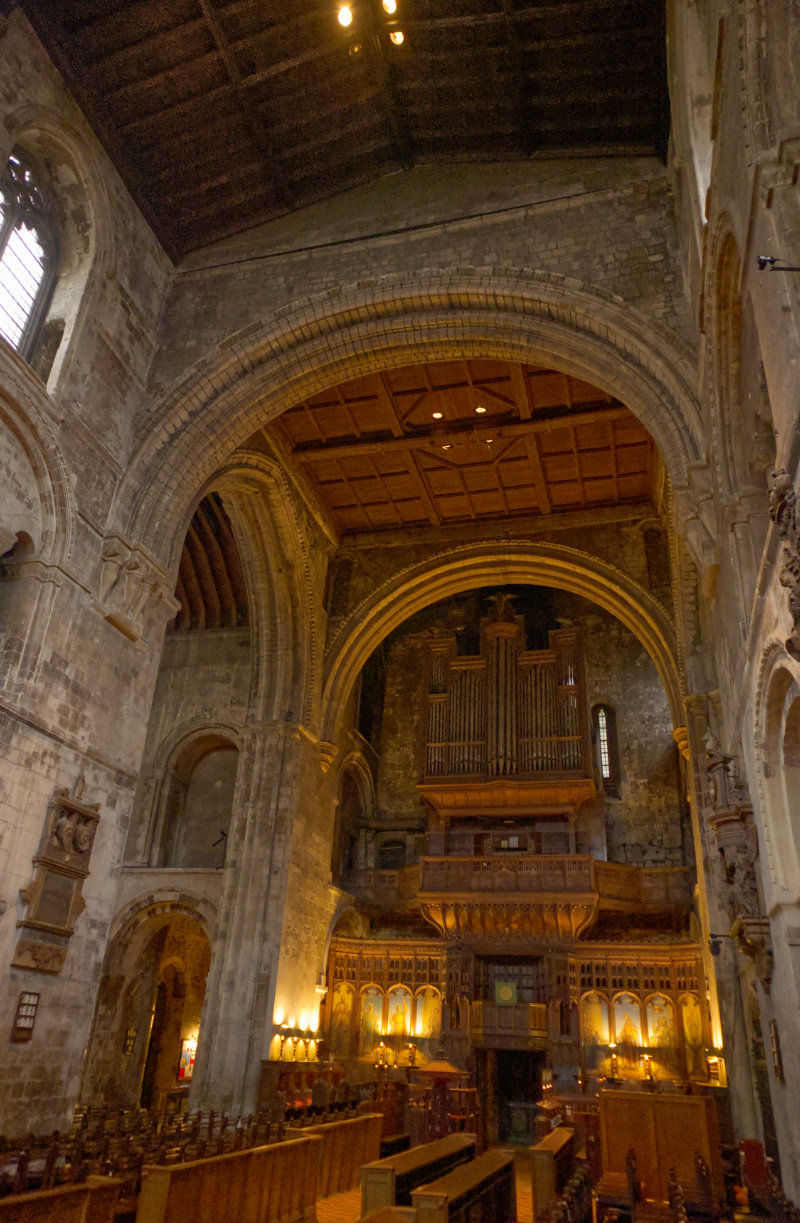
Through the arches behind the present altar is the Lady Chapel.

This is the 14th century Lady Chapel. A Lady Chapel (or Mary Chapel) is a chapel within a larger church or cathedral, traditionally dedicated to the Virgin Mary, often located at the eastern end and serving as a space for prayer and reflection.
This part of the church has an interesting history of it's own. After Henry VIII's dissolution it served commercial purposes as workshops and was not returned to the church until 1885.
It had a particularly famous occupant. After arriving in London, a young Benjamin Franklin found work in a printing workshop right here. This was before the American Revolution so we can claim him as British at this time. Benjamin Franklin lived in London for nearly two decades in two major stints (1757-1762 and 1764-1775) as a colonial agent, working diplomatically and socially, staying at 36 Craven Street (now the Benjamin Franklin House) near Trafalgar Square, engaging with intellectuals, politicians (even King George III), and scientists, and experiencing the growing tensions that led to the American Revolution before fleeing arrest in 1775. His time there was marked by scientific work (like lightning rods), political manoeuvring, and a significant personal life, making the Craven Street home the only remaining home of his in the world.


Immediately to the North of the high altar is the monument to founder Rahere. This is in a mixture of the Decorated Gothic and Perpendicular Gothic styles. A painted effigy lies on top of the tomb under an elaborate canopy. It is unclear whether it is the resting place of Rahere's remains, or his monument, since it was constructed c.250 years after his death in 1144.

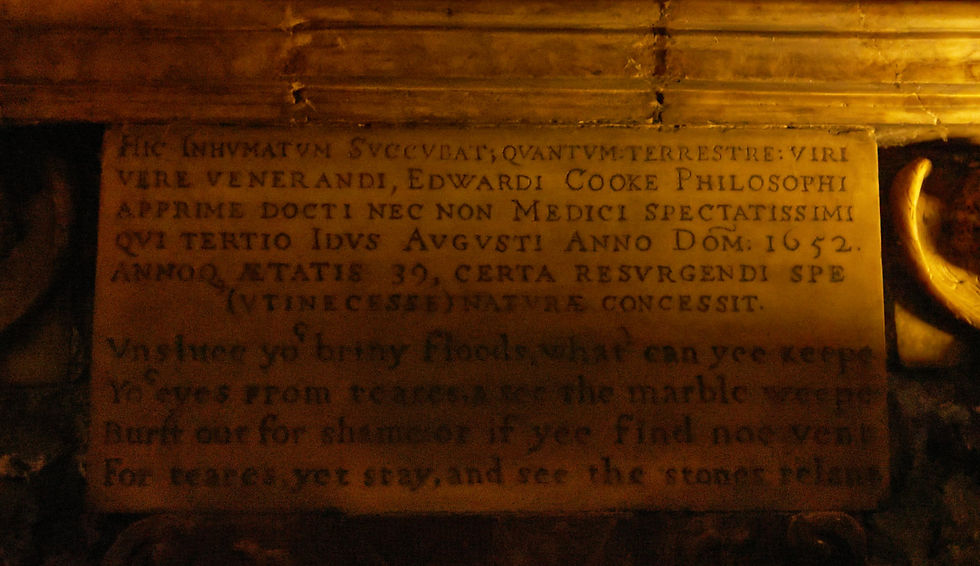
The Weeping Monument of Edward Cooke.
Edward was a medical man, so it's no surprise that his memorial is here at an historic hospital site. He was born in 1613, entered Cambridge University at the age of 17, receiving his M.A. in 1638 and his M.D. in 1644. He travelled extensively in Europe studying at other universities, Leyden in 1639 and Padua in 1641. The marble that forms the memorial was said to have wept tears.

I'm grateful to Baldwin Hamey for the translation on this tomb, and the information about it.
Here lies interred all that is mortal of a truly reverend man, Edward Cooke, an exceedingly learned Philosopher as well as a very notable man of medicine, who, on the third of the ides [the 11th] of August A.D. 1652, and in the 39th year of his age, yielded perforce to nature in the sure hope of a resurrection.
The name on this next tomb was familiar to me. Mildmay is not that common a name.
Sir Walter Mildmay born in 1520 was the Chancellor of the Exchequer for Elizabeth I, and founded Emmanuel College in Cambridge.
Walter's father, ironically, was Henry VIII's Commissioner for receiving the surrender of the monasteries at the Dissolution. So dad played a part in having the nave of this church pulled down.
Mildmay must have been a skilled politician because he worked for Henry VIII, Mary I and Elizabeth I during a period of great political turmoil and not a little danger, when being on the wrong side of history was fairly lethal. He played a part in many great historic events such as the imprisonment of Mary Queen of Scots, but there is too much to mention here. The tomb was restored in 1865 by Henry Bingham Mildmay.
In 1872 Henry Mildmay acquired Mothecombe House in Devon only a few miles from where I live now, and restored the nearby Holbeton Church. This is where I previously encountered the Mildmay name. You can read that post here. A couple of years ago I had the privilege of a guided tour around Mothecombe House by it's then owner Anthony Mildmay-White. It was a fascinating afternoon. I am not sure how many Greats there are linking him to Sir Walter in this church.

During my research in the newspaper archive I found a fascinating list of London's dead during the week of 13th July to the 20th July 1731. It gives us important historical context for what life was like in a big, dirty, overcrowded city like London at that time.
Five people drowned that week, three of them in the Thames, one of whom was buried in the churchyard right here. The commonest causes of death were Convulsion 113, Small Pox 66, Consumption 59, Fever 39, Aged 26, Teeth 17, Dropsie 12, Stillborn 10. Today it is likely that all of those people would have survived or lived a lot longer. Surprisingly to us today people frequently died from dental issues in the 1700s, primarily due to untreated infections leading to sepsis or other systemic complications. Dental problems were a leading cause of death. Dropsie is what we call oedema today or excess fluid in body tissues, usually caused by heart or liver disease. Consumption was later called TB, or tuberculosis.
One man "Hang'd himself (being frightened by threats) at St. Ann in Westminster".
The really revealing list though is death by age group. Isn't it incredible that we have information like this, published in the newspaper archive. The estimated population of London at that time was about 600,000, and mortality rates were high. Remember that these figures are a single week.
The most dangerous age group was those under two years of age, 117 of whom died. As children got older the death toll drops off a cliff because the weak and ill have already been winnowed. Between 2 and 5 only 42 died, while between 5 and 10 only 15 are gone, and once a child survives to the age of 10 only five died in that week up to the age of 20.
Then as people age above 20, the death rates starts to climb again.
20 - 30 and thirty seven are lost,
30 - 40 and it rises to forty four,
when it levels off to forty five for the 40 - 50's.
Only one extra, at forty six dead in the 50 - 60 age group,
but now there are a lot fewer people in these groups.
Although the numbers of dead drop as the age increases from this point we are now talking about the privileged few who have survived this long. In the 60 - 70 group thirty died and then it is ten, eight, and finally only one dead who made it into their nineties.
General life expectancy was forty at this time and that is clearly revealed in these numbers.

If you are familiar with my blog, you will know by now that the font is an item that is often the oldest part of a church. This one dates from 1405 and is believed to be one of only two pre-Reformation fonts in London. As the building has altered over the centuries so has the position of the font, finally ending up on this spot during the restoration of the late 19th century.
The font is still in use today after 600 years and in 1697 one later famous man to have his infant head doused with water was William Hogarth who was born in Bartholomew Close.
William Hogarth FRSA,(10 November 1697 – 26 October 1764) was an English painter, engraver, satirist, cartoonist and writer and he is perhaps best known for his series A Harlot's Progress, A Rake's Progress and Marriage A-la-Mode. Familiarity with his work is so widespread that satirical political illustrations in this style are still often referred to as "Hogarthian".
Coincidentally the only known image of Sarah Malcolm was painted by Hogarth, only a few days before her execution, so famous had she become.

I said I would come back to St Bartholomew being flayed alive, and this sculpture in the church seen below, brings us full circle, from the ancient to the modern.
Barts and The London School of Medicine and Dentistry, commonly known as Barts, is the medical and dental school of Queen Mary University of London, a constituent college of the federal University of London. It was formed in 1995 by the merger of the London Hospital Medical College (the first school to be granted an official charter for medical teaching in 1785) and the Medical College of St Bartholomew's Hospital (established in 1843, with medical teaching dating back to the founding of the hospital in 1123).
Records of students at St Bartholomew's Hospital date back to at least 1662, although a purpose-built lecture theatre at the hospital was not built until 1791, and it was not until 1822 that the governors formally approved the provision of medical education within the hospital. Wikipedia
Formal lectures were approved in 1734: The hospital governors gave approval for surgeons to "read lectures in anatomy in the dissecting-room of the Hospital", marking a step towards formal education.
Exquisite Pain by Damien Hirst
The artist has used traditional imagery of the saint as seen in such places as the Sistine Chapel, holding his flayed skin over his arm and clutching the knife that tortured him. Hirst interprets that knife as a contemporary surgeon's scalpel. The saint appears as a traditional anatomy subject, as was common in early anatomy schools.

" I like the confusion you get between science and religion.... that's where belief lies and art as well." Damien Hirst

In the street that runs at right angles to the old arched entrance is this other grander entrance, part of the Victorian restoration, faced in black flint. This street is Cloth Fair.
Cloth Fair is a historic, narrow street in London's City, near Smithfield Meat Market, named for medieval cloth trading during the Bartholomew Fair; it's known today for its preserved Georgian and pre-Great Fire buildings, including 41-42 Cloth Fair, often called the oldest house in the City, and properties once owned by poet Sir John Betjeman, offering an oasis of historic charm. Meat came on the hoof back then, not vacuum packed, which carried its own risks.
Gloucester Journal - Monday 10 September 1770
Last Monday afternoon an over-drove ox ran through Cloth-fair, and pursued a gentleman so close that he was obliged to take shelter in the one-pair-of stairs room of a corner house in Bartholomew-close: the ox came so quick after him that the door could not be shut ; but by the help of the chairs and tables he kept him at bay some time, when casting his eyes round the room, he ran furiously at another gentleman, and gored him in so terrible a manner that his recovery is doubtful.

Of course, opposite the church entrance in Cloth Fair is this traditional London pub, The Rising Sun. Religion and beer were never far apart.
In 1865 the publican was looking for a Lad to join the staff.

The pub was established in 1616 in the reign of James I. It's original name was the Starre Tavern.
The early 19th century was a relatively enlightened period for Britain. Science and medical research were moving forward in leaps and bounds, and a more lenient regime had reduced the number of executions each year from several hundred to a mere few dozen. With fewer executions and a growing thirst for medical knowledge, there was suddenly a gap in the market for fresh bodies for dissection – usually supplied to the hospitals by the hangman.
As the number of dead bodies grew scarce, body snatchers, who up until this point had prowled around graveyards looking for new graves were forced to consider the living. Body-snatchers were rife in the area around the Rising Sun since nearby St Bartholomew’s Hospital was always hungry for corpses. And the semi-comatose – often to be found propping up the bar in pubs – turned out to be the ideal potential corpses.
John Bishop and Thomas Williams pleaded guilty to selling up to 1,000 bodies to anatomists over a 12-year period in the early 1800s. And while most were taken from graveyards, a significant percentage were thought to have been alive and drinking before being “snatched”. Bishop and Williams were hanged for murder on December 5 1831 and their bodies were sent immediately for dissection. London's Pubs.
There's little doubt that some of their "customers" ended their days having one drink too many, right here, while others were exhumed from the church yard opposite. It is possible to read their full confessions in the newspaper archive, but the detail of the murders is too shocking to add here.

I am leaving the history of St. Bartholomew the Great now but there follows a description of the execution day for these notorious murderers for those that want to continue. It is a fascinating insight into society less than 200 years since.
Reading Mercury - Monday 05 December 1831
The execution of these wretched and atrocious criminals, which took place on Monday morning at the Old Bailey, attracted, as might have been expected, an immense assemblage to the spot, and every possible preparation had been accordingly made by the civil authorities in erecting barriers, to mitigate the pressure of the anticipated crowd. Towards evening the crowds increased, and by midnight great numbers were assembled, who actually remained all night on the spot, in order to secure places on the scaffold on the following morning.
The occupiers of houses, from the windows of which a view could be obtained of the execution, exhibited placards, announcing various prices for seats according to the proximity of the domicile to the spot, they were eagerly sought for and secured at a guinea per seat and upwards. So much as ten guineas were given for a single window, and all these seats were occupied by those who engaged them, at so early an hour as five o'clock, upon a cold, cheerless, and uninviting morning.
Shortly after midnight the gallows was brought from the yard, and the workmen proceeded to erect it in the usual place, opposite the Debtor's door of Newgate.
A large space around it was barricaded to keep off the crowd, and the inside of that space was subsequently nearly filled by constables and marshalmen. The crowd as early as one o'clock, amounted to several thousand persons, and continued rapidly increasing. By five o'clock nearly two-thirds of the Old Bailey were filled with a dense mass of people.
As the dawn of day approached, and with it the fatal hour that was to consign the wretched criminals to their well merited fate, all the streets leading to the Old Bailey were thronged with people, chiefly of the working classes hastening to the spot. Constant streams of population were pouring into the Old Bailey till they formed, around the scaffold and at the corner of every street from whence even a distant or a faint view could be obtained, a vast lake of life.
Amongst the immense assemblage might be noticed several females, most of them of that caste whose attendance on such an occasion might be naturally expected, but some of them, it is to be regretted, were of a class that decency, if not humanity, should have kept away from a scene so revolting to those delicate sensibilities that generally characterize females.
At the break of day it is believed there were not less than from 30,000 to 40,000 persons assembled. The tops of the houses, lamp-posts, and every station from which the most distant view of the execution could be obtained, were by this time occupied. The assemblage was the largest that has ever been witnessed on any occasion of the kind since the execution of Holloway and Haggerty, upwards of 20 years since, when some 14 or 15 persons were trampled to death in the crowd. The following fact will convey some idea of the extent and densely congregated state of the crowd on Monday,-namely, that even so far as St. Sepulchre's church, in Skinner-street, several individuals, whose screams for relief had induced the people to raise them up, were passed over the heads of their neighbours.
I am going to leave the detailed description of the execution at this point when the barriers holding the immense crowds gave way and many were trampled underfoot.


Comments