St Olave's - Exeter

This is the story about St Olave's church in Fore Street, Exeter.

We are here in Fore Street and this is St. Olave's church, which was founded by Lady Glytha in 1053, and those of you who know your English history will be immediately aware from that date, that Glytha did not have very long to appreciate her handiwork. Glytha was the mother of King Harold.
We do know that thirteen years after Glytha founded this small church dedicated to King Olaf of Norway, later to become St. Olave, that William The Conqueror arrived at Hastings with an army of 7000 men and turned Saxon England, French, killing three of Glytha's sons in the process and locking another one up for 43 years. After most of her family were wiped out, that's the thanks you get for founding a church, Glytha disappeared from the history books and it is assumed she fled to Norway where she had many relatives.
Glytha dedicated the church to Olaf II Haraldsson who was King of Norway from 1015 to 1028 and later became Saint Olaf in 1030. He was also known as Olaf the Holy. It is an irony that Glytha dedicated the church to Olaf as he was born in Rouen the capital of Normandy and is thought to have used priests of Norman descent as his missionaries. It was the subsequent Norman invasion that saw Glytha lose everything.
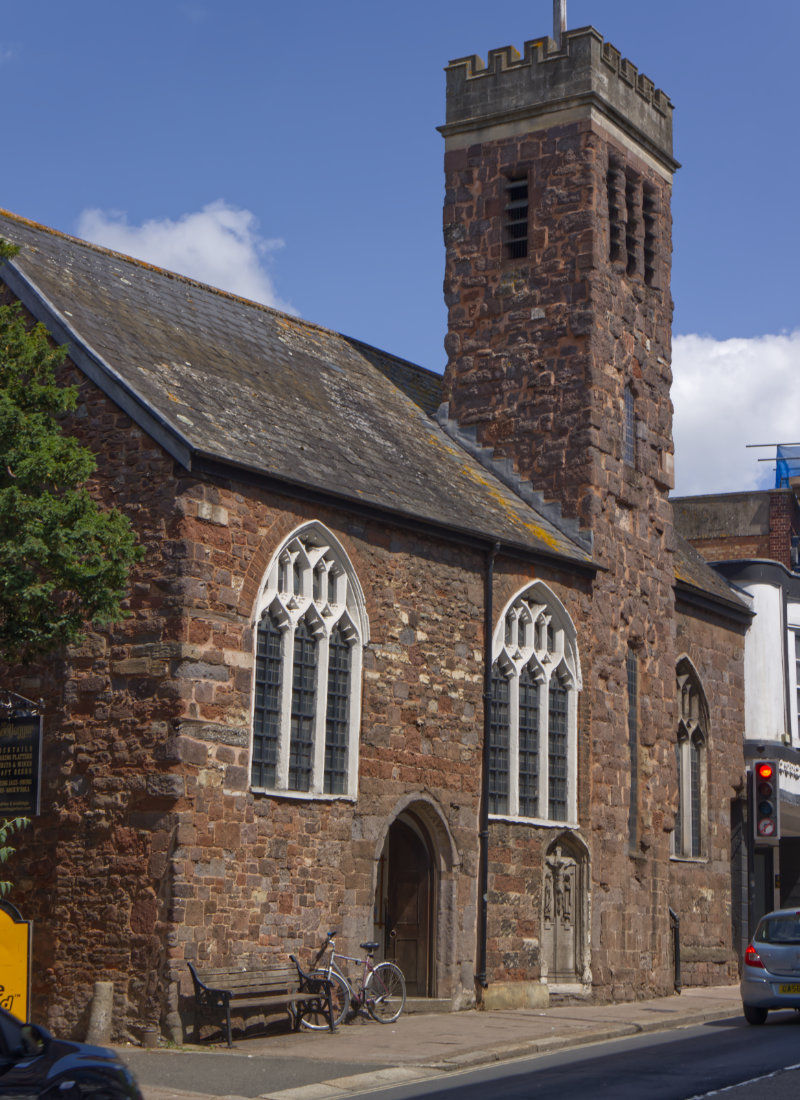
The church was rebuilt in the 14th century and restored a few times after that so that what we see today, bears the scars of time and historic changes, leading to a fascinating interior, like no other ancient church I have visited.

Before Glytha disappeared it is thought that she led the revolt against the Norman invasion here in Exeter, which led to a great siege. The siege lasted 18 days but it was a hopeless cause and the surrender was inevitable. King William swore an oath not to harm the city but quickly established Exeter Castle to keep order and power. Most landowners had their property seized and it was transferred to Norman hands.

One of the earliest mentions of St. Olave's church in the newspaper archive is a short announcement which appears in several papers all around the country. An announcement of a simple wedding that obviously made national news, and an interesting one it is too, if only for the way it is written and worded and for what it doesn't exactly spell out. What it does do though is to use italics in a very subtle way, which I will display here.
London Moderator and National Adviser - Wednesday 04 February 1818
MARRIED.
At St. Olave's Church, Exeter, Mr. J. Richards, of that city, cooper, aged 22, to Miss Stone, a blooming damsel of seventy-two: The tender bride was conveyed to the Church in a sedan chair, the better to conceal her maiden blushes from the prying eye of curiosity.
One could probably use that concise image to build an entire novel.

There is some interesting history in an article in The Western Times of the 11th of June,1875 written at the time of one of the church's restorations, after it re-opened.
"Yesterday St. Olave's Church, Exeter, which has been closed for some months in order that certain alterations might be made, was reopened for public worship.The alterations are of considerable importance in so small a church."
There follows part of the history of the church, some of which I have already mentioned, namely the part played by Glytha.
"She built this house stately and beautiful-not as it now was-and during the restoration they found some token of her beautiful work on the stone capitals, work which those who erected the present building could not imitate, and the imitation of which those who had carried on this restoration had not attempted."

After a long and very critical account of the Civil War and how the church was treated by the Puritans, including use of the church interior as a graveyard, and the smashing of idols, it continues "God grant that the hand of the spoiler might never again come with axe and hammer to break down the carved work of the sanctuary or to desecrate to profane or base uses the soil with which were mingled the ashes of the forefathers of this parish. Beneath this church were laid the bones of the Mayors of Exeter for 25 years, and of many men and women who served God and their country well in their generation."

A Huguenot conformist congregation was started in 1686 at St. Olaves Church – one of two churches used by the refugee settlers, There was also a non-conformists congregation, founded in 1620. Those that attended St. Olaves numbered 120 in 1715, under the minister Andrew Majendie. Services were conducted in French, and the church was popularly known as the French church. This ceased in 1758 when its members joined the Anglican Church.
The Edict of Nantes of 1598 granted the minority Protestants of France substantial rights in the predominantly Catholic country. This period of religious tolerance lasted until 1685 when it was renounced by Louis XIV when Protestantism was declared Illegal.
All Protestant ministers were given two weeks to leave the country unless they converted to Catholicism and all other Protestants were prohibited from leaving the country. In spite of the prohibition, the renewed persecution – including many examples of torture – caused as many as 400,000 to flee France at risk of their lives.This exodus deprived France of many of its most skilled and industrious individuals, some of whom thereafter aided France's rivals in the Netherlands and in England.
Outside London, the largest foreign communities in England in the late 17th century were in Devon, Canterbury, and East Anglia where about a third of each population was Huguenot. In Devon, the largest groups were in Exeter and Plymouth. These settlements came about because of each town’s proximity to the sea and relationship with the textile trade, where immigrants could obtain work. In Exeter there were opportunities for skilled weavers in the flourishing serge business. The city briefly became famous for carpet production thanks to Swiss Huguenot Claude Passavant, who purchased a London workshop in 1755, and brought many of the weavers to Exeter. Huguenot Places

More changes were still to come.
Western Morning News - Monday 27 December 1915
ST. OLAVE’S CHURCH. EXETER.
At a solemn celebration of the Holy Eucharist at St. Olave's Church, Exeter, yesterday morning, the rector (Rev. E. C. Long) being the celebrant, the Bishop of Crediton (Dr. Trefusis) dedicated a handsome new reredos. The reredos which for beauty and size has few if any equals in West of England parish churches, includes a carved oak triptych, containing figures of saints and angels and carved oak panels. The principal theme of the artist is that of the incarnation of our Lord, and it's central figure is a beautifully carved statue of the Blessed Virgin and the Holy Child, with a panel representing the Annunciation below. There are also carved figures of St. Olave (the patron saint of the church), of St. Denys (patron saint of France) and St. Joseph (patron saint of Belgium) Niches are left for four other statues.....

Below is one of those tombs of a former Exeter Mayor. Thomas Salter was a silversmith at a time when Exeter had its own assay office.
This city has an interesting history with spoons dating from the 16th Century, although the assay office was not officially opened until 1700 when a date letter system was initiated. The town mark (a castle with three turrets) looks very similar to that of Edinburgh, but can be differentiated by the existence of the lion passant. Spoons of all the major forms and patterns are to be found.

This is an early Georgian Provincial Rat Tail Hanoverian Britannia Silver Tablespoon - from Exeter, by Thomas Salter


St. Olave's also has a connection to the world steam loco record that was set in 1904, just as we entered the 20th century.
Bath Chronicle and Weekly Gazette - Saturday 17 February 1934
G.W.R. TRAIN'S 102 MILES PER HOUR
Bathford Man Who Set Up a Record
We are indebted to Mr. J. M. A. Willsher for reminding us of a remarkable railway exploit achieved by a relative, Mr. M. W. Clements, for many years an express driver on the Great Western Railway, who died recently at Exeter, at the age of 81. In May, 1904, while driving a special mail train on the Great Western Railway from Plymouth to Paddington with the engine " City of Truro," Mr. Clements attained the highest speed ever officially recorded with a steam locomotive—102.8 miles an hour. This speed was attained on the Wellington Bank. The engine which accomplished this record run is now preserved in the recently established Railway Museum at York. Our informant adds that Mr. Clements had put in 47 years' service as driver of express passenger trains on the Great Western Railway. A man of genial disposition, he was for several years a sidesman at St. Olave's Church, Exeter. All his sons have followed his calling, and are now drivers on the G.W.R., and frequently pass through Bath. Mr. Clements was born, bred and brought up Bathford.
As steam locomotives were the fastest machines ever built up to that time we can be fairly sure that Mr Clements had travelled faster than any human before him.


Comments