The Hanging Gardens of Goodrington

This is one of the Seven Wonders of South Devon. I haven't decided what the other six are yet, but this may be another series of posts. This post is about the Goodrington Cliff Gardens.
Goodrington is a small town in Torbay South Devon in the no man's land between the more famous Paignton and Brixham, either side. Technically it is part of Paignton, but feels quite separated from it by Roundham Head. Goodrington has a lot to offer the holiday maker, including much ancient history.
Goodrington is mentioned in the Domesday Book of AD 1086 as Godrintone in the ancient hundred of Kerswell. The village became part of Haytor Hundred when it was derived from Kerswell Hundred. In the 18th century the name was written as Goderington.
Today Goodrington in shorthand could be shown thus, with brightly coloured beach huts lining its sea front, with Roundham Head behind. It has three sandy beaches, a water park and three holiday parks as well as sundry cafes, hotels, and an old fashioned boating lake. It is what I would describe as traditional unspoilt British seaside. This path rising above the beach huts is one of the ways you can explore the cliff gardens. It also leads to Paignton harbour the other side of the hill.

A good reason I now discover for making this post is that Wikipedia, under Goodrington, doesn't even mention the cliff gardens.
Goodrington Cliff Gardens were built over a 15 year period, being initially a project to prevent erosion of the soft sandstone cliffs.
Construction & Timeline1921: The local council approved the initial shore protection and sea wall schemes.
August 1929: Construction of the lower promenade and cliff walk began under the Distressed Areas Relief Scheme. The ambitious project employed many unemployed coal miners from South Wales.
1931: The lower promenade was completed.
1933: The cliff face pathways were finished.
May 23, 1936: The £54,000 project was officially opened to the public by Sir Robert Horne, Chairman of the Great Western Railway.

On the sea wall near the cafe is this easily missed, rare plaque, remembering a King who never wore a crown. On the death of his father George V, on the 20th of January 1936 Edward instantly became King Edward VIII. He was only to reign for less than a year and abdicated in scandal before his coronation. As a consequence you will not find many references to him in the public realm because his short reign was both short, and mired in controversy. But while he was King, the Goodrington Cliff Gardens were officially opened. More on the constitutional crisis here.

This illustrates the original challenge that faced the creators of this small wonder.

Skegness News - Wednesday 10 June 1936
A PAIGNTON METAMORPHOSIS.
By laying the last coping-stone and unveiling a commemorative tablet, Sir Robert Horne, chairman of the directors of the Great Western Railway Company, formerly opened the new cliff garden, parks, and promenades at Goodrington Paignton, recently completed at a cost of £74,000.
In the last few years Goodrington has undergone a complete metamorphosis. Once dangerous cliffs have been converted into delightful walks and gardens, while a stretch of swampy wilderness is now changed to pleasant walks, model yacht pond, miniature motor-boat pond, tea gardens, putting courses, and seaside cabin colonies.
The scheme was begun in August, 1929, when it became necessary to protect the cliff walk at the top of Roundham Head from sea erosion. A promenade, nearly a quarter of a mile in length, has been constructed at the sea edge, thus joining Goodrington sands and park with the cliff walk at all stages of the tire. The whole of the concrete work has been finished with a coloured cement to harmonise with the natural colouring.

The irony of the scheme being built to protect from coastal erosion is that Torbay only exists because of inundation by the sea and subsequent erosion of the softer sandstones, leaving promontories like Berry Head and Roundham Head to act as defensive arms. Torbay would have been a shallow river basin before a combination of subsidence and ice age related sea level change over thousands of years flooded the bay, just as the river valleys at Dartmouth and Salcombe were flooded to form rias. Here in Torbay the most noticeable natural feature, up close, are the cliffs themselves, easily visible, and close enough to touch, bordering the sea wall.
This is Breccia and you can read about it in more detail here.

It may look like a left over pile of builders rubble, but this geological miracle is 400 million years old and was created in a tropical sea somewhere on the equator.

Since it travelled all of the way to this spot, on our floating continents, half way around the world, and became Devon, it has been crumbling back into its original constituent parts of sand, mud and rubble.
This is the view from the end of Goodrington Promenade and it is clear that the cliffs are eroding into the sea. There were serious proposals for some years to extend the promenade and sea wall around Roundham Head to Paignton but these never reached fruition. Much of the headland has been lost in the intervening decades.

Humans, generally though, have a habit of making the best out of a bad job, so rather than despair of its crumbly heritage the people of Goodrington made a beautiful garden, with stunning views and sub-tropical greenery, free for all to enjoy if they have the stamina.
Talking of stamina, much of the cliff walk is wheelchair accessible, while sloping, with some parts joined up with steps, which explains why I even saw a man in a wheelchair about half way up.

Getting the larger scheme to the finishing line was not smooth sailing all the way though. Back in 1934 there was some concern locally as to how the initial erosion prevention plan and cliff gardens was ballooning into a potential early Disneyland attraction, including promenades, boating ponds, parks and retail outlets.
There was a major turning point in October 1934 however when an inquiry into the ongoing plans clarified some of the controversial rumours.
Paignton Observer and Echo - Thursday 01 November 1934
There was a remarkable development at the Ministry of Health Inquiry on Thursday, conducted by Mr. W. Fyffe, M.Inst. C.E., into the Council's application for a loan of 21,800, when the anticipated opposition faded out, and there was almost unanimous support for the scheme.
This change of attitude was caused by the withdrawal of the car park proposal, which removed the chief bone of contention. The inquiry was to have been held at the Town Hall, but so great was the interest manifested by the public that it had to be adjourned to the Public Hall to accommodate the hundreds of ratepayers who attended.
Several public bodies were represented, and the spokesmen for these supported the scheme outlined to the Inspector.
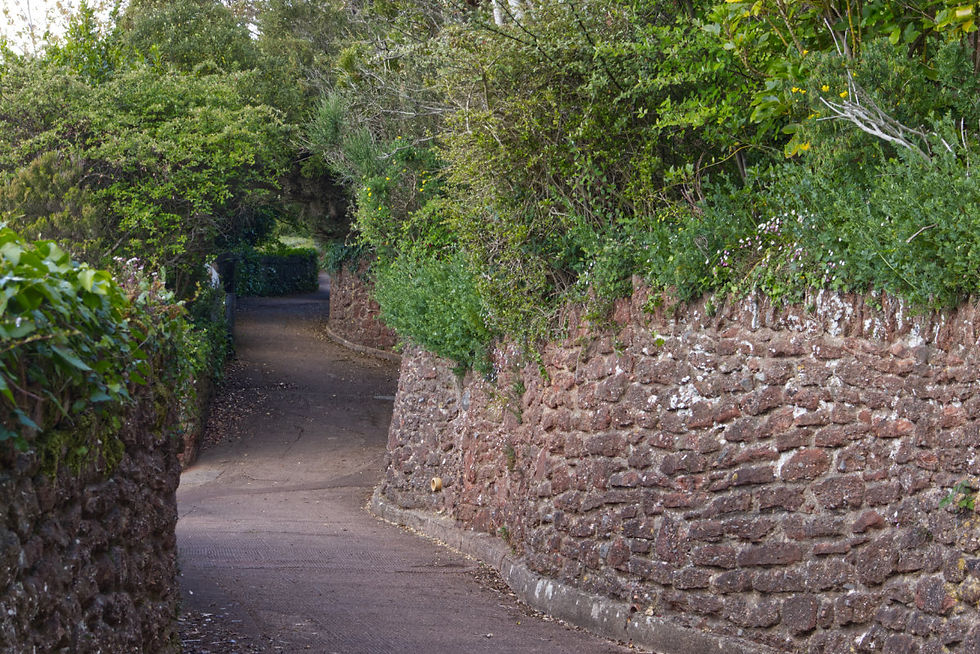
The erosion prevention scheme with its associated cliff garden eventually led to the extension of the sea wall and the creation of the park that still exists today behind the sea wall. This extension was needed to replace the access paths along the front to Paignton over the hill. These had already been damaged by the sea. The scheme was then further extended to Goodrington South Sands.
Western Morning News - Saturday 23 May 1936
The construction of this wonderful park is a portion of the Goodrington Development Scheme, which was commenced in 1929 with works of cliff protection on the southern side of Roundham Head. This work was necessitated by the erosion of the cliffs.
A sea wall was completed in June, 1931, and a promenade and cliff walks have now been built and finished with a coloured cement to harmonize with the natural cliff colouring.

Western Morning News - Thursday 15 August 1935
Paignton's £50,000 Scheme
CHILDREN PLAY WHERE MOSQUITOES ONCE THRIVED
Mosquitoes and flies used to breed in a swampland at Goodrington. Paignton, three months ago. This, unfortunately, was near Paignton's new residential area and the fine stretch of beach which extends southwards beyond Roundham Head.
Now that swampland is a garden in which ornamental ponds are graced by swans and miniature yachts. The marshy grassland, useless for building or other purposes, has undergone a complete metamorphosis. A desert has been transformed into a garden of lakes and flowers.
An important part of the scheme was the construction of the cliff garden and promenade. Sandstone cliffs at Roundham Head, which are 100 feet high, were being destroyed by erosion and there were frequent landslides. It was feared that in the course of time even the pleasure grounds on the cliff top would disappear.
CLIFF REINFORCED.
The cliff was reinforced, and paths and gardens constructed on its least inclined surfaces. Beneath, a sea wall was built, and this, coloured red like the cliffs, forms one of the most pleasant promenades on this Devon shore. It is capable of accommodating bands and audiences for swimming galas.
Before this work was completed over 80,000 tons of rock had to be removed, but in recompense for this task the fine Goodrington promenade assumed shape. It is over 300 yards in length, and may in the near future be extended around the cliff to make a continuous promenade linking up with the Paignton sea front.
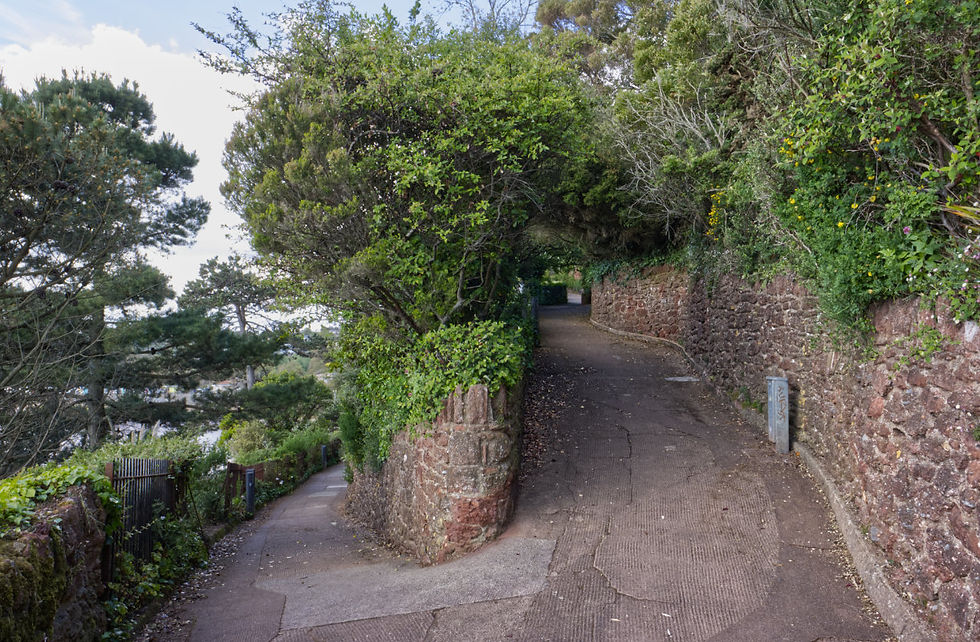
As far back as 1911 a report by the Royal Commission on Coast Erosion and Afforestation, mentioned Goodrington in connection with Torbay and the problems already being experienced at nearby Preston and Paignton where efforts had increasingly been made to stop sand and shingle removal from the beaches which was a noted problem. The report also mentions the notorious case of Hallsands further down the coast where beach levels had dropped 19 feet after 650,000 tons of shingle had been extracted from Start Bay.
"In Tor Bay, which is exceptionally shallow, erosion is taking place at Hollicombe Sands
and on the foreshore at Goodrington and Preston, near Paignton, and is alleged to have
been caused to a great extent by the removal of sand and shingle from the beach." Exeter Flying Post - Saturday 01 July 1911
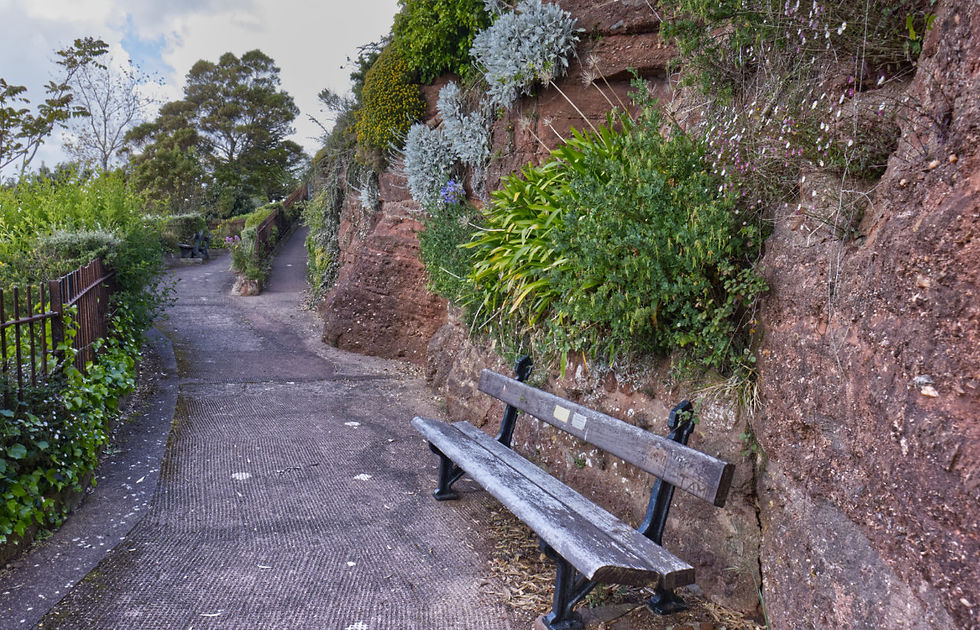
Today the Torbay Palm is synonymous with the so called English Riviera. Back in the 1920's a palm, in common parlance, was also a title given in honour. It was also a time when newspaper journalists waxed lyrical, using poetical descriptions in their work.
Western Morning News - Thursday 06 September 1928
Undoubtedly the palm for sheer beauty must go to Goodrington. Railway halts, constructed this year, enable passengers to step right on to the beaches there and at Broadsands.
Throughout a summer's day bathing girls disport themselves among the rocks, in the sea-hollowed caves, or on the sands, and chubby little imps run to and fro among their crumbling sand castles, so unstable that they dissolve into an unrecognizable mass with the first gentle lick of the incoming tide. They are as ephemeral as those castles-in-the-air- the hopes and aspirations of the elders - before Providence or an immutable and unrelenting Fate.
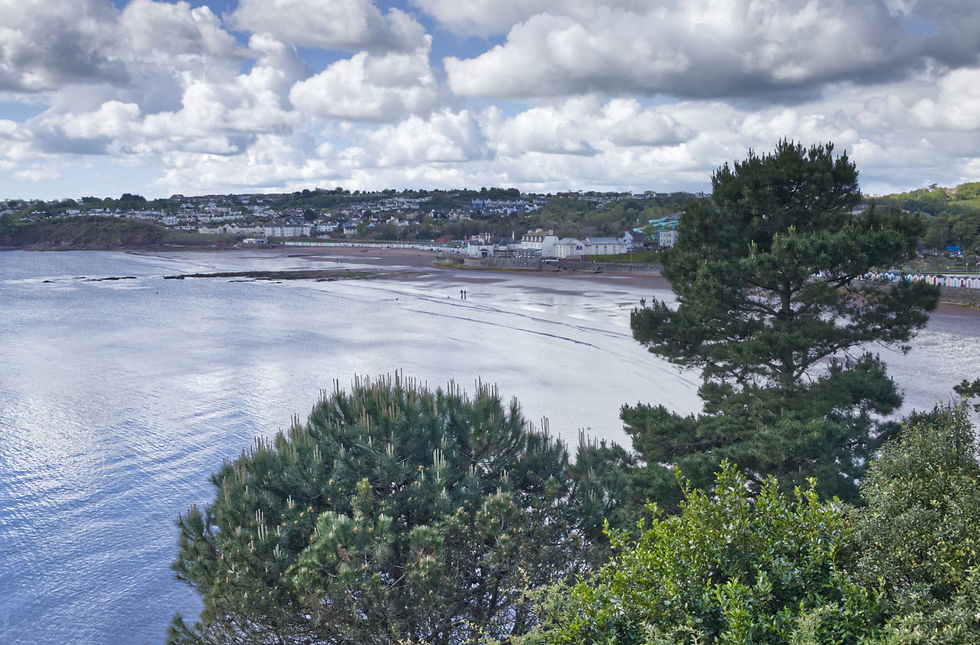
Torquay Times and South Devon Advertiser - Friday 04 September 1931
NEW CLIFF GARDENS AT PAIGNTON
The new Cliff Gardens and Promenade at Roundham Head, Paignton, are rapidly nearing completion, and all being well the official opening will take place in September.
From a stretch of gaunt ragged cliffs the Paignton Council, at a cost of £20,000, have converted the site into a series of delightful terraces and gardens. It has been a marvellous transformation, and reflects great credit upon the town's Engineer and Surveyor, Mr. F. Ralph Penwill, who is responsible for the carrying out of the scheme.
Everything has been designed with the view of giving the utmost pleasure to the public, and to this end no expense has been spared. From the top of the headland to the promenade below six sets of gradually winding steps lead down on so easy a gradient that invalids or elderly people can descend or ascend without difficulty. In addition, there will be flights of steps from the top to the bottom of the cliffs, giving quick access to those who are more agile. The paths are finished in a red non-slippery material to harmonise with the general colouring of the cliffs and to prevent eye-strain, which would have been the inevitable result of the glare of the summer sun in this quarter. The paths are all protected by green painted railings, and all other artificial work is in red conglomerated rock.

By 1933 the "New Cliff Walk" was already a local attraction and was being used to promote a hotel.
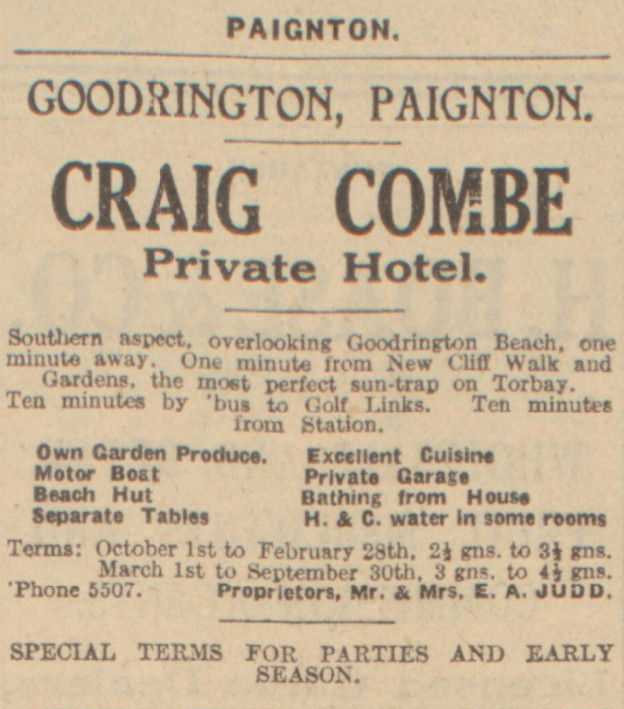

Paignton Observer and Echo - Thursday 11 February 1932
PRAISE FOR CLIFF GARDENS
[To the Editor, " Paignton Observer."]
SIR,-It is so often the case that any developments contemplated, or in course of construction by a Council, is advertised so well before hand by many critics, often of the arm-chair variety, whose practical activities in progressive enterprise are as limited as their views, that when the achievement is completed, if it actually survives the judgment which the critic metes out, that nothing more is said or heard of the achievement, even though it be so important a one as that so wonderfully achieved at Goodrington.......
.....We decided to take a walk to see this new enterprise one day last week. To say that we were amazed and delighted, is putting the matter very mildly. We were proud to think that Paignton possessed someone of courage and large vision to conceive and complete in the way it has been done, for the future of Paignton, such a magnificent improvement.
The rock has been so cut away as to produce the effect of a huge amphitheatre with the promenade overlooking the beautiful sands of Goodrington. Looking up from the promenade, which is wide and spacious, the innumerable terraced walks at various gradients winding up to the top of the Cliff, add to this effect. The paths themselves are artistically made and the face of the cliff has been made into wave-like faces, creating a most artistic effect as the paths follow these recesses, which also has been made good use of by the gardeners for pockets for growing rock flowering plants, flowers and shrubs. One can imagine, when these plants are fully grown, no more delightful a spot.

Torquay Times and South Devon Advertiser - Friday 01 April 1932
The new Cliff Garden and Promenade at Goodrington was another big attraction to both residents and visitors who took the opportunity of inspecting the beautiful display of shrubs, trees and plants which include many rare specimens, the gift of Mr. H. Whitley from his well-known botanical gardens.

The beach huts or as they were first intended, changing huts, nearly never arrived. In 1932 Mr. Hunter Joy as President of the Chamber of Commerce spoke after his re-election.
Torquay Times and South Devon Advertiser - Friday 22 April 1932
CRITICISM OF PROVISION OF BATHING HUTS AT CLIFF GARDENS.
Some time ago, operations were commenced for blowing down the cliffs at Goodrington, and then, of course, the fat was in the fire. People were annoyed, and they saw ruin and devastation staring them in the face, but work had to be seen when it was finished, to be appreciated. The Goodrington cliff now was a triumph, and was one of the finest pieces of work which the town had done.
He had heard the other day, however, a suggestion that bathing huts should be erected at the font of the Cliff Gardens. Did they think it was dignified or that it was necessary for that beautiful promenade to he used for bathing huts for the convenience of alfresco diners-out, etc .? He suggested that if the Council really intended to do that, he hoped they would think again.

It may surprise readers of this post to discover that nude bathing in the sea was relatively commonplace as far back as 1878. So common in fact that laws were increasingly considered necessary to prevent people, I am assuming almost exclusively men, from revealing themselves to others inadvertently, as the seaside became more heavily populated and urbanised. The existing law at that time only applied to bathing machines.
Exeter and Plymouth Gazette Daily Telegrams - Thursday 11 July 1878
BATHING IN PUBLIC
We imagine that no one who has had occasion to look into the subject will deny that the laws which regulate public bathing in the open air require amending. The Public Health Act for this purpose is defective, and although "local authorities " all round the coast have issued many orders regulating the "beach " within their districts, it would seem that they have no power to enforce them to the necessary extent.
The local authorities at Paignton some time ago made by-laws to regulate the bathing on Goodrington Sands, but they had to be informed that by the terms of Section 69 of the 10th and 11th Vict., cap. 89, the scope is limited to the regulation of public bathing in connection with the use of bathing machines......
....and we find that any person being a traveller, or any resident on the English coast, may object to any other person divesting himself of his clothing within the range of vision from the highway or from the windows of a domicile. And the traveller, the lodger, or the house-holder may do more than object-he may prosecute the offender for a misdemeanour. It matters nothing that the person who intends to bathe exhibits the greatest delicacy while divesting himself of his clothing, nor that he enters the water with the greatest rapidity, for the law is the offspring of civilization, and disapproves of "man" in a state of nature, and will protect any person from being compelled to study the "nude" if he objects to the exhibition.
As far back as the reign of George III a notorious case revolved around the actions of a Mr. Crunden. Mr. Crunden had always bathed in the same spot until a house was erected, from where the new home owner could see him bathing. The defence argued that the house had come to the "nuisance" for bathing was older than it's erection. (Forgive me that one)
The judge in the case laughed off the defence and Mr. Crunden had to cease and desist. We don't know if he bathed elsewhere or covered up. Apparently though, the real problem was the "uneducated Englishmen". Some things never change, it seems, for the ruling classes, who still think "uneducated Englishmen" are our major threat, even today.
It would be no hardship to require all bathers and swimmers to wear drawers. It is very doubtful whether a "request" to this effect would be attended to in many parts of England. The wearing of a bathing dress is considered "foreign" and "outlandish" by hosts of uneducated Englishmen, and they hate innovation. Yet it is hard that the comfort of a seaside place should be spoilt by indecency.
Was this an early example of the gentrification of the seaside, where the "uneducated" had happily frolicked in the nude until the genteel city dwellers started arriving in their droves, courtesy of the railway? I am guessing that the rural poor in 1878 probably considered wasting good money on a costume designed to get you 30 feet across a beach, only to get wet, was probably more of a luxury than a necessity. The average "uneducated Englishman" back then was in today's money earning 75 pence a week.

The new cliff garden, sea wall and promenades eventually cost a total of £74,000, the sum today of about £3.7 million.
War Cry - Saturday 27 June 1936
Paignton's New Amenities
Gardens, Park, and Promenades Cost £54,000
Cliff Gardens and promenades are among the new amenities provided for the enjoyment of future visitors to Paignton. Cliff Gardens, Goodrington Park, and promenades have been completed at a cost of £54,000 in addition to £20,000 spent in the purchase of land.
Cliff Gardens have been made where an overhanging cliff was broken down. A new rock walk leads to a new promenade, which is in the most sheltered spot on Paignton's three-mile coast line. The new promenades extend to the length of three-quarters of a mile.
Goodrington Park stands on what was formerly marsh-land. The Park Gardens will be flood-lit at night.


Paignton Observer and Echo - Thursday 30 April 1936
MAKING PAIGNTON BRIGHTER
Scheme For Illuminating Goodrington
FLOOD-LIGHTING CLIFF WALK.
Paignton Sea Front and Goodrington are to be much brighter at night during the coming summer than ever they have been before.
It will be remembered that last week the Paignton Observer reported the remarks of the Chairman of Directors of the Paignton Electric Light and Power Company, which referred to the scheme for the ornamental lighting at Goodrington.
This week the scheme was outlined to a Paignton Observer representative by Mr. A. E. Baker, the manager of the company.
The principal feature of the scheme will be the flood-lighting of Goodrington Cliff Gardens. Powerful lamps are to be placed in a line in the flower-beds at the foot of the cliff walk, illuminating the whole surface of the cliff.

I mentioned above that Mr. H. Whitley famed for his botanical gardens donated the exotic plants to the scheme. Mr. Whitley also owned the Primley Zoological Gardens which later became Paignton Zoo. He made news in 1939 too when one of his exhibits with four legs escaped.
The infamous escaped leopard from Primley Zoo was a 3-year-old Indian leopard named Ben, who escaped in January 1939.The leopard attacked an assistant keeper and escaped through an open door. The leopard never reached the Cliff Gardens, but would probably have felt very at home in its lush undergrowth. After a week on the loose on the zoo's large estate, the animal was tracked down and shot dead in some laurel bushes by an army marksman.

Herbert Whitley seen here sporting a rather exotic looking orchid was an English animal breeder who had a passion for breeding animals and plants, especially those blue in colour.
The size of his private collection led him to open to the public as Primley Zoological Gardens. He had repeated clashes with the Inland Revenue over his refusal to collect "entertainment tax" on tickets to the site, which he believed to be educational rather than an entertainment, and this twice led him to close the zoo to the public for extended periods. It finally reopened permanently after the Second World War, and became known as Paignton Zoo. Wikipedia



By 1938, swimmers were very definitely wearing a bathing costume or this one would have needed to borrow more than a coat.
Paignton Observer and Echo - Thursday 16 June 1938
BRIXHAM TO GOODRINGTON IN JUST OVER HOUR.
Imagine the surprise of a Goodrington beach attendant on Monday afternoon when a man in a bathing costume and covered in grease walked up to him and asked to borrow a comb and an old coat.
With visions of a successful (or unsuccessful) Channel swim, the attendant enquired the reason for the request and discovered the swimmer was one of the crew of H.M.S. Northampton, a sloop lying off Brixham Harbour, off which he had dived and swum to the Cliff Promenade, Goodrington.
The sailor left the boat at 3.40 and reached land-a distance of about three miles-at 4.50. He asked for the loan of the coat that he might catch the 'bus back to Brixham. How he paid the fare is not known, but trust Jack to tell a pretty good tale !


Comments