The Liver Building

This post is a snapshot of history, in a time of great change, and also turned out to be a memorial to those who died making this icon of the age.
I'm in Liverpool again, for medical reasons, and doing some touristy bits in between, so we found ourselves doing a tour of the iconic Liver building. In case you are not aware, the building is Liver as in Diver, while Liverpool the city, is Liver as in Giver. That's English for you. They both derive from a mythical bird though, more on that later.
I would also like to sneak in here, with a thank you to all the staff of the St. Paul's Eye Unit, University Hospital of Liverpool for saving my life exactly a year ago today.

This building has the accolade of being Europe's first sky scraper. It is 167 feet to the main roof, with spires reaching 322 feet. The Royal Liver Building to give it its full name is a Grade I listed building in Liverpool, England. It is located at the Pier Head and along with the neighbouring Cunard Building and Port of Liverpool Building is one of Liverpool's Three Graces, which line the city's waterfront. It was also part of Liverpool's formerly UNESCO-designated World Heritage Maritime Mercantile City.
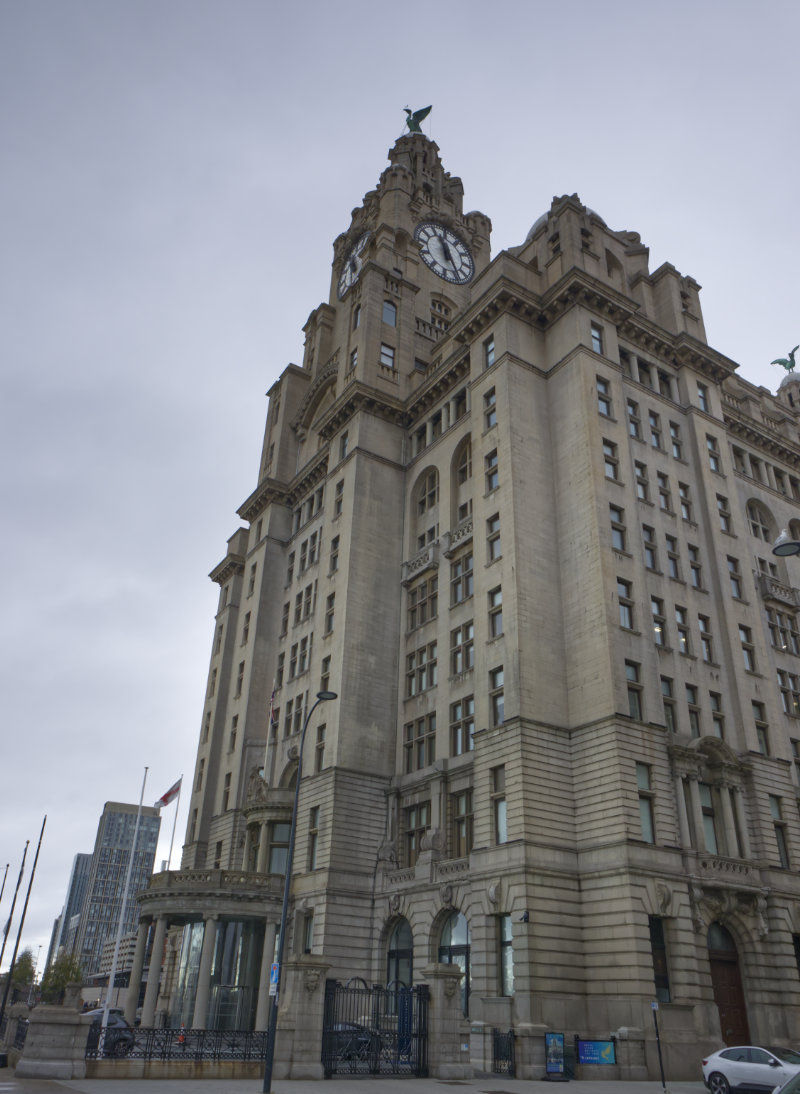
Yorkshire Post and Leeds Intelligencer - Tuesday 12 May 1908
THE NEW ROYAL LIVER OFFICES AT LIVERPOOL.
Lord Stanley of Alderley, as one of the trustees of the Royal Liver Friendly Society, yesterday visited Liverpool to lay the foundation-stone of the magnificent pile of buildings to be erected on the Pierhead for the new chief offices of the Society - buildings of steel and granite, covering an area of one and a quarter acres, rising in ten storeys to a height of 146ft., with two flanking towers 200ft., above the ground. The site was purchased by the Society from the Corporation for £70,000. It is calculated that when the offices are occupied the city will reap an annual income in rates of £10,000.
The Liverpool Lyver Burial Society was founded by a group of working men from Liverpool in the Lyver Inn on 24 July 1850 to "provide for the decent interment of deceased members". By 1857 the Society had moved to its fourth head office and had expanded throughout the United Kingdom. By the end of the 1890s a decision was taken to build what would become the Royal Liver Building; it opened on 19 July 1911. Wikipedia
The first mention I can find in the newspaper archive of the new society was a year later, and there were some tongue in cheek observations about it too, which is interesting. Fireworks and celebrations were being frowned upon as unseemly for a burial society and there was not a little tasteless sarcasm.
The Era - Sunday 24 August 1851
ZOOLOGICAL GARDENS .- The Liver Burial Society's fete and gala took place on Tuesday before several thousand spectators. The amusements were many and varied, though, to our thinking, somewhat out of place. Much merriment was excited by the closing tableau,
when was exhibited, amidst a blaze of splendid fireworks, the words, " Success to the Liver Burial Society." The effect of this scene would have been greatly enhanced by the committee appearing in hatbands and scarfs, and still more so, if they could have provided a few sepulchral figures, attired in white, to have glided about the Gardens amidst the festive throng......

The Dublin Builder - Saturday 27 June 1908
THE NEW ROYAL LIVER BUILDING AT LIVERPOOL
........In boldness of construction and hugeness of size it will compare favourably with the average sky-scraper erected by our American cousins on the other side of the Atlantic. That this is so, as to the capacity of the building, can be realised from the fact that there are twelve acres of floor space in the building......
.......The building itself will cover an area of about 5,970 square yards, the overall dimensions being 301 feet long by 176 feet wide. Above the pavement level there will be 10 storeys, with 4 additional storeys in each of the two great towers at either end of the building. There will also be a deep basement below the ground level, which will be lighted by large areas. Internally the structure itself will be lighted by two light wells, each 65 feet square. The main body of the building, namely, ten storeys, will rise to a height of 170 feet from the ground, while the height from the pavement to the top of the main dome will be 290 feet. It will thus be one of the highest buildings in these countries.....

cont'd........The foundations have already been put in by Messrs. Wm. Brown and Sons, of Salford. They consist of immense concrete piers carried down to sandstone rock, at an average depth of 25ft. below the basement floor, and vary in size, according to the load they are calculated to carry. The excavations were sunk down through clay and gravel, ordinary timbering being used, until the rock was found. Concrete filling was then commenced, and most of the timber withdrawn in stages as the piers were formed. Some trouble was caused by water at high tides, but not sufficient to stop the work........
......The building will be principally interesting on account of the method of construction, which will be in reinforced concrete on the "Hennebique" system. This will be the largest building, so far, constructed on this system, and an idea of its immensity may be gauged from the fact that some of the columns are calculated to carry a load of 1,270 tons, while some of the reinforced wall piers are over 25 superficial feet in cross section. The outside of the building will be faced with grey granite, more than 25,000 tons being required.......
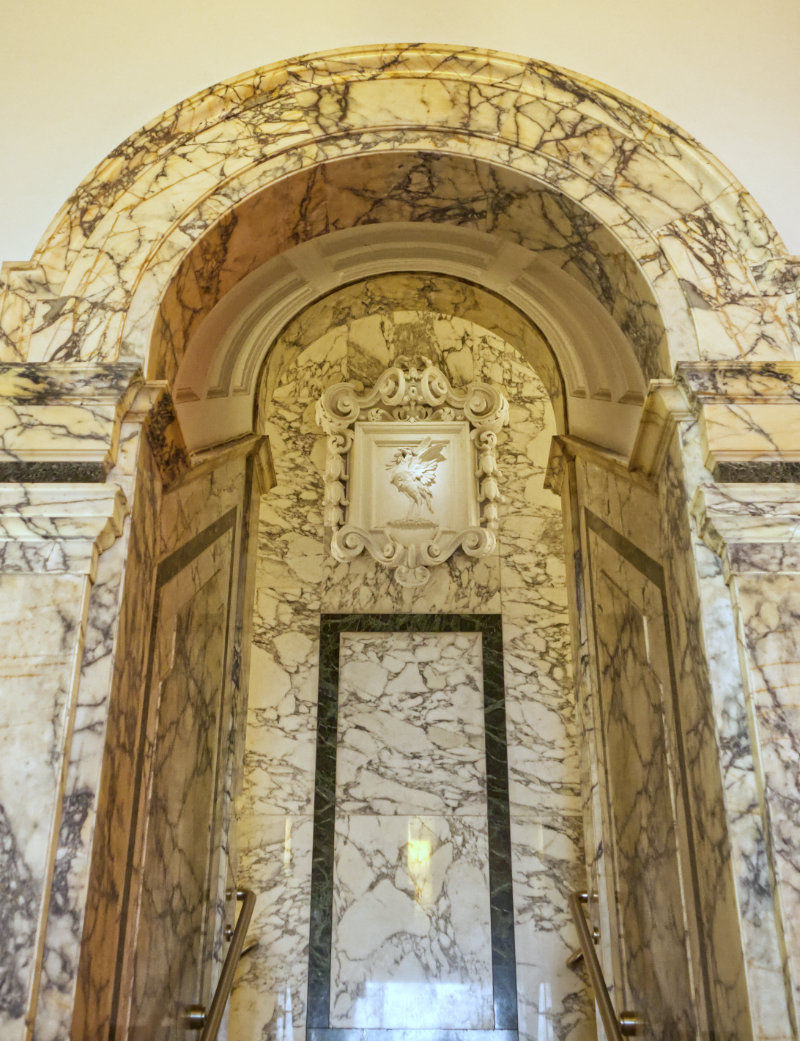
cont'd....There will be 16 electric lifts in the building, two of which will be for goods only. Four of the passenger lifts will be of the express type, running at a high speed, serving the upper floors, on which will be situated the society's offices. One of the express lifts will also serve the clock tower. The estimated cost of the building will be (including the price of the land) about £400,000. It is anticipated that it will be ready for occupation at the end of 1910, and will be used as an office building, the Royal Liver Friendly Society occupying two of the upper floors. The architect is Mr. W. Aubrey Thomas, State Insurance Buildings, Dale Street, Liverpool.......
It is worth remembering, that at this time, even in America, the height of buildings had been limited not by construction techniques but by the availability of elevator or lift technology. Much was made in this case of the huge advances made in lifts.

The origins of the Liver bird are lost in time, so many theories abound. The borough of Liverpool was founded in 1207 by King John giving the town certain rights and privileges. Liverpool's ancient seal is thought to date from this time and that seal depicted a generic bird thought to be an eagle, holding a sprig in its beak. By the 17th century the bird's true identity had been forgotten and it was commonly interpreted as a cormorant or "lever".
In 1611 the municipal records describe the mayor receiving a plate "marked with the Cormorant, the Townes Armes", while in 1668 the Earl of Derby gifted the town a silver-gilt mace engraved with a "leaver". In his 1688 work The Academie of Armorie, Randle Holme records the arms of Liverpool as a blue "lever" upon a silver field. Wikipedia
It was not until 1796 that the city's coat of arms was formalised after a request from the Mayor to the College of Arms. His request calls the bird "a lever or sea cormorant". The arms were granted on 22nd March 1797.
The story of the Liver Birds continued to evolve even after the Liver building was constructed, when the two Liver Birds that perched on top acquired the nicknames Bertie and Bella. Bertie is said to look out over the city while Bella looks out to sea. The two copper giants were designed by Carl Bernard Bartels and constructed by the Bromsgrove Guild of Applied Arts.

The Bromsgrove Guild of Applied Arts (1898–1966) was a company of modern artists and designers associated with the Arts and Crafts Movement, but which also embraced other major design motifs. Founded by Walter Gilbert, the guild worked in metal, wood, plaster, bronze, tapestry, glass and other mediums. The Guild received a Royal Warrant in 1908. The Guild's most famous works on public display are the main gates of Buckingham Palace. Wikipedia

The penalty clause built in and added by hand is an interesting highlight. £20 per week amounts to about £1500 per week today.

The building was refurbished in 2008, with some original infrastructure features left behind as interesting artefacts of its history.
The building remained the head office for Royal Liver Assurance until its merger with Royal London Group in 2011. In October 2016, the building was put up for sale for the first time in its history.
In 2019, as part of a larger repositioning of the building, a visitor attraction was opened giving the public the chance to tour the West Clock Tower of the building on a regular basis for the first time in its then 108 year history. Previously this had only been open to the public during Heritage Open Days, which have been running during September each year since 1994.
The Liver Building was sold again in 2025, with long-term tenant Princes Group purchasing the building for £60 million.


Within nine years the society had 100,000 members and a Capital of £5,152, or £305,000 in todays value. That at a time when members were paying one penny a week into the scheme.

By 1900 and at a jubilee meeting at Hope Hall Liverpool it was announced that the Lord Mayor of Liverpool was now a member and the discussion was mainly about expansion into the colonies, specifically Australia and Canada. The company now had a surplus of £50,000.

Liverpool Daily Post - Wednesday 22 August 1906
ROYAL LIVER'S NEW OFFICES.
PORTION OF GEORGE'S DOCK
PURCHASED.
£70.000 FOR THE SITE.
We announced a few days ago that a portion of the site of the old George's Dock would shortly be sold to the Royal Liver Friendly Society as a site for proposed new offices. At a special meeting of the Corporation Estate Committee, yesterday, it was agreed to recommend the City Council to sell the northern portion of the old dock site-that area between Water-street continuation and St. Nicholas's place-containing about 6000 square yards, to the Royal Liver Friendly Society for £70,000........

The building uses a reinforced concrete frame, which was revolutionary at the time, with the granite serving as the outer skin.

Liverpool Journal of Commerce - Tuesday 01 November 1910
THE NEW ROYAL LIVER
BUILDING.
Masons' Strike.
SOME days ago a dozen or fourteen men engaged on the final work of the towers and turrets of the above building came out on strike. So far as this class of masonry goes the work is now at a standstill. Only a month or two is required to complete the tower.
The masons object to what they call unskilled men doing the pointing work of the building, but it is a question whether this class of work is in the category of a mason's duties. In London, according to a statement made at the building, the point has been decided against the masons. At any rate the men engaged to do the "pointing" are the same as were engaged to do a similar class of work at the Houses of Parliament and by the County Council at London Bridge.
It may be stated that the granite work was started in December, 1909, when the masons were engaged, and that the building has now been in course of erection for about three years.
Last week 554 men were engaged in various departments upon the building; and there have never been fewer than 450. Inside work is going on quickly, there being 154 plasterers, attended by 80 labourers, engaged. Many men are occupied in plumbing work, heating, gas, and electric supply preparations and installations. It is denied that any breach of the fair wages clause governing such affairs has occurred. It is understood that a deputation from the men will meet the committee of management of the Royal Liver Society to-day with regard to the dispute when it is hoped a settlement of the difficulty will be arrived at.

From the towers there are great views of the docks and waterfront. Here it was that large liners from America arrived and left transporting vast numbers of people. The people of Liverpool were rightly proud of the new icon rising fast, in full view of those arriving by sea.
Bolton Evening News - Friday 30 December 1910
One Better.
Of two passengers who arrived at Liverpool yesterday by one of the Atlantic liners one was
an American, who was making his first voyage across the big ferry. His companion was an
Englishman, who had been paying a very short visit to the States. True to type, the American
was boasting of all the great things his country was doing, and was finishing one of his best
efforts when he looked up and saw the new Royal Liver Buildings, "What's that?" he asked.
"Don't know," calmly replied the Englishman."It wasn't there when I came away three weeks
ago."-" Liverpool Courier."

While the upper floors were reserved for the Royal Liver Company itself, there were other companies to occupy the building, mostly in the fields of shipping. One such was The Pacific Railway Company.
Liverpool Journal of Commerce - Tuesday 01 August 1911
C.P.R. AND ITS NEW OFFICES
An Inspection at the Royal Liver
Building.
The removal of many well-known shipping companies to the Royal Liver Building continues to such an extent that the place is becoming rapidly a "hub" of maritime commerce. Most Liverpool people associated with shipping have heard with interest of the magnificent premises acquired in the building by the Canadian Pacific Railway Co.
Yesterday, representatives of the press had an opportunity of inspecting this great imperial
company's new home. Lettered bronze plates on either side of the main entrances on the north and south sides of the building guide the enquirer.
As one enters the offices through revolving doors of an unequal size, and so constructed as to form efficient wind barriers, one is struck by the vastness of the space and the suitable treatment that it has received. Each of the large windows is a scheme of decoration in itself. The upper portion of each window has the well-known red and white house flag of the C.P.R., whilst below, a rich decorative effect is achieved by the use of the arms of Canada and the various provinces, all portrayed in their true heraldic colours.
The extent of this company's business and its imperial ramifications necessitate a great deal of descriptive matter on the windows, which, being treated in burnished gold, forms a fine relief to the severity of the granite structure. The whole office is panelled to a height of eight feet in figured mahogany with heavy mouldings and general classic treatment of cornice pilasters. The Canadian method has been followed in the arrangement, the whole space being open to view, and as the various private offices have glass panelled screens a great effect of lightness is produced - a contrast with the English tradition, which prompts principals of a business to withdraw themselves into inaccessible and hidden shrines.

The class system was never far removed at this time, in fact as modernity intruded into everyday life, keeping a distinction between the classes became even more of a requirement, as this description of the Canadian Pacific offices continues......
The first class passengers have a waiting room and lounge, provided with luxurious settees and chairs, and all Canadian newspapers and magazines. The main counter provided for the second cabin passengers, freight, general and baggage departments, is of an unusual size, being 100 feet long, behind which the general traffic staff work at desks arranged in departmental battalions, the typists being located behind a long glass-panelled screen at the back of the office, whilst on the north side of the building are located the manager of steamship, marine, and victualling departments.
The C.P.R. have arranged exceptionally ample and elaborate accommodation for third class passengers, who have a comfortable and airy booking hall on the ground floor, with an entrance in the south portico of the main corridor in the building, whilst in the basement there are extensive waiting rooms with comfortable seats, writing desks, newspaper stands, large cloak-rooms, and lavatories, while a refreshment counter will be introduced, so enabling passengers arriving early on sailing morning to secure light refreshments at a nominal cost. It is safe to say that no other steamship company can offer such comfort and such exceptional office facilities to their third class passengers, and in elaborating these plans the company has added to the already high reputation it enjoys for the comfort and careful attention it extends to all classes of passengers travelling over its ocean and rail connections.

On our tour we had to ascend two areas by spiral staircase but when first built, the building was famous for its lifts or elevators.
Liverpool Journal of Commerce - Thursday 09 November 1911
THE SCIENCE OF LIFT
MAKING.
THE WORKING OF A GREAT
SYSTEM.
To say that the Royal Liver Building is unique is, of course, only repeating what has been upon everybody's lips of late. The more one is able, however, to look into some of its features the more clearly does evidence appear of the care and skill which has been bestowed by the Committee and their advisers upon the building and the thousand-and-one features it contains.
Recently we have had the pleasure of enquiring into the system of Lift Installations which has been adopted. This is, we presume, one of the features of the building which has attracted the interest, not only of all visitors, but of all experts in building design. The system is as unique as the building itself, and we are confident that it will in all directions be regarded as superior to anything in this country. No doubt a few remarks on the installation itself will be of interest to our readers.

It was realised that in a building of this magnitude, containing as it does nine floors, the first feature of the lift service must be efficiency. A service has therefore been arranged, consisting of so many lifts, that surely it must be quite impossible for any passenger at any time to suffer delay.
In the main corridor of the building there is a battery of no less than ten Passenger Lifts, five on each side. Some of these are used as Express Lifts, running at a speed of 400ft. per minute, and stop only at certain floors. Others that run at a slightly-reduced speed serve all floors as may be required by the passengers. In addition to these machines there are four Passenger Lifts situated at the Pierhead entrance. These are provided for the exclusive use of visitors and officials at the Offices of the Royal Liver Friendly Society.
At the opposite extremity of the block another Passenger Lift, and also a Goods Lift, working side by side, have been installed; these lifts carry on the service for the well-known Liverpool Club, whose premises are situated on the ninth floor.
Each of these lifts is operated by electricity, and all are of similar design and pattern; in fact, most parts of same are interchangeable. All the winding gears or machines are fixed overhead, directly above the lift wells in the most convenient positions, and the uninitiated visitor who enters the large motor house containing the machines for the ten Central Lifts may well be excused should he imagine he has stepped into an Electric Lighting Station.

On every floor there is a clever illuminated device attached to each lift, which shows at a glance the direction in which lift is travelling. The passenger is thereby enabled at once to see which lift will he the first to reach him, and time is thereby saved.
The cages of these lifts are each suspended by four highly flexible steel wire ropes, each of which is of more than sufficient strength to sustain the load with safety. The passenger is, however, a person whose safety must not depend entirely upon the construction and strength of a wire rope; ingenuity is therefore once more set to work to devise not one, but many, protective appliances from causing injury to those who will travel in these luxurious lifts.
For instance: Beneath each cage an elaborate safety gear is attached, and connected in such a way to the wire suspending ropes that should such an extraordinary thing as the breaking of these ropes occur, this safety gear would immediately come automatically into action........Another contrivance which is provided is specially worthy of description. This consists of a governor, which is so connected to the gearing that, should the speed of either of the machines for any unaccountable reason exceed that which it is intended to run at, the above described safety gear is brought automatically into action and slows down the speed at once.
Automatic stopping arrangements exist in duplicate at each end of the travel which slow-up and stop the lifts, so that safety is ensured even should the attendant fail to do his duty in stopping the machine, or anything untoward happen.
Obviously for a contract of this magnitude (which, by-the-by, is the largest ever placed for
Electric Passenger Lifts in one building in this country) there was very keen competition amongst the firms capable of dealing with it.
Liverpool Weekly Mercury - Saturday 25 February 1911

This area, now features modern services like air conditioning.

The four clocks, three on the west tower and one on the east tower were arranged to show one face in each direction and were originally named George clocks, because they were started at the precise time that King George V was crowned on 22 June 1911.
The Great George Liver Clock
Liverpool Echo - Thursday 25 May 1911
ROYAL LIVER CLOCK.
LARGEST IN THE WORLD.
The large four-dial electric turret clock now nearing completion in the two handsome towers of the new Royal Liver-buildings will be the largest electric clock in the world. Each of the four dials, which are situated 230 feet from the ground, is twenty-five feet in diameter. Each dial is built up in twenty-seven sections, and owing to a clever arrangement of the design the whole of the four dials have been cast from four patterns only, the design of the dial being such that the same patterns have been repeated around the dial. This arrangement naturally ensures uniformity and accuracy in the spacing.
On close examination it will be observed that the chaptering consists of twelve distinctive marks in lieu of numerals, as advocated by the late Lord Grimthorpe (the designer of Big Ben), which gives a clear reading of the time and is favoured for large clocks.......
cont'd.....Much curiosity is being exhibited as to the modus operandi-the practical method of working a large time-keeping instrument claiming, in fact, to be, as it virtually is, the wonder of the world in horology. The clock will, as already stated, be worked electrically and automatically from Greenwich Observatory. Although not generally known. Greenwich mean time is forwarded every morning to the Head Post office in Liverpool at ten o'clock, all telegraphic work being suspended a minute before the hour for the "time" message to pass.......

cont'd...... In future, a wire will be laid connecting the time wire at the General Post Office with the electric clock at the Liver-buildings, to which the current will be directly transmitted. The clock will thus not only instantly declare Greenwich mean time to the city and "the sea," but the current and the mechanism are so constructed that the current each day will correct any errors, fractional, of course, which may have occurred in the clock's time recording during the previous twenty-four hours.
This, too, will be automatically accomplished. It may also be stated as a wonderful feature of the electric clock that it will have an attachment, working automatically, which will switch on the light at night, when the clock is to be illuminated, and switch it off in the morning when day-light makes the hands readable.

The arrangements are so ingenious and perfect that the lighting and extinguishing operation will follow the natural order of the seasons, giving longer or shorter lighting hours according to the period of the year. When the clock is thoroughly finished in every way, structurally and electrically, the case will be "closed "-to speak, as it were, in household clock phraseology-and will not be touched again for thirty years. In other words it will "go" for thirty years without being "wound" or "set." At the end of these years, the estimate is that a variation of a quarter of an hour may have crept in. What is known as the "cams" will then be reset, and the clock will go on for another thirty years. Thus, from the time the clock has been started till the end of sixty years in its existence, it will only have been once reset.

Wells Journal - Thursday 06 October 1910
BIG BEN TAKES SECOND PLACE.
Liverpool is to have the largest clock in the Kingdom. Big Ben's dials are 22ft. 6in. in diameter ; those on the Royal Liver building will be 24ft. Big Ben requires the services of two men for five hours every other day in order that its great weights, weighing 21 tons, may be drawn up 160 feet to keep the clock going. Those weights occupy the whole of the centre of the Westminster tower, and they represent a grandfather clock on a tremendous scale. With Liverpool's new clock, however, affairs will be different. There will be no weights at all, and no enormous pendulum comparable to that of Big Ben. Instead, it will be an electric clock. It will not need winding at all, the only requisite being a steady supply of motive power.

Liverpool Echo - Friday 23 June 1911
LIVER CORONATION CLOCK.
STARTED YESTERDAY FOR THIRTY
YEARS' RUN.
The Liverpool celebrations at the crowning of George V. will be memorable to the citizens
of Liverpool in years to come. The inauguration of the huge timekeeper in the Royal Liver Friendly Society's new building at the Pierhead was attended yesterday by a representative body, including some of the chiefs of the society and a sprinkling of the general public. These assembled in the clock tower to the number of about forty or fifty, and looked a small assemblage indeed in such a place.......
......The inaugural ceremony was fixed for 1.40 p.m., when the great ceremony of crowning King George took place in Westminster Abbey. The arrangement as to time had been made through London with the Greenwich Observatory. Just before the function the Chairman, with his eye on an electrical timepiece, specially fixed for the occasion to time the start of the gigantic instrument, delivered a short address appropriate to the occasion. He said that he was about to set the largest electrical clock in the world going, and he did so in honour of their Majesties' Coronation (applause). Liverpool had ever been a loyal city, and it was only natural that the great society of which he was chairman. and which had its inception in Liverpool-less than sixty-two years ago- should contribute its quota, and so swell the
immense volume of expressions of goodwill towards the King and Queen (loud applause).
He hoped the reign of his Majesty would be a long and glorious one.

cont'd....The time to start the clock had now arrived, and the Chairman, turning to a lever, moved
it, and the great machinery at once began to revolve. Mr. Lewis, in performing the ceremony, said :- "In the name of God I turn on this clock to start on its thirty years' expedition."
As soon as the clock started, the chairman suggesting that it should be called "The Great George Liver Clock." expectant crowds outside raised a great cheer for the Coronation-syrens blew and tugs tooted, and everyone was in a state of almost frantic jubilation-the actual Coronation, of course, being the chief source of the popular outburst. Several verses of the National Anthem were then sung, and the proceedings terminated.
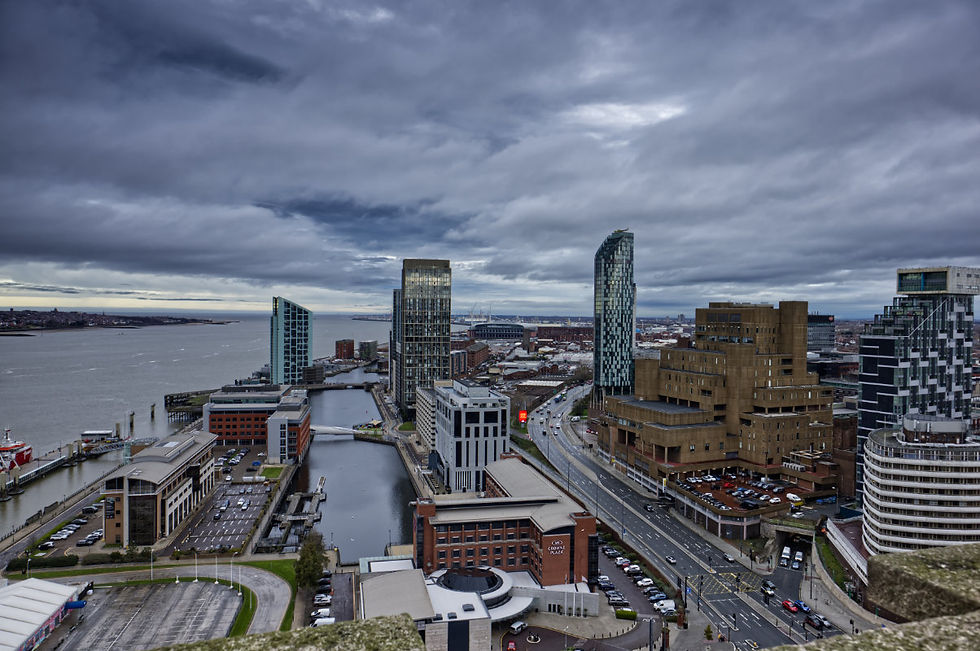

This is as close as our tour gets to the actual Liver Birds, a glimpse of a beak and twig.


Memorial
During the guided tour of the building there was some mention of the building methods used to construct it. Passing mention was made of safety systems on building sites of the day, remembering that the Royal Liver Company was in its origins a death benefit insurance business. Men dying during construction would therefore have been a sensitive issue. This piqued my interest about the question, "How many men died during the construction of the Liver Building?". Google offered only one man, in answer to that question, Herbert Crickmore. Our guide suggested that it was suspected the number was higher although nobody was really sure after 100 years.
Not being a conspiracy theorist but more of a realist, my suspicion was that because deaths on building sites at that time were not uncommon, that it was more likely to be a sign of the times that we don't have an accurate figure, rather than some sort of cover up.
Let's start with the fact that this was at the time Europe's first sky scraper, followed by the novel construction methods and the fact that there was little custom made safety equipment available. Photos of the workforce shows labourers on the site wearing ties and waistcoats and ordinary leather shoes. Ambulances were still horse drawn. This was the tallest building anyone working there would have ever seen, and even the Empire State Building in New York was not to be built for another twenty years.
I proceeded to do a detailed newspaper archive search for deaths associated with the building during the construction period 1908 - 1911. First, national newspapers which did not reveal much, but then a more targeted search in local papers in Liverpool. When I targeted the Liverpool Echo, the Liverpool Evening Express, the Liverpool Weekly Courier and the Liverpool Daily Post I was able to compile a list of seven men confirmed to have died on the site, including one man who was a carter, delivering timber, who met with an accident. Unsurprisingly all of the others including a 16 year old apprentice died due to falls from a great height. These were all confirmed by small articles listing the coroners reports. These were not headline news, one even being the final item in a newspaper. It is a sign of how safety in construction has improved that any of these incidents today would be front page news.
So here, possibly the only place you will see this information in one place, is a list of those confirmed to have died during the building of the Liver Building. Should anyone know different then please let me know.
Liverpool Weekly Courier - Saturday 10 October 1908
BOOTLE CARTER'S DEATH.
While unhooking a rope on a lorry loaded with timber at the new Royal Liver buildings, at the Pierhead, yesterday week, a carter named John Southward (33) of Bootle, was so badly injured by some planks falling upon him that he died in the Northern Hospital on Wednesday, as the result of a fractured skull. At the inquest at Liverpool Coroner's Court, yesterday, the jury returned a verdict of "Accidental death."
Liverpool Echo - Monday 07 December 1908
FATALITY AT THE NEW LIVER BUILDINGS.
Mr. Sampson, Liverpool city coroner, held an inquest, this afternoon; on the-body of Robert Fleming, twenty-one, a labourer, engaged at the new Royal Liver Buildings, at the Pierhead.
On Friday afternoon the deceased was engaged in working small waggons on the fourth storey, when he accidentally pushed one of them over the open lift, and both fell to the basement, a distance of 75ft The unfortunate man was killed almost instantaneously, the skull being badly fractured.
A verdict of "Accidental death" was returned.
Liverpool Weekly Courier - Saturday 27 February 1909
A FEARFUL FALL.
Accident at Royal Liver Buildings.
Mr. T. E. Sampson, Liverpool coroner, held an inquest on Tuesday on the body of a French ornamental plasterer, named Saint Marc, aged about 40, who belonged to Calais, and who for the last three or four months had been employed as a labourer on the erection of the Royal Liver buildings at the Pierhead. On the 15th inst., when the building had reached the sixth floor-about 120 feet above the basement-Saint Marc was engaged in spreading concrete round the top of a lift well. While he was standing with his back to the opening he seemed to overbalance and fell down to the basement. He was conveyed to the David Lewis Northern Hospital, dying on Monday morning from his injuries.
The Coroner remarked that considering the terrible height from which the man fell it was wonderful he had lived so long. The jury returned a verdict of "Accidental death."
Liverpool Daily Post - Friday 25 March 1910
FALL FROM THE LIVER
BUILDING.
SCAFFOLD FATALITY.
An inquiry touching the death of Herbert Crickmore (37). bricklayer, who lived at 121, Kilshaw street Liverpool, was held by the City Coroner, yesterday, at the Liverpool Coroner's Court.
The deceased was on Wednesday working on a scaffold of the Liver-buildings, in course of
erection at the Pierhead, the contractors being Messrs, Edmund Nuttall and Co. Two other workmen were also working with the deceased on the scaffold, which was on the ninth storey, and 150ft. from the ground. It was stated that two lots of bricks and mortar, weighing in all 5cwt., were also placed on the scaffold. The operations were carried out on the same lines which had been adopted throughout the whole of the building, 6in. spikes being driven through the cleet. It was stated that this arrangement was sufficiently strong to hold a much greater weight than was upon it. The foreman bricklayer declared that he had given instructions that no material should be placed upon the scaffold, but on a beam above it.
The scaffold gave way in the centre, and the deceased fell to the ground. He was picked up dead. The other two workmen had narrow escapes, and saved themselves by clinging to the woodwork until assistance arrived. It was stated that this was the first scaffold accident of the kind that had occurred during the operations in connection with the building, which was nearly completed.
The jury, in returning a verdict of" Accidental death ' expressed the opinion that bolts should be used instead of spikes.
Liverpool Echo - Wednesday 16 November 1910
LIVER BUILDINGS FATALITY
EVIDENCE AT THE INQUEST.
An inquest was held to-day at the Liverpool Coroner's Court, before Mr. T. E.
Sampson, on the body of Arthur Robert Perry, forty-seven, a foreman bricklayer, who lived at 7, St. Paul's-road, Seacombe.
The deceased was employed at the Royal Liver offices, in course of erection at the Pierhead. On Monday, while giving instructions to the men under him, who were bricksetting a hoist wall, he overbalanced and fell a distance of 144 feet. He was removed to the Northern Hospital, where he was found to be dead, his skull having been badly fractured. The deceased was a reliable and steady man. It was stated that it was impossible to have guarded the place where the deceased fell.
Mr. Fitt, engineer for Messrs. Nuttall, contractors for the building, expressed the sympathy of the firm with the widow in her bereavement.
A verdict of " Accidental death" was returned.
Crewe Guardian - Friday 18 November 1910
FATAL FALL AT THR ROYAL LIVER OFFICES.
FOREMAN FALLS 175 FEET.
On Monday afternoon a man named Arthur Terry, foreman, employed at the new offices of the Royal Liver Friendly Society, Liverpool, met with a shocking death. He was at the top of the building when he stepped back ward and fell down the well of the lift, a distance of about 175 feet. He was removed in the horse ambulance to the Northern Hospital, but on arrival at that institution life was found to be extinct.
Liverpool Evening Express - Wednesday 18 January 1911
APPRENTICE'S TERRIBLE FALL
Shocking; Accident at the Liver Building.
The Liverpool City Coroner (Mr. T. E. Sampson) to-day inquired into the circumstances attending the death of John Gavin (16). 87. Highgate-street, who met with his death on Monday by falling down the staircase well of the new Liver Buildings.
The father of the boy said that his son was with him in employment at the new Liver Buildings. The deceased, who was a plasterer's apprentice, had been working there for about three months. He was a healthy lad not given to giddiness or " larking. "On Monday morning he left his son at the foot of the staircase, but did not know which way his son went.
About a quarter of an hour later be was told somebody had fallen down the well, and he found it to be his son. His head was seriously injured. There was a temporary handrail on the staircase about three feet high, but with no upright. William Jackson, manager of the plastering company, stated that the deceased was a good lad and was quite accustomed to the staircase. There were no marks to show if the deceased had slipped.
John Henry Bates deposed that he was working on the seventh floor, and he saw the deceased mounting the stairs. When he last saw him he was at the bottom of the eighth floor and still going up the stairs. The handrail from that point upwards was quite sound, but the rail between the sixth and seventh floor was broken. There was nobody near the deceased when last seen. The rail must have been broken by deceased's fall. When picked up the youth's head was badly injured, and after first aid had been rendered he was taken to the Northern Hospital, but died soon afterwards.
In answer to a juryman, Mr. Fitt, resident engineer for the general contractors, stated that the rail was considered quite sufficient for temporary purposes. Mr. Eve, factory inspector, he believed, considered it satisfactory. The medical evidence was that death was due to a badly fractured skull. A verdict of " Accidental death " was returned.
Mr. J. H. Glover watched the case for the employers. He expressed their great regret at the unfortunate accident They did everything they possibly could to prevent such unfortunate occurrences.


Comments