Two Torquay Churches 2 The Building

It's a story about 19th century Torquay, the heyday of the English Riviera, when Torbay became the playground of Europe's High Society and the area was changed beyond all recognition in just a hundred years. There is scandal that shook the nation, pots of money, million pound artworks, sacrilegious ornaments, and a catastrophic thunderstorm, world famous artists, Lords, Bishops, yachts and diamonds, not to mention a brief appearance from Sir Andrew Lloyd-Webber.
This is the long awaited Part 2 of my Two Torquay Churches. Part 1 is here and features the Brutalist Central Church of 1976. This church couldn't really be more different to 1976 Brutalism, as it is High Victorian and High Church, as well as being perched high above the harbour on the centre of the Torquay seafront. The eagle symbol of St. John soared into the sky just as the church tower does today, guarding over the harbour
This is the little known jewel in the crown of peak Torquay Riviera wealth and splendour. It has a fine but modest exterior which gives little away about the treasures of art and design that lie within. It's full name is St John The Apostle, Torquay.

The church is situated high up a flight of stone steps for a reason, as Torquay is hemmed in on all sides by the sea and by cliffs behind. Building land is at a premium today as it was back in the 1800's. In fact as we'll see when we get inside the building the rock cliffs play a big part, situated as it is inside a former quarry.

No expense was spared on the architecture, decoration, furnishings and windows. We haven't even got inside and you can see that no element of the façade seen up close missed the artists touch and consideration. This isn't even the main entrance door.

Torquay Times and South Devon Advertiser - Friday 13 October 1905
Regarded externally, this sacred edifice may be described as the most attractive and imposing ecclesiastical fabric which Torquay possesses, and is a conspicuous object from the bay. Situated on a lofty eminence, from which it looks down upon the town, this nobly-proportioned Church, with its picturesque tower holds an extremely commanding position. St. John's is undoubtedly " High" church. and is considered one of the finest and most elaborate of the late G. E. Street's architectural creations, the style being Gothic of the first pointed period.
High church refers to Christian traditions—primarily Anglican, that emphasize high ceremony, liturgical worship, rich tradition, and sacramental theology. It prioritizes formal, prescribed orders of service, ornate vestments, incense, and priestly authority, often sharing similarities with Roman Catholic worship. That is where the trouble started.

The church is now a listed building and was designed by George Edmund Street, built between 1861 -1871. It replaced an earlier chapel on the same site opened in 1823.

This map, below, of 1802, shows the area still surrounded by farmland and woods but that was all to change in only a few decades as The "English Riviera" was born. At the time of this map the population of Torquay was 838. By 1860 it was nearer 16,000. The first period of rapid growth though was just about the time this map was made during the Napoleonic Wars when Torbay became the chief harbour for the English Navy. Navy officers chose this area to build their many villas, around the bay and in the hills above.
The birth of English tourism in the 1840's and the arrival of the railway in Torquay in 1848, saw Torbay adopted as the go to destination for those wanting to escape the noise and grime of the newly industrialised cities either to retire, to set up a new life, or just to escape for a week as the novel idea of the holiday took off.
World events were playing out in Europe, and the Franco Prussian War in the later 1800's was about to see the European elites flee the continent in search of political stability and safety. They packed up their homes on the French Riviera and chose Torbay which is where it acquired the nickname of the "English Riviera". This church was indeed fit for Royalty and there were plenty of assorted European Royals either visiting the area or setting up home, not to mention the occasional American multi-millionaire.

The church replaced an earlier one called Torquay Chapel consecrated in 1823, because the population as we have seen outgrew that church very quickly. There was also far more money around by this time, as we'll see later.

It was also around this time that major controversy hit the Church of England, the established Protestant church. It's time to mention Henry VIII again as I often do at this point in any church history, so influential was he. England was Protestant thanks to Henry, and Catholicism was considered highly suspect, even dangerous, for several hundred years. By the mid 1850's a movement called the Oxford Movement emerged. Also known as Tractarianism, it saw a growing sympathy with the church in Rome, which had been cut off centuries earlier by Henry. It was highly controversial and national news headlines were about to be made right here in Torquay.

Tractarianism, or the Oxford Movement, was a 19th-century (starting 1833) High Church Anglican movement aiming to renew the Church of England by reviving lost Catholic traditions, sacraments, and doctrine. The movement argued that the Anglican Church was a continuation of the ancient Catholic Church, not just a Protestant reformation.
In 1837 the Reverend WG Parks-Smith began his long incumbency of 33 years and it is this background that explains why this church came about, why it looks the way it does, and throws light on subsequent scandalous events that followed. The troubles began in the old Torquay Chapel and continued into the new church we see today.
The events that created that national scandal seem completely insignificant today in our contemporary society where the established church no longer carries the power that it once did.
Here is the main entrance, and that multitude of repeated arches is drawing you inside like a stone whirlpool.

After all the scandal that ensued was there Divine Intervention?
Dorset County Chronicle - Thursday 25 July 1867
TORQUAY.
DAMAGE TO A CHURCH BY LIGHTNING .
- During a severe thunderstorm which passed over this town on Tuesday week, St. John's Church, High Terrace, was struck by lightning, and a portion of that well-known edifice was destroyed. The church is in process of restoration, and a portion of the new chancel was completely wrecked, large stones being scattered over the road, and some even finding their way across the tops of the houses down to the Strand.

This is just the overture, the entrance porch, double height and urging you to crane your neck back to look up. This is the base of the tower, the last part of the church to be completed. The main church was finished by 1871 and by then Parks-Smith had fled to Brighton, never to return. The tower was completed in 1885. The memorial neon cross which shines out over Torquay at night was installed in 1955.

There are two bells in the tower, one of which is the original St John's Chapel bell. Above the inner door stands a statue representing St John himself. St. John the Evangelist is frequently depicted in Christian art in connection with an eagle, which serves as his primary symbol, and sometimes with an urn (chalice/cup) containing a serpent. These attributes highlight different facets of his life and theology.


Once inside the visitor does not know where to look first as every aspect of the interior vies for attention all at the same time. There is not a single feature or element that has not been touched by the architect or the artist. This is Anglo-Catholic Victorian Gothic at its finest and everything is of the choicest materials, including whole artists palettes of coloured Devonian marble. Italianate flourishes abound.
The Nave soars to a height of 56 feet with light flooding in from the clerestory (upper level) windows. It is 128 feet long and 58 feet wide.

In the chancel the groined roof is of warm Ham Hill and darker Caen stone.

The Chancel is divided from the Nave by a lofty brass archway with gates and marble screens. By James Leaver of Maidenhead.

The scandal started in the old chapel in 1847. This was clearly national news.
Derbyshire Advertiser and Journal - Friday 23 April 1847
An extraordinary exhibition was made on Sunday last, in St. John's Chapel, Torquay. The interior of the chapel was dressed with flowers, and other tawdry ornaments; and even the communion table-prepared of course for the administration of the Holy Sacrament was not exempt from the profanation; glass vases were placed on the table, and a cross, decked and covered with flowers, stood in the midst. The Bishop, who was present, testified his displeasure by removing the vases with his own hands, and we understand that he has directed legal proceedings to be instituted .- Western Luminary.
A contemporary account describes far more drama than is mentioned above.
"The Bishop lays hold of the two flower-pots exhibited on Easter Sunday 1847, and endeavours to take them down from the " altar.' They were fastened with a string so that he could not place them on the floor. He therefore chucked them over the back, and they hung dangling out of sight for the rest of the day. But he made no attempt to remove the cross-at least there is no record in the evidence of any attempt. The cross, however, now becomes the main subject of attack and the poor priest stands out as one who had outraged beyond endurance the patience of his Bishop. "
Two months later the Bishop announced his verdict on the case, and admonished the vicar and ordered that he pay the costs of the ecclesiastical trial that followed the incident. "Mr. Smith had agreed to abide by the decision of the Bishop without any further proceedings".

In case you ever wondered, this is what a church built in a quarry looks like when the architect chooses to boast of his accomplishment and show off the natural rock at the back of the church.


Although the north or rear wall of the church mirrors the south with matching window arches, here we see the ingenious solution to having no light, just a quarry wall. Where there would otherwise have been stained glass windows we see instead beautifully designed mosaics in the classical style which deliberately include much gold, which is intended to be a substitute for exterior light.

Six mosaics grace the church. These are the work of Antonio Salviati who was commissioned by the architect George Street to make these at his studio on the Venetian island of Murano. His work can also be seen in Westminster Abbey and Exeter College Oxford. The mosaics depict scenes from the life of St. John.

You can see his work here in Torquay if you don't want to visit his other commissions in St Paul's Cathedral, The Houses of Parliament, the Opera in Paris or the United States Senate.

High up near the roof where no viewer will ever get close, just my long lens, the details still continue, with marble pillars and stone flourishes. The nave walls are faced with irregular stones of varying shades placed in a "crazy paving" style. Even the roof itself is carved and inlaid, barrel vaulted divided into rectangles by bands inset with black pointed quatrefoils.

By 1864 St John's and its vicar were in trouble again. This time it was the ornament behind the altar in the new church. The Reredos, or decorative scene, included a crucifix. In 1864 this was a big problem. The established church of England did not display crucifixes, just plain crosses. The crucifix which includes the image of Christ on the cross was perceived as placing too much emphasis on Christ's suffering rather than his victory. The empty cross in the English church symbolised Christ's rising and salvation.
Suffolk Chronicle - Saturday 24 December 1864
The Bishop of Exeter has refused to license St. John's Church, Torquay, until a crucifix placed in the reredos is removed. The bishop states that several of the clergymen connected with this church have gone over to Rome, that the teaching and the ritual have given great offence to the parishioners, and that it will be wise for the present clergy to allay rather than to increase the irritation which prevails.
Apparently the problem was solved by adding the two other sufferers to the crucifixion scene. "either the bas-relief was removed or the crucifixion scene was fully represented by the addition of the other sufferers, so as to avoid the semblance of the Romish worship of the crucifix." In the event the two thieves, in marble, were set up either side of the figure of Christ, but as soon as the Bishop of Exeter died these it seems were removed.
The furnishings like the altars, pulpit and font were never going to escape the decoration, and every imaginable variation of local marble vies for the attention of the viewer, greens, reds, browns and creams.
The font is octagonal with inlaid marble and zig zag moulding.

The font cover is of wrought iron designed by A E Street, the son of the architect.

The Victorian obsession with ceramic floor tiles is raised up a notch with yet more added marble. The patterned tiles are Minton.

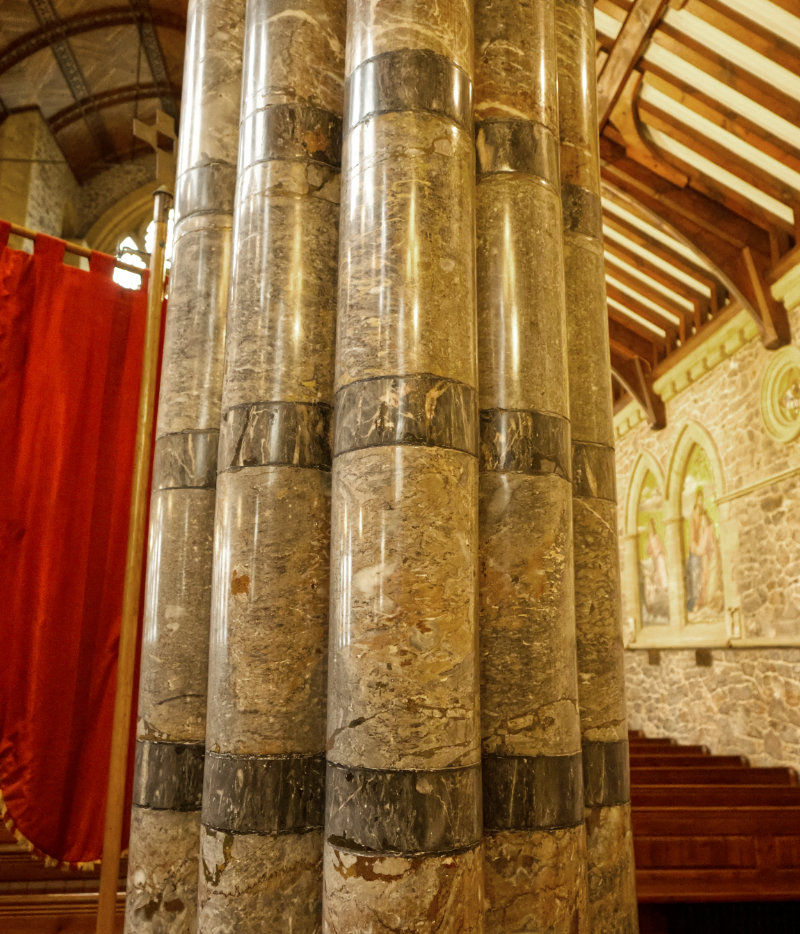
Let's have fluting on those piers and why not, let's have two different shades of marble. The expression "Less is more" had not yet been invented and this was very much "More is never enough". The piers are formed of clusters of eight shafts constructed of grey marble with black bands.
This is the altar in the north aisle and on the right is the pulpit. The pulpit is a comparatively simple affair for Street, consisting of a drum with inlaid marble patterns on the west and northwest faces only, standing on a wide stone base with marble shafts inset in the angles.

I mentioned earlier that the congregation at St. John's had money to spare, but they also had jewels to spare too.
Cornish Telegraph - Wednesday 02 February 1870
THE COLLECTION on Sunday evening at St. John's Church in Torquay after the Bishop's sermon amounted to £11 19s. It is also stated that two diamond rings were found among the offerings of the congregation.
This one collection was in today's terms worth £750.
By 1876 the money was pouring in.
Torquay Directory and South Devon Journal - Wednesday 20 September 1876
St. John's Church Torquay
There is an Offertory at every service, that everyone may have an opportunity of giving alms, secretly, and as a part of worship. The church is free and open in every part, at every service. It is open all day for private prayer. Visitors are entreated to remember that a church like this cannot be carried on, with its continual services, without great expense, and, as its benefits are freely thrown open to all, it is hoped that all will contribute to its support.' Our correspondent further informs us that the annual average amount of the Offertory for the last three years was £1,800. The church has accommodation for about 1,000 worshippers. It is full on Sundays and well attended on other occasions. The Offertory is collected in bags .-
This is the staggering sum in today's prices of £113,000 donated annually just in the collection plate. There were also bequests.
Margaret Dockray left £100 in her will to the church in 1881, worth £6600 today.

Pulpit detail. Devon Marble formed during the Carboniferous period, composed of marine life like corals, brachiopods, and crinoids. Primarily quarried near Petitor, Babbacombe, and other parts of South Devon. The industry developed rapidly, with major works established at Petitor in 1807, hitting peak production by the 1840s. Known for taking a high polish, making it a popular choice for ornamental, architectural, and decorative uses. Used for interior decoration, church, and school fittings, such as the pulpits and floors.
..... Mr. Harry Hems of Exeter, doubts whether Devonshire marbles, equally as rich in colour and texture, although vastly more economical, are not raised almost daily in the neighbour-*hoods of Torquay and Plymouth. He states, too, that the interiors of St. John's, Torquay, and All Saints', Babbacombe, are striking examples of what may be done with our local marbles, and declares that he knows few, if any, churches in Italy or elsewhere on the Continent, in which marble plays more successful parts than it does in these churches. Torquay Times and South Devon Advertiser 1905

Western Times - Saturday 02 May 1885
NEW TOWER FOR ST. JOHN'S CHURCH TORQUAY.
Special services were held at St. John's, Torquay, on Thursday on the occasion of the opening of the new tower. The Church was designed by the late Mr G E Street, R.A., and is in the transitional style from Early English to Early Decorated. It has been erected in portions at various times since 1863. The position is most picturesque and advantageous, the natural rock being available for foundations, &c, and the limestone for building the church.
The completion of the tower, consisting of the ringing chamber, belfry, &c., has been carried out by Mr A E Street, M A., the contractor being Mr Chubb, of Torquay, and Mr Ireson clerk of the works. The walling consists of limestone, and the dressed masonry of Ham Hill stone, The tower is finished with a saddle-back roof, the gables being enriched with tracery. The sides of the roof which is covered with slates have an open cusped parapet. Each angle of the tower has a fine pinnacle, and it is surmounted by a Iarge gilt weathercock. The cost of the recent addition amounts to £1,750, but by the time the whole of the works are completed and paid for the entire outlay will have reached about £2,000, of
which there is £375 to be raised. The opening service took place at five o'clock on Thursday afternoon in the church.

Seating around the sanctuary walls is not confined to the three-bay sedilia with trefoil-cusped arches supported on marble columns to the south, for there is an identical arrangement to the north and thereafter, shallow blank arches of similar size return along the E. wall to butt up against the reredos. English church architecture.

Paintings, I nearly forgot, there are paintings too, why not? With more gold of course, and more marble.
On the side walls of the chancel are two large figure paintings from the studio of Burne-Jones the famous Pre-Raphaelite artist. They were gifted to the church in 1889. Today we see the copies which replaced them as one of the main conditions of their controversial sale. The originals were auctioned at Sotheby's in 1989 to raise funds to save the Salviati mosaics which had suffered from water damage from the leaking roof.
The paintings were bought by Sir Andrew Lloyd-Webber and are now on display at the Carnegie Museum in Pittsburgh after he sold them in 1997. The larger than expected windfall raised for the church was used to set up a permanent fund to maintain the fabric of the building. Why Pittsburgh? Lloyd-Webber's first hit musical, Jesus Christ Superstar, had it's world premiere there in 1971.
Torbay Express and South Devon Echo - Wednesday 22 November 1989
VOLUNTEERS at a South Devon church were celebrating today after an astonishing £1.5 million windfall which shocked the London art world.
Two paintings which hung in the Church of St John the Apostle overlooking Torquay Harbour were sold last night by Sotheby's for a staggering £1,452,000.
Proceeds from the sale of the two oils by Victorian artist Sir Edward Burne-Jones will go to repair the crumbling church and its other art treasures.
Today the vicar the Rev Roger Beck was travelling home from the sale in London at which both paintings were bought by one anonymous bidder, unaware that his church was even richer than he thought.
The Rev Beck saw the paintings knocked down for a total of £1,320,000, and set off for home today unaware of an extra 10 per cent premium which will boost the figure by £132,000.
Speaking from his London hotel he revealed that he had cracked open a bottle of champagne last night with his solicitor and one of his churchwardens.
He said: "Besides being very happy of course, we were rather amazed and surprised at the amount.
"I understand it was a record for a Burne-Jones painting."
Mr Beck described how he and his colleagues were surprised by the speed of the sale, in which two dealers bid against one another for the first painting 'The King and the Shepherd', which was knocked down for £620,000.
The competition hotted up even more for the Nativity scene which was the next lot. It eventually went for £700,000. "We were pinching ourselves," said the vicar. "There was a certain unreality about it all."
Sotheby's had valued the paintings at between £180,000 and £250,000 each, and a reserve of £160,000 each had been set.

Gilded wrought iron and stained glass. The best artists of the time, in every field were all kept busy for the ten years it took to build.
A fine and particularly elaborate iron parclose screen, also designed by Street, fills the arches between the chancel and S. chapel, with each of its two sections being made up of three divisions. Made by James Leaver of Maidenhead.

In 1902 the former Liberal Prime Minister Lord Rosebery attended a service at the church.
Torquay Times and South Devon Advertiser - Friday 04 July 1902
LORD ROSEBERY AT TORQUAY.
AT ST. JOHN'S CHURCH.
On Saturday afternoon the beautiful steam yacht Zaida, a vessel of 350 tons, with Lord Rosebery on board, dropped anchor off the Haldon Pier and during the evening His Lordship was rowed into the harbour, landed, and took a short walk round the town. He was not generally recognised, but some few people who attended the great Liberal meeting at Newton which His Lordship addressed, remembered hie features and the news that Torquay had had a very distinguished visitor quickly spread. The Zaida remained at anchor during the night and on Sunday morning Lord Rosebery was again landed and attended service at St. John's Church, where the Vicar (the Rev. B. R. Airy) preached. At the conclusion of the service a small shower fell and His Lordship on leaving the Church hurried down to the pier and took a boat straight back to his yacht. About a quarter of an hour afterwards the Zaida weighed anchor and stood out of the Bay making for the eastward. The visit of Lord Rosebery was quite unexpected. His Lord ship is seeking rest and quiet after a rather busy time and he could not have selected a more suitable way of obtaining a restful holiday than by a cruise around the beautiful coast of Devon. His visit to Torquay recalls the fact that some of the last century's foremost statesmen frequently visited Torquay, amongst them Lord John Russell, Lord Palmerston and Lord Beaconsfield.
The Steam Yacht Zaida was a 350-ton twin-screw schooner built in 1900 by J.S. White and Co., Ltd. in Cowes, measuring approximately 150 feet in length. Owned by the Earl of Rosebery, she was a luxurious, seaworthy vessel used for extensive Mediterranean cruising before being utilized as an Auxiliary Patrol Yacht in the Royal Navy during World War I.

More marble, more angels.

Rev. Parks Smith successor was Canon Robinson and the Roman controversy continued, so I'll finish this piece with reference to a noted sermon of his in 1872, because of it's analogy of the nearby Slapton Ley to the Church of England, separated as he saw it by a narrow strip of land from the larger Catholic sea nearby. It's a significant description today given the Slapton Ley's increasingly fragile nature since it's recent damage due to government gravel extraction which started only twenty years after this sermon was preached.
The priest of St. .John's amusingly introduces a few thoughts which struck him when walking between Slapton Lea and the sea.....
Well ! Honorary Canon Robinson compares the fresh water lake at Slapton to the Church of England, and the "deep-voic'd neighbouring ocean," if we may venture to pluck a flower from Longfellow, to the Catholic Church, saying to her isolated Anglican sister, "Come and join us "-"Quod semper, quod ubique, quod ab omnibus." "But no!" the lake seemed to reply in its coldness, " we will not join you !"
Now really what does this amiable Honorary Canon mean? Is he prepared, if he could so prepare his people to throw the Church of Protestant England into the Papal See, to be re-bound by that despotism which required all the power of Henry the Eighth to sever ? of
whom Gray wrote-
"The majestic lord Who broke the bonds of Rome "

There is so much to see that I have made a separate post to show the best of the stained glass.
The east window is from designs by Sir E. Burne-Jones, and contains fine illustrations of angelic life, and, also representative characters of various orders of men and women who will be found in the New Jerusalem. This window is a very striking one, and its colouring very restful to the eye, both centre and side lights being memorial ones.

Birmingham Mail - Wednesday 01 September 1886
The death is announced of the Rev. William George Parks Smith of Brighton whom many of the elder generation will identify with the early Tractarian party in the diocese of the late Bishop Phillpotts. He was in the 83rd year of his age. Mr. Parks Smith held the vicarage of St. John's Church, Torquay, from 1839 down to 1870, when he resigned. In the early days of Tractarianism he exposed himself to great obloguy and even persecution by the introduction of the weekly offertory, musical services and celebrations, and floral decorations for the altar.


Comments