London Liverpool Street Station

The busiest railway station in Britain is one of the least well known nationally. We all remember the name from the Monopoly Board, but stations like Euston, Marylebone, and St Pancras are arguably more famous.
Liverpool Street Station is so busy because many different rail systems converge or pass through this one spot. It is an accident of history and geography.

It is the terminus of the West Anglia Main Line to Cambridge and Ely; the Great Eastern Main Line to Norwich; commuter trains serving east London and destinations in the East of England, including the Weaver line of the London Overground; and the Stansted Express service to Stansted Airport. New platforms for the Elizabeth line opened in 2022 as part of the Crossrail project. The tube station is now served by the Central, Circle, Hammersmith & City and Metropolitan lines. That is quite a complex conglomeration and therefore no surprise that about 98 million passengers use it every year.
Opened in 1874 it has undergone successive alterations and additions, as you can imagine, not the least of which was happening during my visit in July 2025, when these photos were taken.
When it was originally built, London was under assault by railway construction from every direction and this was the line that arrived from the east. Great Eastern Railway was a newly formed merger of some existing smaller companies and they wanted a new London terminus. They inherited a terminus at Shoreditch but that was too far out of the city. They had their eyes on a site near London Wall but the city authorities did not permit them to go that far south. If they had, it's likely the station would not exist today as that area was flattened by carpet bombing during the Blitz. You can see my posts on London Wall and the nearby Barbican which explain more about that. Ancient Liverpool Street was as far as the railway got into the city.

The name of the station is misleading, as the street and the station were not named after the city but after a Prime Minister. You could be fooled into thinking Liverpool Street was the road out of London, leading to Liverpool but in fact the street memorialises Robert Banks Jenkinson, 2nd Earl of Liverpool, Prime Minister, 8 June 1812 – 9 April 1827. Liverpool's fifteen years as prime minister saw his guiding Britain to victory in the Napoleonic Wars and ushering in a lasting post-war peace. The street was not new in 1829 when it got its new name as it traces its origin back to at least the 13th century.

The station was built on the site of the original Bethlem Royal Hospital, part of the 1247 priory that was right here. By 1403 the priory housed the mentally ill at the hospital which became known colloquially as "Bedlam". That hospital moved later to Moorfields which still exists.
There are two words that entered the English language, derived from lunatic asylums, both of which were mispronunciations of real place names.
Bedlam - Bedlam is a noun that refers to a scene, state, or place of extreme uproar, confusion, and chaos. The term originates from the popular, shortened name for the Bethlem Royal Hospital, a historically infamous psychiatric institution in London established in the 13th century.
Doolally - The British slang term doolally (meaning temporarily insane, eccentric, or crazy) originates from Deolali, a town in Maharashtra, India. During the British Raj, it was the site of a major military transit camp and sanatorium where soldiers awaited transport back home.

It's difficult to believe today but in the 1970s, the station was threatened with total demolition, but a public campaign saved it. It was heavily modernised in the 1980s, coinciding with the development of the Broadgate office complex.
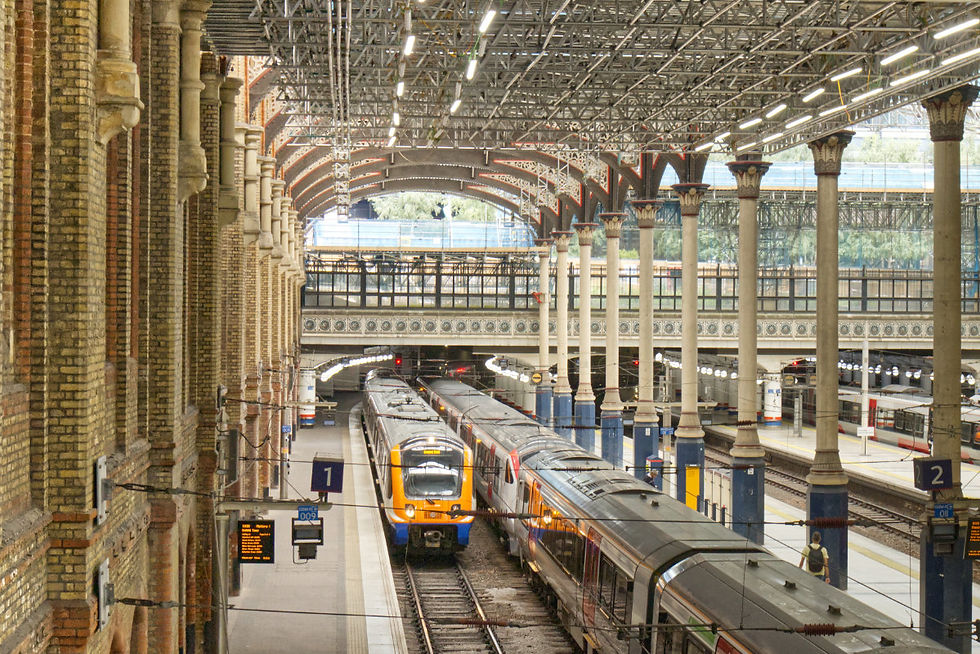
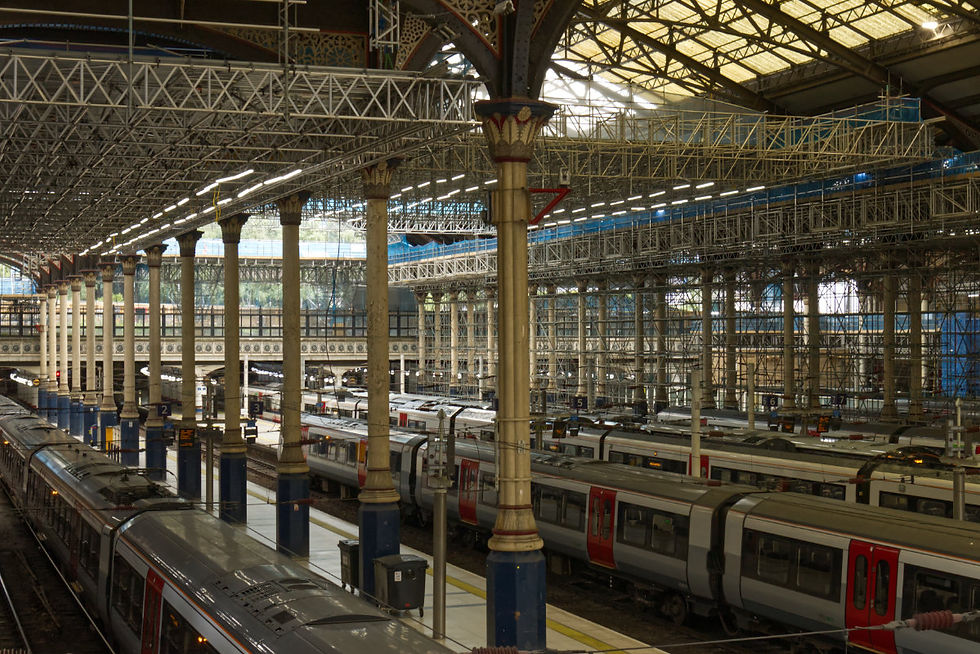
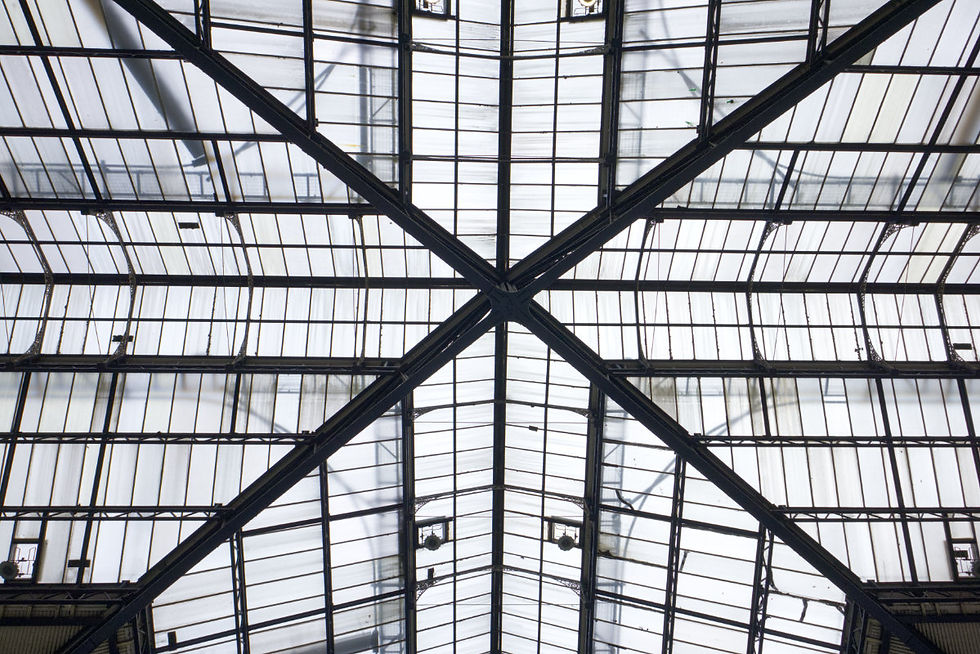
There is about to be more major change of the station, and part of that change was the cleaning of the roof, and changing of the roof panels which was underway on my visit. The scaffolding forests seen in some of these photos are temporary and the difference between the cleaned and renewed parts of the roof and the older parts is clear.

London Liverpool Street Station is undergoing a major £1.2 billion redevelopment plan to expand capacity and improve accessibility. The City of London planning committee approved the controversial project in February 2026. This follows months of revised proposals made during 2025 to address heritage and architectural objections.
Major parts of the plan will include a 76% increase in the concourse area, new lifts and escalators to create step free access to all areas, ticket barriers, and updated lounges and toilets. Some 1980's additions will be demolished and a new 97 metre office tower will rise over the new concourse. There are new planned entrances and the retail area will be moved on to a balcony level opening up the historic views of the train shed at platform level.
This photo features on the Network Rail website and shows how the retail and ticket barrier line currently blocks all sight of the train shed behind.

London City Press - Saturday 14 February 1874
THE LIVERPOOL STREET STATION OF THE
GREAT EASTERN RAILWAY.
THE Great Eastern Metropolitan Extension Railway has been opened to the new terminal station at Liverpool-street ; but, for the present, and until the building of the large station is completed, the suburban traffic is the only part of the traffic of the company which will be sent over this extension. Some portions of the work of the new line, were unusually heavy, especially those parts extending from the Bethnal-green Junction, and the final terminus in Liverpool-street between which points the clearing away of property and the excavations covering ten acres of ground have formed one of the heaviest portions of the undertaking.
The new station will be the broadest and one of the largest of the London termini. It will be a combination of what is known as an "end-on" and "side-long" station the local and suburban forming the "end-on" portion, and similarly arranged to Charing-cross and Cannon-street the main line being the "side-long," and differing but little from the arrangements of Paddington and Euston. There will be two road approaches, one at the street level to the suburban, and one down a light incline of one in twenty to the main line offices. The exit on the arrival side has been carefully planned to avoid that overcrowding generally so inseparable from the incoming of a main line train, both the platform and the roadway being especially wide, and the gradient to the road level easy. Independent entrance and exit have been provided for empty vehicles. The Metropolitan and East London Railways will both run into the station and there will be subway communication with the former company's new station about to be erected on the opposite side of Liverpool-street. The new terminus has a clear width of 310ft., the Metropolitan lines being to the west, followed by two double docks for the suburban traffic and a single one for the East London which, with a heading or circulating platform 50ft. wide, form the "end-on "portion of the station while the main lines on the east run right up to Liverpool-street, with platforms more than 1,000ft. long.
Only thirteen years after it first opened, this was the news.
Hackney and Kingsland Gazette - Monday 11 April 1887
LIVERPOOL STREET STATION.
The traffic at Liverpool street terminus, which it is proposed to enlarge at a cost considerably over half-a-million, has of recent years increased by leaps and bounds. The daily average number of passengers using it is now nearly 87,000, whereas ten years ago the average was not quite 44,000. No wonder that the Great Eastern managers think that they could very well do with another four acres of elbow-room, bringing up the total area of the terminus to thirteen. Ten years hence, perhaps, the daily average of passengers will be 190 000. (Today that cost would be the equivalent of £33 million)

Seven years later and the new enlarged station is nearing completion and already open for business, with much snagging still to do, which meant total chaos for travellers, with long delays.
Railway Times - Saturday 07 April 1894
LIVERPOOL-STREET STATION.
Although not completed, the new addition to the Great Eastern Railway Company's terminus at Liverpool-street was opened for traffic on Monday morning, and the whole of the eighteen platforms beneath one roof were brought into use. The day of opening had been fixed some time beforehand, and the officials and contractors decided to keep to the engagement, notwithstanding their unpreparedness, with the most vexatious results to the passengers both in and out of London.
Monday morning found the new station in no sense prepared for traffic-the approaches blocked with material, the cement only just laid on some of the platforms, and, worst of all, the signalling apparatus was unfinished. The last of the point rods, lock bars, and levers were only placed in position on Sunday, and when it was attempted to work them on Monday morning the interlocking apparatus completely broke down. Recourse was had to hand-signalling, and the result may be imagined-long lines of trains waiting outside the station, and other trains standing at the platforms half-an-hour, three-quarters, or an hour and upwards behind their advertised time to start.
The aspect of the company's lines was extraordinary. For miles out of London on each line of rails every block section was occupied by a standing train, which could only move forward one block at a time, and that necessarily with irritating slowness. The delay became worse as the day went on, and the whole of the suburban services of the company were completely disorganised. Matters have, of course, been mended since Monday, and train arrangements have now almost resumed their normal condition.

In 1894, an estimated 300,000 horses lived and worked in London. They served as the backbone of the city's transport and logistics, hauling everything from private carriages and cabs to heavy commercial drays and massive double-decker buses. The sheer volume of these horses—over 50,000 of which were dedicated strictly to public transportation at any given time—produced over 1,000 tons of manure every 24 hours. This massive build-up of waste and the resulting health hazards culminated in the infamous Great Horse Manure Crisis of 1894. AI Overview


In 1891, Great Eastern Railway were already promoting trips to the seaside with special "Tourist Tickets". Liverpool Street to exotic destinations like Hunstanton and Cromer were on offer. Other escapes went to Southend on Sea and Southwold. Travelling First Class to Cromer cost 34 Shillings or 20 Shillings in Third Class. Today that is the equivalent of £140 and back then it amounted to 4 days of skilled labour which was a considerable sum.


Aberdeen Press and Journal - Friday 25 September 1903
Two cats have been employed at Liverpool Street Station London collecting for a charity.
In 1903, the Great Eastern Railway (owners of Liverpool Street Station) began housing station cats to control rampant mice and rats in their bustling warehouses and grain stores, not initially to collect for charity. However, railway cats across London (most famously "Faithful Kitty" at Paddington and others) were subsequently trained to wear small collection boxes around their necks. Commuters would toss coins into the pouches to raise money for various railway workers' and orphans' charities. These feline fundraisers became incredibly popular tourist attractions, drawing substantial donations.

Dundee Evening Telegraph - Tuesday 14 February 1928
Loud speaking telephones are shortly to be provided at Liverpool Street Station London to announce altered running of trains.
In 1928, the London and North Eastern Railway (LNER) introduced pioneering "loud speaking telephones" at Liverpool Street Station. Installed at the entrances to all platforms. These loudspeakers utilized heavy-duty amplifiers and advanced horn technology to cut through the immense background noise of steam trains, a true marvel of early 20th-century public address (PA) engineering. The equipment was similar to public systems used for large outdoor crowds of the era and helped revolutionize station operations and passenger navigation. AI Overview


Dundee Courier - Monday 30 June 1924
The King and Queen of Denmark had a cordial send-off at Liverpool Street Station London on Saturday night when they left on their return to Copenhagen. They were loudly cheered by a large crowd. King George and Queen Mary accompanied their guests to the station.


Aberdeen Press and Journal - Saturday 14 September 1935
Despite an all-night search by hundreds of detectives and police, Victor Blake, who escaped from custody at Liverpool Street Station London was still at large yesterday. Blake was being taken from Liverpool to Clacton to answer a charge in relation to the theft of jewellery at Frinton. While waiting for a train in London he was supplied with a cup of tea. When his escort turned to pay for the tea the man jumped through the refreshment room window and disappeared.

This very grand war memorial, below, was to make a lot more news than anyone expected, the day before it was unveiled. It only got this small mention in the local Pall Mall Gazette, but was to be national news only a day later.
Pall Mall Gazette - Wednesday 21 June 1922
A war memorial erected by the Great Eastern Railway Company in the main booking hall of Liverpool-street Station to-morrow by Field-Marshal Sir Henry Wilson M.P., the dedication service being conducted by the Bishop of Norwich. The booking hall will be closed to the public from 12.15 to 1.15.

Next to the grand war memorial is a smaller memorial to the man who unveiled the larger memorial next to it. It's an astounding tale. As this memorial states, Sir Henry Wilson who unveiled the war memorial was dead only two hours later. On the day of my visit I remember thinking, this will be an interesting story to write about when I make this post. I had no idea what a story it would be.
On 22 June 1922, two London-based members of the Irish Republican Army, Reginald Dunne and Joseph O'Sullivan, assassinated Wilson outside his house at 36 Eaton Place at approximately 2:20 pm. He was in full uniform as he was returning from unveiling the Great Eastern Railway War Memorial at Liverpool Street station at 1:00 pm. He had six wounds, two of them fatal, to the chest.
Stories later circulated that the first shot missed. Rather than taking shelter in the house, Wilson drew his sword and advanced on his attackers, who were able to shoot and kill him. These stories often stressed that he had died a martyr. His housemaid testified that she found his drawn sword lying by his side.
I had not heard of Sir Henry Wilson but there is so much to know about him that it would likely take you at least an hour to read his Wikipedia page.
Both men were hanged for Wilson's murder at Wandsworth Prison on 10 August 1922 and buried within the prison grounds.

Dundee Courier - Friday 23 June 1922
A Distinguished Military Career
The tumult and the shouting dies.
The captains and the kings depart.
Still stands thine ancient sacrifice,
An humble and a contrite heart.
Lord God of Hosts, be with us yet,
Lest we forget-lest we forget.
These immortal lines from Kipling's "Recessional" were the last words uttered in public by the murdered Field-Marshal. He spoke them to a large and deeply moved gathering at Liverpool Street Railway Station yesterday afternoon after he had unveiled a memorial to 1220 employees of the Great Eastern Railway who had made the great sacrifice.
Sir Henry Wilson before quoting Kipling's lines said :- "It is always a proud duty for one soldier to talk about other soldiers. We soldiers count as our gains our losses. This tablet commemorated some twelve or thirteen hundred men who fell in doing their duty. In doing what they thought was right they paid the penalty."

Broadgate is a large, 32-acre office and retail estate in the Bishopsgate area of the City of London. The modern and mainly-pedestrianised development is located on the original site of Broad Street station (closed in 1986) and beside and above the railway approaches into Liverpool Street station. The perimeter of the managed estate is Bishopsgate to the east, Sun Street, Appold Street and the eastern part of Worship Street to the north, the southern part of Wilson Street to the west and Eldon Street and Liverpool Street to the south. Wikipedia
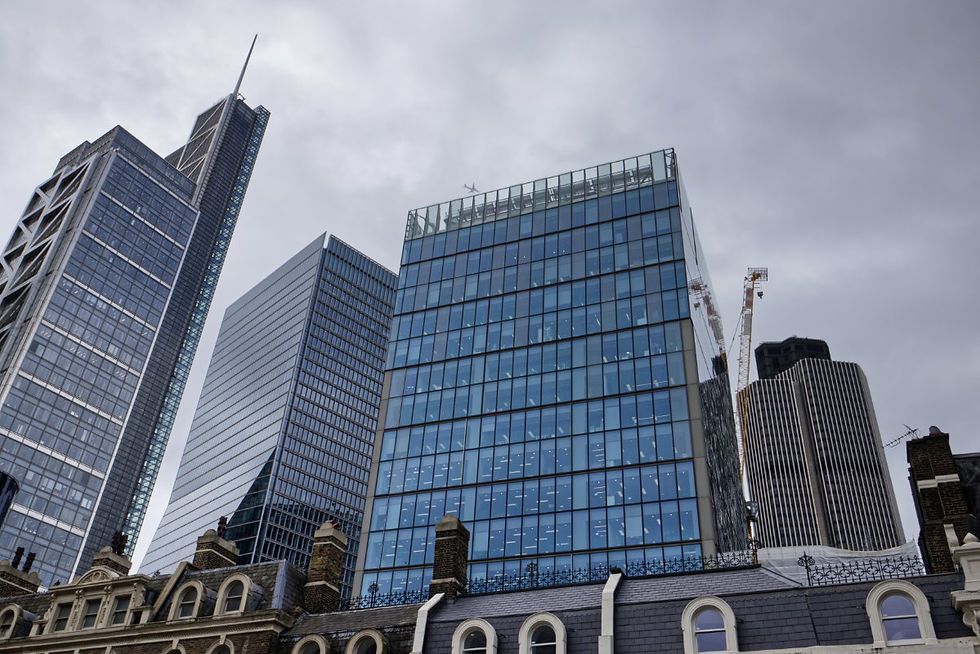
The iconic clock towers at London Liverpool Street Station sit atop the main entrance facades on Liverpool Street and Bishopsgate. Dating back to 1874, the historic landmark features distinct Victorian-era architecture, though it currently faces highly controversial redevelopment plans. AI Overview

The hotel adjoining Liverpool Street station is currently the Andaz London Liverpool Street. Originally opened in May 1884 as the Great Eastern Hotel, it was designed by renowned architects Charles Barry Jr. and Edward Middleton Barry to serve the Great Eastern Railway's London terminus. The lavish red-brick Victorian building was at the time, the only hotel operating in the City of London.

The red-brick bas-relief of the SS Great Eastern—Isambard Kingdom Brunel's famous steamship—was sculpted by Charles & Edward Barry. It is located on the facade of the former Great Eastern Hotel facing into the train shed at Liverpool Street Station.

The steam train relief is part of a larger series of carved brick. Other sections feature cherub-like figures and putti engaged in various railway jobs and construction trades.

Cambridge Daily News - Monday 18 August 2003
Railway children visit top museum
HUNDREDS of children from the region got a free rail trip to see one of London's top museums on Saturday. Train company West Anglia Great Northern teamed up with a national children's charity, Kids Out, to stage the event. About 200 youngsters from Cambridge, Ely and King's Lynn hopped aboard a special train to Liverpool Street station. There a fleet of National Express coaches ferried them to the Natural History Museum. The trip, called Kids Day Out, was for children mostly from low income families and the aim was to give them a fun time their parents might not be able to afford.

Northampton Chronicle and Echo - Thursday 28 May 1992
Underground music
COMMUTERS are to be treated to an electronic concert tomorrow, when Radio Three takes over a London Underground public address system. All day long, Liverpool Street station will reverberate to a variety of experimental sound pieces specially composed by musicians from all over the world who are meeting in the capital for a three day acoustic music conference hosted by the BBC.

And this is where I enter the story and why I was at the station on the 17th July 2025. 200 years of Railways.

20 July 2025 to 1 November 2025
To celebrate the 200th anniversary of the railway, Liverpool St station is unveiling an exclusive new Landscape Photographer of the Year exhibition. For many years, the winning photos from this competition have been shown at Network Rail managed stations as part of a nationwide tour. The new display at Liverpool Street will, for the first time, be made up of entirely railway photography.

In 2025 Railway 200 celebrated the 200th anniversary of the modern railway. Thousands of events and activities celebrated a British innovation that changed the world.

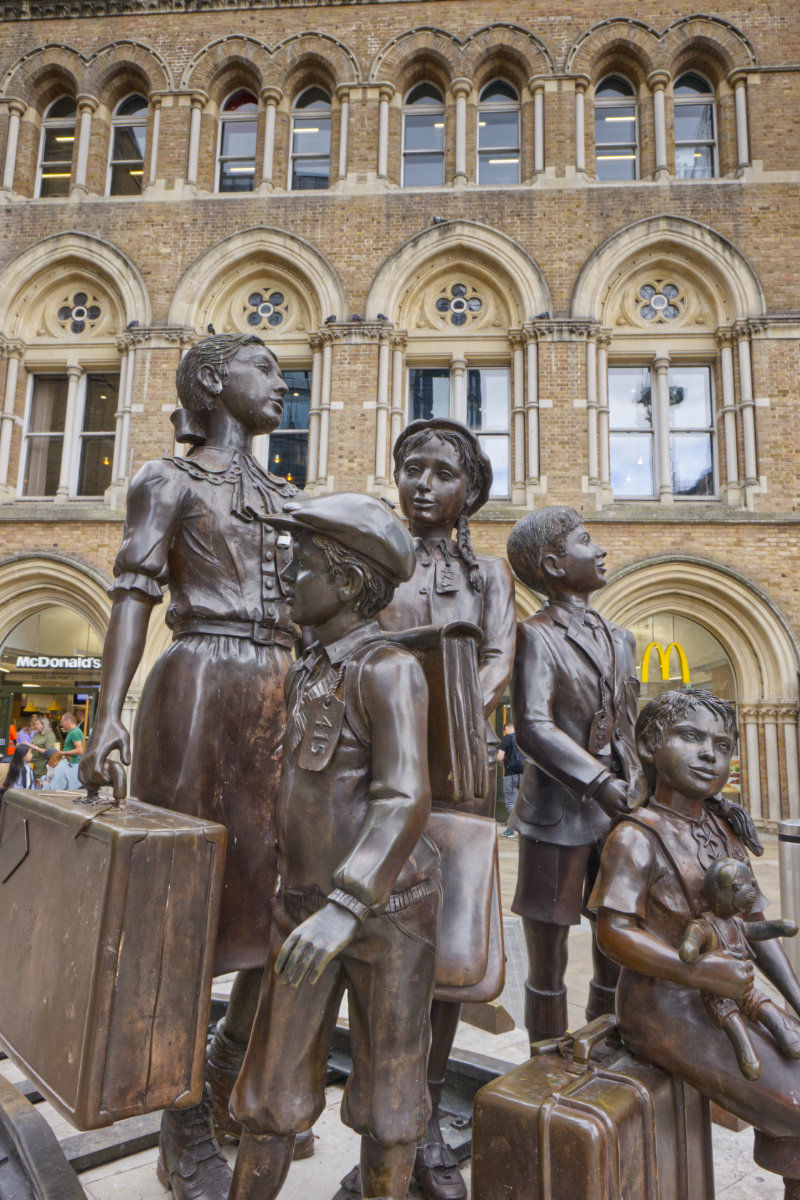
Finally, I want to mention this statue at the entrance to the station.
During World War II, Liverpool Street Station served as the arrival point for the Kindertransport between 1938 and 1939. The station became the UK gateway where nearly 10,000 unaccompanied Jewish children fleeing Nazi-occupied Europe were greeted by volunteers. Today, this legacy is honoured by the famous "Kindertransport - The Arrival" bronze statue in Hope Square.
You may have seen the 2023 film about the life of Sir Nicholas Winton starring Sir Anthony Hopkins. It tells the true story of how the young British stockbroker rescued 669 predominantly Jewish children from Nazi-occupied Czechoslovakia before the outbreak of World War II.
Belfast Telegraph - Wednesday 02 September 2009
MIRACLE ESCAPE MARKED
A TRAIN has left Prague for London to mark the 70th anniversary of mass evacuations of children from Czechoslovakia to prevent them from being sent to Nazi concentration camps. In all, eight trains carried 669 mostly Jewish children through Hitler's Germany to Britain at the outbreak of the Second World War.
The 100 year-old Briton Sir Nicholas Winton who organised the transports will be at London's Liverpool Street Station on Friday to greet some 170 passengers, including 22 he saved. Hana Franklova was one of them. The 78-year-old said yesterday she expected "a highly emotional" experience and called the event "a miracle".


Comments