Odds and Sods April 2026

A beautiful month of sun and spring flowers, much needed after the rain of January and February. These are Primroses in a hedgerow, in a particularly good year.

This is a Green Lane. Green Lanes are roads that never made it. They never saw tarmac when it arrived in the 1840's and so they are still official rights of way but only used by feet and occasional farm vehicles. They take you back in time because this is just as it looked in April 1800.

In this Green Lane there are parts where you can still see the original road surface. They were paved with stone by local farm labourers. On this lane I have noticed that the stones are placed on edge and in a herringbone pattern. I can only assume that this was done because the surface became more durable if the stones locked together.

One steep section forms a holloway, topped off with hedges in bloom.

While visiting Bristol for a concert we explored a new part of town which was a great find. It seemed to be mainly Georgian and had many old buildings that had escaped bombs and developers. This was an indoor market in a former Exchange.

The Bristol Corn Exchange, built in 1741-1743 by John Wood the Elder, is a Grade I listed Palladian-style building on Corn Street. Now home to St Nicholas Market, it historically served as a trade centre and features unique "nails" (trading tables) from the 17th century and a famous clock displaying both local and Greenwich time. National time did not arrive until much later when the railways needed to make more accurate timetables.

This next one is a real surprise given all my posts and links already published this week.
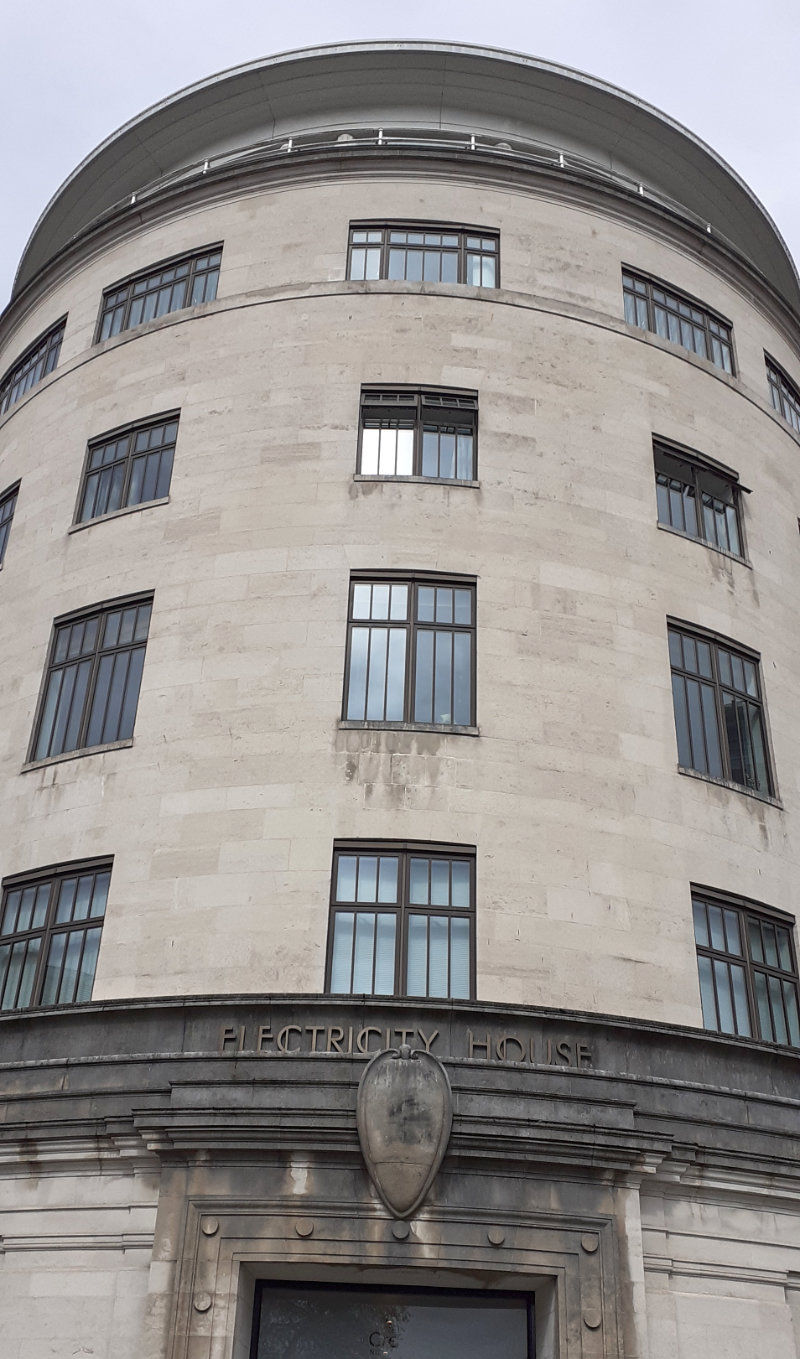
Electricity House, formerly known as West Gate, is a Grade II-listed Art Deco building at the former junction of Rupert Street and Quay Street and facing The Centre in central Bristol, England. Designed by Giles Gilbert Scott, it was constructed between 1935 and 1937 for the Bristol Corporation Electricity Department, but was not fully completed or occupied until 1948 due to wartime requisitioning. Electricity House has since been converted into a residential building following redevelopment in 2016.
Until I just looked this one up I had no inkling that it was another Giles Gilbert Scott gem. I have just published a short post about a small church in Plymouth, which was his last building. His greatest work was Liverpool Cathedral.
And here is that church in Plymouth. What a cooincidence that I should blunder into two of his buildings in the same month in two different cities.

Still in Bristol is this tiled masterpiece. It is a hotel but I was intrigued about its original purpose so had a close look at the images on the front. We see Gutenberg on the left and Morris on the right. Both surrounded by the letters of the alphabet. Both figures are operating printing presses. Only the facade remains with a newer building added at the back.
The Former Everard's Printing Works is at 37–38 Broad Street in Bristol, England. It has been designated as a Grade II* listed building.
It was built in 1900–01 by Henry Williams, with the Modern Style facade by William James Neatby, who was the chief designer for Doulton and Co., as the main works for the printer Edward Everard. It has a triple archway design on the ground floor with two on the first floor and four on the upper floor. Above them is a female figure holding a lamp and a mirror symbolising Light and Truth.
The contributions of William Morris and Johannes Gutenberg to printing and literature are celebrated in the design. Behind each figure are typefaces representing their work. After the demolition of the rest of the building, the facade was incorporated into a new building which was used as offices by the NatWest bank. It was later converted to be the Clayton Hotel, which opened in 2022.
Wikipedia

The cold easterlies have finally abated but although sunny, most of April was cold. On the beach it was warm out of the wind.

Another fragment of old Bristol.


Check out the series of photos I took on the beach here. Betwixt Land and Sea.

This is a gap in the cliff behind which is a waterfall. The shingle has since moved away and this is not now accessible.

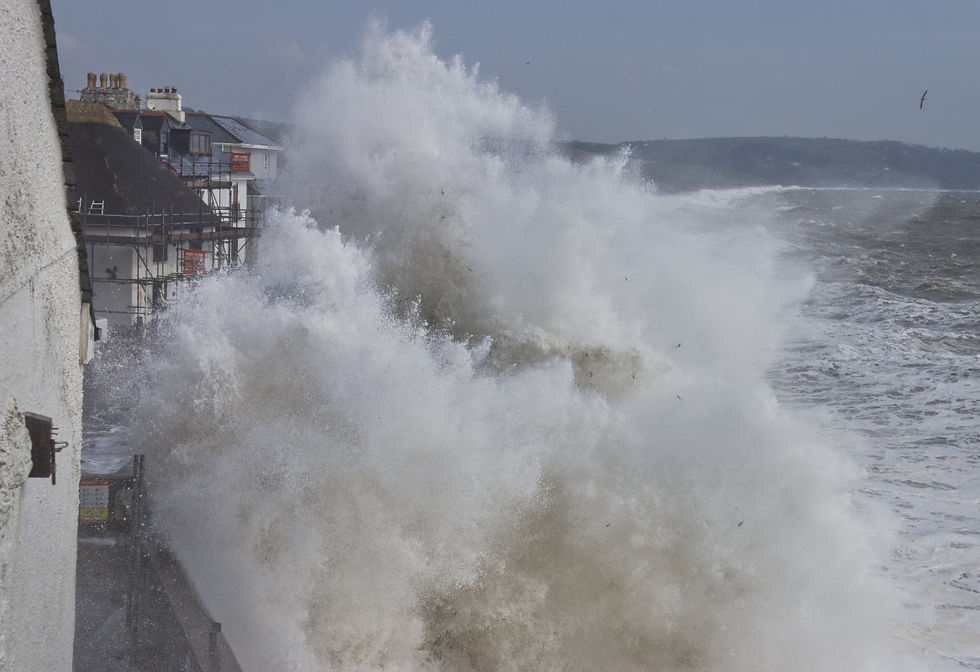
This was why the shingle moved away. The beach above is in the north of the bay and this village is in the south of the bay. One's loss is another's gain and the shingle came back to Torcross after this gale. The beach here was raised probably 20 feet.

The cliffs at Torcross hide various World War 2 gun emplacements. They make a great shelter for a photographer and his camera, dodging the wind and waves. I have published a series of photos of this gale here.




Comments