Odds and Sods December 2025

This is a sobering thought. Right here people sunbathe in summer, setting up their sunny spot, leaning against the base of these beautiful slate cliffs. I don't venture there because this is apt to happen.

Another sobering thought is that the newly exposed slate layers have been hidden away from the sun for 400 million years before emerging into sunlight last month, here at Strete Gate. This is the work of the Variscan orogeny, which sounds slightly rude. These rocks began as sediment deposited in a tropical sea, which were then subjected to intense pressure and heat during a period of mountain building termed the Variscan orogeny. The cliffs have a beautiful metallic quality when freshly exposed due to recrystallized clay minerals. During their long life they have also tilted to this sloping angle, from being horizontal.
The rocks are also called Lower Devonian after Devon of course.
The Devonian is a geologic period of the Palaeozoic Era, spanning approximately 419 to 359 million years ago, known as the "Age of Fishes" due to significant diversification in marine life, including armoured placoderms and early sharks. This era marked crucial evolutionary milestones, including the emergence of the first forests, insects, and tetrapods—the first four-legged vertebrates transitioning to land.
When these rocks were being formed, nothing had ever walked on land before, let alone got out a beach towel and coated itself in Factor 30 sun cream.

A bit further inland and you can tell that this scenery is old because it is smooth and rounded. Geologically new landscapes tend to be sharp and pointy like Everest or the Matterhorn. Given enough time Everest will eventually look more like this.


What a coincidence this is. Here is a shot of a beautiful lichen in the local church yard in Sherford, and it turns out that lichens likely first appeared or became widespread on land during the same Early Devonian period, roughly 410 to 420 million years ago, with fossils like Spongiophyton indicating they were established by that time. This means that they have been here in this part of Devon before it was even Devon.
In fact Devon wasn't even here, it was in the southern hemisphere in a tropical sea. Being a bit wet and way too warm it moved northwards becoming an equatorial desert before eventually heading further north. In fact it was on a different land mass to the rest of Britain and is unique in that it is the only county in the UK to have an entire geological period, the Devonian, named after it.
When Devon hit the rest of Britain it roughly formed a line between Exmouth and Camelford in north Cornwall. It must have been a hell of a bang. Above that line is the rest of England and Wales, part of what was once the continent of Avalonia. South of that line the parts of Devon and Cornwall were part of the continent of Armorica. This line was only identified as recently as 2018 at the university of Plymouth.


Here is the lych gate at the local church and you can see that even the man made walls have been here so long that they have decided to lean in sympathy with the bedrock.

The church is so old in fact that it served as refuge in long ago dangerous times, which is why it looks like a castle.


I have done a series of posts about the church if you want to know more about it.
The church isn't curved, by the way, that's the fisheye effect of a series of photos blended together to produce this image. I could have digitally straightened it all out, but I rather liked it.


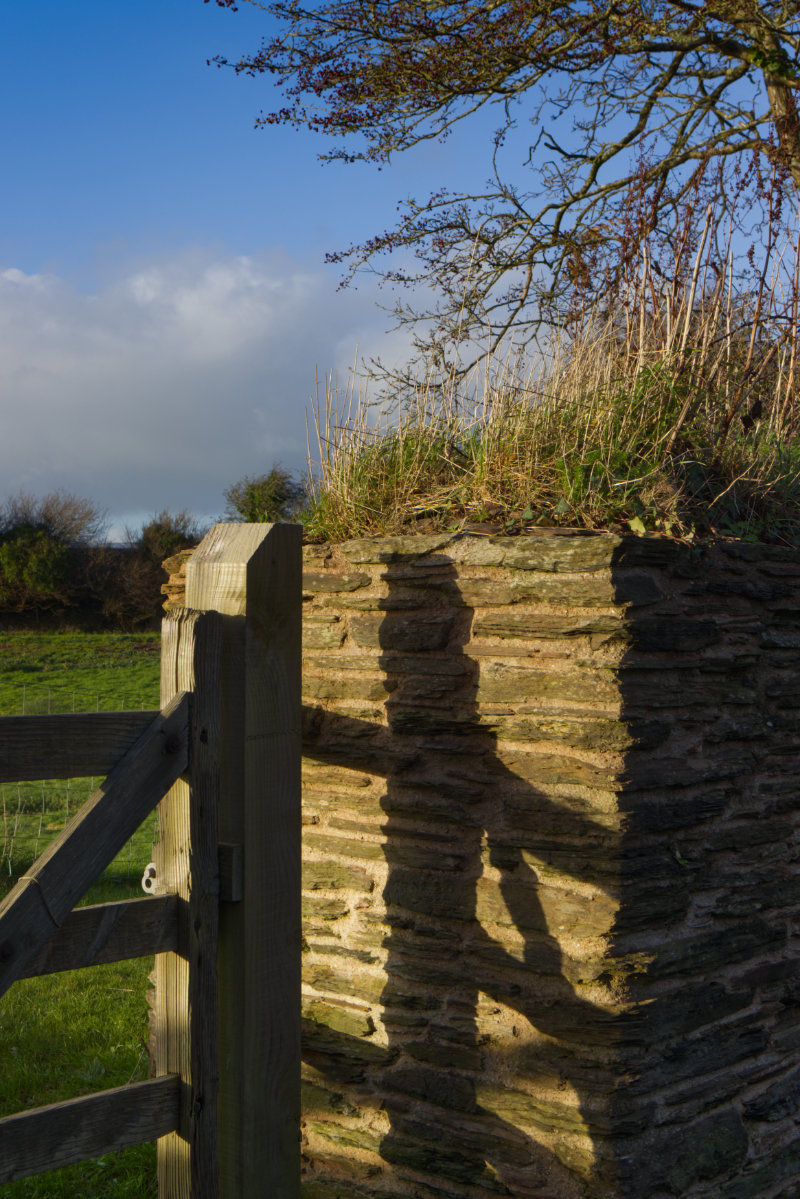
The few sunny days in December produced some lovely low angle shadows and glowing colours, which I will end this post with.




Comments