Odds and Sods June 2026

This is a museum dedicated in part to a large collection of red objects. It's a museum that I wouldn't have a lot of time for in the normal course of events, but in this case, the singular colour of the large number of objects added something unique to what it offered. I'll reveal all at the end of this post and in a later specially dedicated post.

This quirky scene in the local High Street caught my eye. The stone pillars belong to the The Shambles, an ancient market structure, parts of which date back to 1586 at least. A mobility scooter had been parked in the loading bay, and it's occupant had left it without the crutch, which remains sticking out of the back. In addition, the butcher's shop just out of view on the right had placed their fake sheep in the parking area to hold the place, presumably for a delivery van. I doubt there is a chance of ever seeing this scenic arrangement again any time soon or in any other place.

This was a new stretch of the South West Coast Path, that we hadn't done before. It led from Ayrmer Cove at Ringmore, to Challaborough near Bigbury. I have made previous posts about all of these places. It offered us a new perspective on Burgh Island looking south, as we normally see it from the other headland in the distance, Bolt Head..

In Start Bay the view to the lighthouse was clearer than usual, with less marine haze.

From the Strete end of the bay and with a long lens you can get a less than usual view of Torcross.

While I had the long lens I took some shots of the tiny blurs we normally see on the horizon and it's amazing what is out there, slowly moving past along the English Channel. Here is a trawler and the gulls know when it's fishing time.

Less common a sight this close to shore is an enormous container ship chugging along probably on its way to Rotterdam or Hamburg.

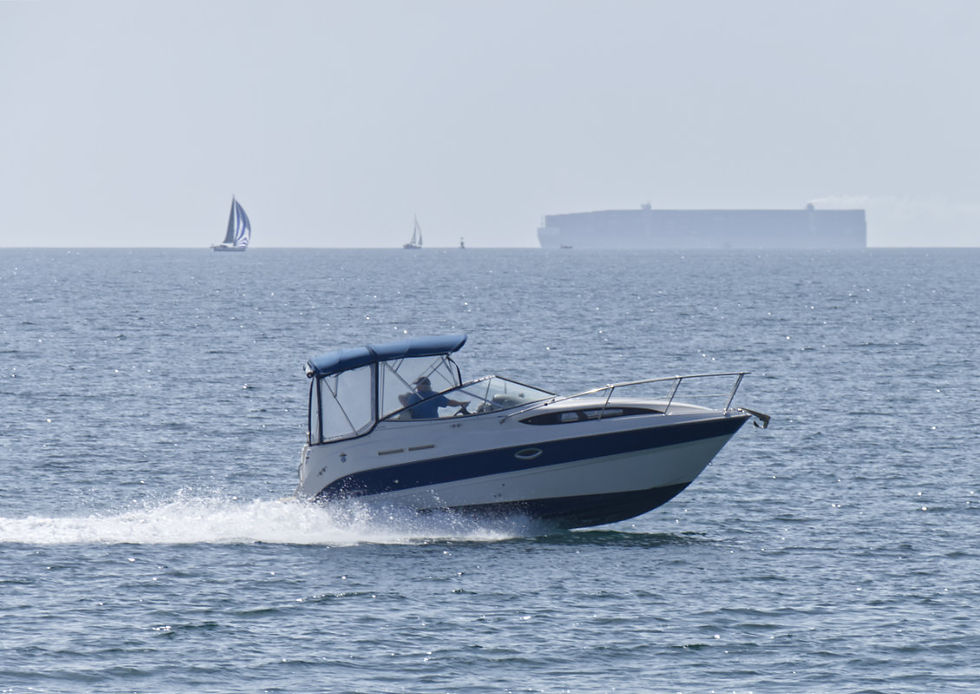
Closer in to shore are the "Gin Palaces" zipping along between Dartmouth and Salcombe.
A gin palace is an English name originally for a lavish bar selling gin, later transferred by association to late Victorian pubs designed in a similar style. In the 20th century, the term "gin palace" came to be used for large ostentatious pleasure craft, such as a motor yacht or luxury yacht, typically moored in a marina and fitted with a sun deck used for outdoor entertaining and leisure, normally involving alcoholic drinks. Wikipedia

Summer is in full swing and there was a mini heat-wave, which we were all warned could end life on this planet, unless we go back to living in caves.

Meanwhile our national government still hasn't decided if we can have £10 million to repair our local lifeline yet. They have just told us that 34,000 asylum seekers have been given the right to stay in 2025 due to a single ECHR rule loophole. The government have also told us that it will cost us £5 billion for these 34,000 to live here for the rest of their lives, and that includes estimated figures for them working and paying taxes too. None of that even starts to deal with the hundreds of thousands more already here and those to come, many of whom have already been denied the right to stay but are still here.
"In newly released statistics, the Government estimates that the 34,000 people who made Article 8 claims last year will cost £5 billion over the course of their lifetime." Robert Jenrick
Our damaged road now has to wait while a business survey is completed to show proof that we need this road. Presumably if we wait long enough, and enough local businesses go bankrupt, we will have all the proof we need.


We visited two ancient castles in June. This one is in Okehampton, where I have been before, and I didn't even know there was a castle there. It is tucked away in a wooded valley on a large mound.

Okehampton Castle is a medieval motte and bailey castle in Devon, England. It was built between 1068 and 1086 by Baldwin FitzGilbert following a revolt in Devon against Norman rule, and formed the centre of the Honour of Okehampton, guarding a crossing point across the West Okement River. It continued in use as a fortification until the late 13th century, when its owners, the de Courtenays, became the Earls of Devon.

With their new wealth, they redeveloped the castle as a luxurious hunting lodge, building a new deer park that stretched out south from the castle, and constructing fashionable lodgings that exploited the views across the landscape. The de Courtenays prospered and the castle was further expanded to accommodate their growing household.

It all went awry when Henry Courtenay was executed by Henry VIII, and the property was abandoned and left to decay, while the park was rented out by the Crown. Parts of the castle were reused as a bakery in the 17th century, but by the 19th century it was completely ruined and became popular with Picturesque painters, including J. M. W. Turner. Wikipedia
Picturesque was a painting style by the way not a description of the painters. Turner was not particularly picturesque himself as you will have noted in the biopic Mr. Turner starring Timothy Spall, who I feel sure wouldn't be offended by my implying his own lack of picturesque features.

Nunney Castle in Somerset, is later and medieval. Built in the late 14th century by Sir John Delamare on the profits of his involvement in the Hundred Years' War, the moated castle's architectural style, possibly influenced by the design of French castles, has provoked considerable academic debate. Remodelled during the late 16th century, Nunney Castle was damaged during the English Civil War and is now ruined.

The architectural historian Nikolaus Pevsner has described the castle as "aesthetically the most impressive castle in Somerset. Wikipedia
Today, artists like Liam O'Farrell continue the picturesque tradition with paintings of Nunney. They often feature the castle and nearby church reflecting in the calm waters of the moat.

The Church of All Saints at Nunney, Somerset, England, is a Grade I listed building dating from the 12th century.

Sir John Delamare and other lords of Nunney Castle are buried in the church. All Saint Church in Nunney.
Sir John Delamare (c. 1320 – 1383), ignominiously perched here on the window ledge, was a knight at the court of King Edward III of England and the builder of Nunney Castle. His heir was his niece who married a William Paulet, so the other characters shown here are all Paulets.

This figure is Constance, wife of Sir John Paulet. He died in 1437 but we don't have any dates for her. It is remarkable to think that this sculpture has lain here for 600 years.

The market cross across the road from the church is Grade II* listed. It was originally built around 1100, when it stood in the churchyard of All Saints' Church. It was removed in 1869, as the noise from children playing on the steps annoyed the rector. The stone was discovered in a builders yard and rebuilt in his garden by the squire of Whatley and the Celtic cross added. After his death and a fire which destroyed his house, the cross was again dismantled and rebuilt on its present site, next to the river in Nunney village in 1959. Wikipedia

Here is a clue as to the contents of the big red museum.

Here is a bigger clue. No, it isn't an exploding clown car, it's a 1958 Ford Fairlane Skyliner Retractable, which amazingly is now 70 years old. One button push converts the car from a hardtop to an open tourer. Of course, it meant your touring was limited as most of the car's storage contained the roof.

The red objects in the museum in the headline photo are of course, cars, and I have never seen so many red cars in one place before. A later post about The Haynes Motor Museum will follow.


Comments