Odds and Sods October 2026

My monthly Odds and Sods are what could usually be described as random, or a popular overused word now, an eclectic mix. Well this month they are even "eclecticer", that is more eclectic than usual, as I have sun and fog, ancient and modern, stormy and still, neat and creased, organised chaos and all of those, topped off with melted cheese.
I am starting with a pleasant reminder of a hot sunny day at the Acropolis of Lindos and a column of ancient and modern stones, assembled into a jigsaw of, "this is what it probably looked like".

It is of course harvest time and Halloween too, so these are everywhere.

I took some great local country walks, as the weather has been so mild and pleasant. I turned one of those walks into a story of geology, time and history, which I called South Hams Layer Cake.

On one of those walks I spotted, some way off, this line of cattle, and this shot was the best I could do with my phone on a zoom setting, but it serves to tell a small story itself. It's about the constellations that we all think we know so well. So I call this shot the constellation Bovinus Major. It was many years ago when I first got the surprise of finding out that constellations were totally imaginary and were born out of a trick of light, slight of hand, and wish fulfillment. This photo will explain how it works. These cows from this angle appear to be a constellation in the form of a long line, Bovinus Major, or in Astrology terms, maybe, the Striped Snake. If you were born under the sign of the Striped Snake, you probably still believe in horoscopes.
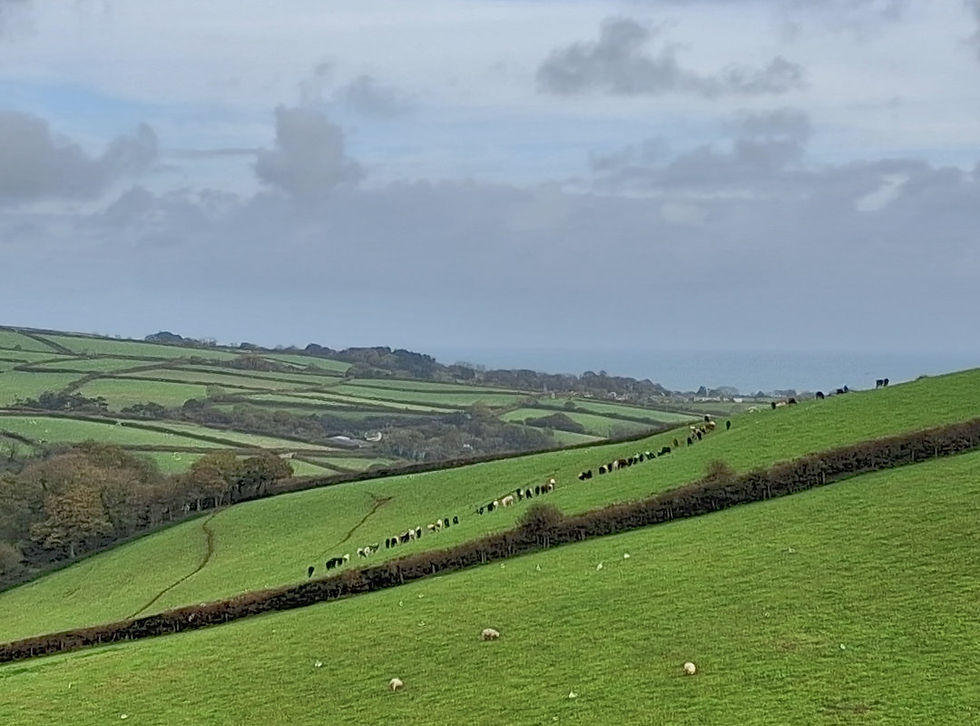
Here is Bovinus Major in even closer close up. A bit pixelated, but you get the idea.

But if you move to another part of the universe, or walk further along the lane in this case, and look at the same scene from a different angle, something we can't actually do with stars because they are so far away, you see the truth behind the straight line. Our constellations are just stars billions of light years apart, that line up into a shape we might associate with something familiar, like a common animal, maybe a Great Bear, but they only line up from one infinitesimally small point in the universe, where we are standing. It is a fiction, pure and simple. So where does this leave Astrology? In a fiction dustbin it would seem. I predict a life of disappointment ahead.

Here is Lindos again, from the Acropolis, and probably the best vantage point. Something you cannot see from this distance is the gift shops. Almost every one of those narrow streets is lined with gaudy gift shops. You also cannot see the coach park a quarter of a mile away where 50 air conditioned coaches sit waiting for the cruise passengers that have just been delivered.

Also in Lindos, and this goat is not as stupid as you might think. That truck is just another cliff ledge to be conquered in a quest for tasty leaves.

This is the wall outside Sherford Church in Devon and a lovely thing it is too. Many years ago someone decided to insert these few stones vertically and why not?

The wall holding up the lych gate started to migrate west many moons ago. It has a greater lean than the Leaning Tower of Pisa, but rather than knock it down and rebuild it, someone built a buttress, just out of view, to prop it up and I'm so glad they did. Was it the same wall builder who went vertical in the photo above. I like to think so.

In the cemetery in a prime location lie the mortal remains of Philip Walford Peters and his wife Judy. I noted the D.F.C. and the A.F.C. and thought this could be interesting. Why is he buried here and what did he do to win this medal? I was to discover that he was a legendary British hero.
Mitcham Advertiser - Thursday, 25 June 1942
SUTTON
BELMONT D.F.C. - Flight-Lieut. Philip Walford Peters, of Belmont. who received a D.F.C. in June for his gallantry in a fight against nine Messerschmitts, has married Miss Frances Joan Giles, daughter of Mr. and Mrs. G. H. Giles, of Sherford Down, Kingsbridge. Devon.
So that answers why he is buried here. He married a local lass.
In June 1940 in an announcement by the Royal Air Force, Philip Walford Peters was awarded the Distinguished Flying Cross or D.F.C. as a Pilot-Officer during operations in the Battle of Flanders and the evacuation of Dunkirk. When the flotilla of little boats were saving the British Army soldiers trapped on the beaches of Northern France under enemy fire, one of those British planes in the dogfights above was flown by this local hero, and in an extraordinary manner, because he was fighting top ranked, heavily armed German fighters with a reconnaissance aircraft. In one recorded incident his plane was actually hit and his parachute saved his life in an unintended way.
Anson I N9732. Hit by fire during an attack by Bf 109s during a low-level patrol over the Channel off Dunkirk beginning from 10.40 a.m. One bullet lodged in the pilot’s parachute pack, also one bullet each through the metal flaps in the port mainplane and port engine cowling. 42259 P/O Phillip Walford Peters (Pilot), 740155 Sgt. Deryk Cobham Spencer (Nav.), AC Pepper (WOp/AG) and 812071 Acting Corporal Lewis George Smith (AG) all unhurt. Aircraft MK-V damaged but repairable.
P/O Peters, Sgt. Spencer and Act. Corp. Smith all received Immediate awards of the DFC or DFM for this action, during which the crew claimed two Bf 109s shot down and two more damaged. Martin aviation pages.
Dunkirk Dogfight (June 1, 1940): Piloted by Pilot Officer Philip "Pete" Peters with crew members Sergeant Deryk Spencer and LAC Pepper, Anson N9732 famously shot down two Luftwaffe Messerschmitt Bf 109E fighters over the English Channel while patrolling the Dunkirk beaches during Operation Dynamo.

Why did Phillip Walford Peters also receive the award of A.F.C.? He received the A.F.C. eight years later on 28th October 1948 for his exceptional devotion to duty, flying skill, and contributions to non-combat military aviation.
As a Pilot Officer with 500 (County of Kent) Squadron, Peters famously piloted a twin-engine Avro Anson reconnaissance aircraft. On 1 June 1940, during a patrol over the English Channel amidst the Dunkirk evacuation, his crew was attacked by three Messerschmitt Bf 110 fighter-bombers. Showing immense tactical skill, Peters and his gunners remarkably shot down two of the heavily armed German fighters, a rare and legendary feat for a comparatively slow, lightly armed reconnaissance plane. This action initially earned him the Distinguished Flying Cross. The AFC was concurrently used to reward extraordinary achievements, piloting excellence, or high-stakes development work during non-routine, non-combat flights. Peters' award in late 1948 recognized his high standard of operational execution and leadership during this critical early Cold War reconstruction era.
Back to Start Bay now and it has been a busy month there and in Torcross in particular, where work is now underway to defend the sea wall. This photo is an attempt at photographing nothing in particular and it's mighty difficult to do. Fog and faint sunlight breaking through on to a very calm sea. Two specks feature, a buoy and a bird.

While Philip Walford Peters was defending the evacuating troops at Dunkirk, nobody had even considered the possibility of anything on the scale of D-Day and the invasion by the allies in Northern France just four years later. The war at that stage was starting to look lost. Here in Torcross those landings in Normandy were rehearsed and this tank was a casualty of a disastrous practice exercise, here it is, recovered from the seabed a few years ago and serving as a memorial. It is under siege at the moment from the construction site, set up for the current works.

There are the works and the tank looking small and precarious on the shingle ridge that divides the salty sea and the freshwater Slapton Ley.

This is the sea wall that is about to be beefed up by massive boulders shipped in from Norway and Scotland.

That ship on the horizon has just arrived and is carrying those boulders. Any day now they will be dropped on the beach and arranged into a defensive line.

The shingle is to be dug away from the steel base of the wall and boulders placed in front of it to prevent its exposure proving to be a weak point.

In this shot you can see what waves can do to this steel when the water pressure gets under it or behind it. It can screw it up into a ball as if it is a piece of aluminium foil.


Back in Rhodes is the ancient Synagogue which I managed to visit. There will be a photo portrait of this building to come shortly.

On a recent Ghost Walk in Paignton I spotted this neglected doorway. You can see my Doorsteps post here.
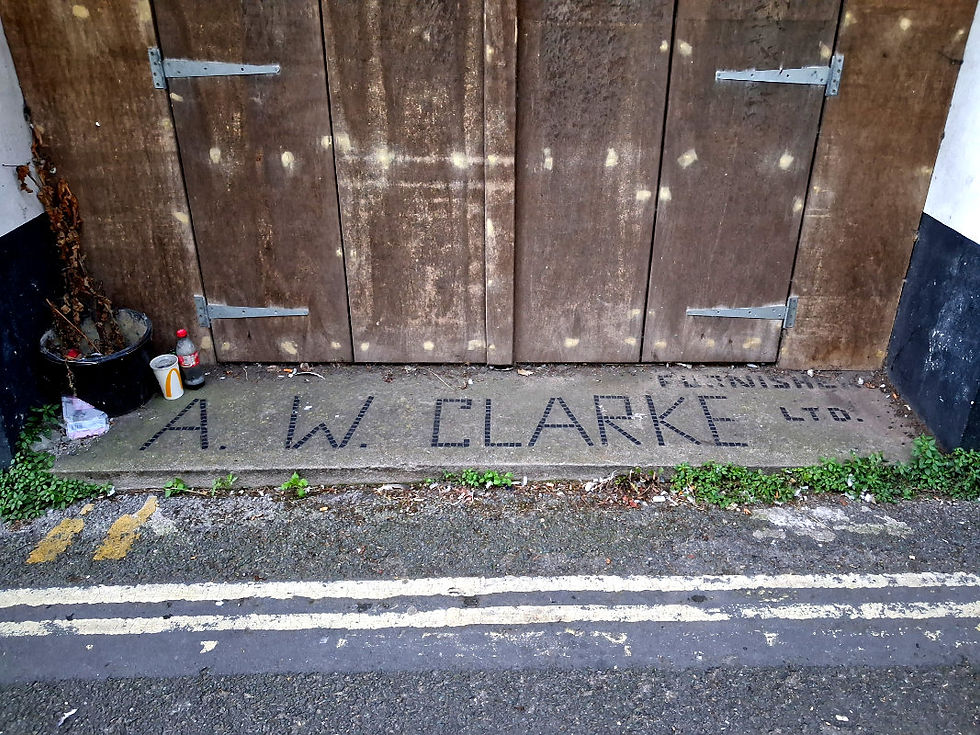
Above the window upstairs is the old block and tackle pulley for lifting up the heavy furniture.

Meanwhile as the ghosts came out and the sky got darker we arrived at Kirkham House, one of the oldest houses in Paignton, and with the traditional street lamp it looked pretty spooky.
Kirkham House is a well-preserved late medieval house, built of local stone. It lies near the centre of the town of Paignton, which 500 years ago was a small village clustered around its parish church, not far from the palace of the bishops of Exeter. English Heritage

Meanwhile back in Rhodes, and when you stay in a hotel, you try to leave the room reasonably tidy when you go out.

It was obviously not tidy enough for someone, and I have been given a lesson in folding. I was quite touched by the care and attention I discovered on my return.

(The before photo was staged, after the folding lesson just as a demonstration of my skill.)

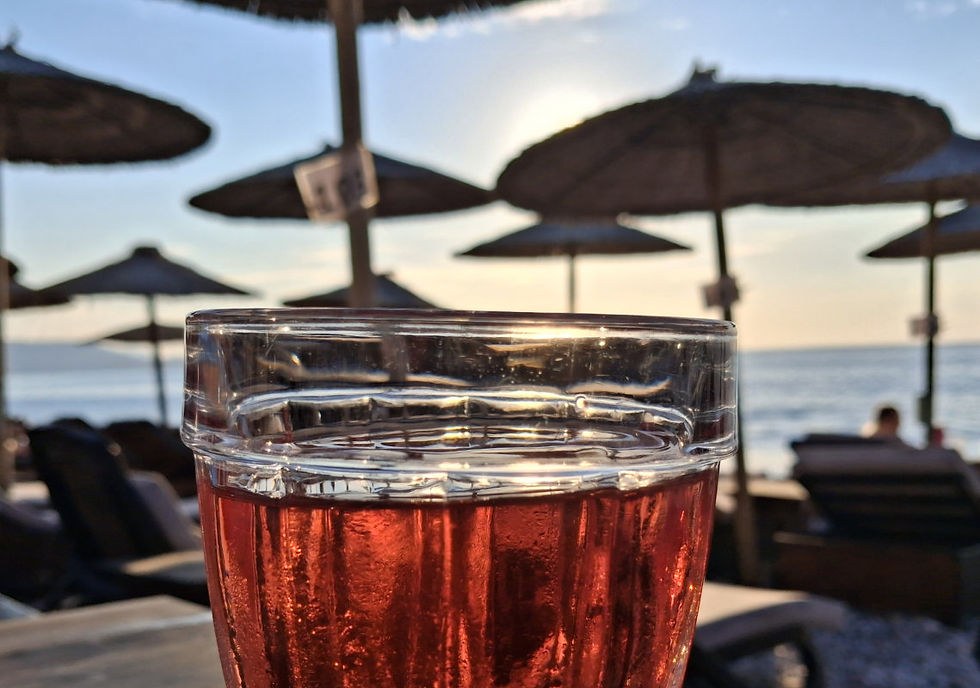
What better way to sit and watch the sunset than with a glass of chilled Rosé.
This was a dusty Rhodian reminder of the recent past, when photos were just chemicals on plastic sheeting wound onto a roll. Usually 24 chances to make a decent image, or if you were splashing out 36. Kodak is a name I am very familiar with as I used to sell the film and also collect people's film cases for developing. We used to have a daily collection of films which were usually returned the next day.
ΠΡΟΪΟΝΤΑ is Greek for products which surprised me as it looked more like Pronto to my eye which would have made sense next to the very precise time for developing your phots, of "23" minutes. I also like the way that 23 is shown in quote marks as if the shop owners themselves didn't really believe it. I can imagine someone returning 23 minutes later to be told, "That isn't our claim, it's theirs, blame Kodak".

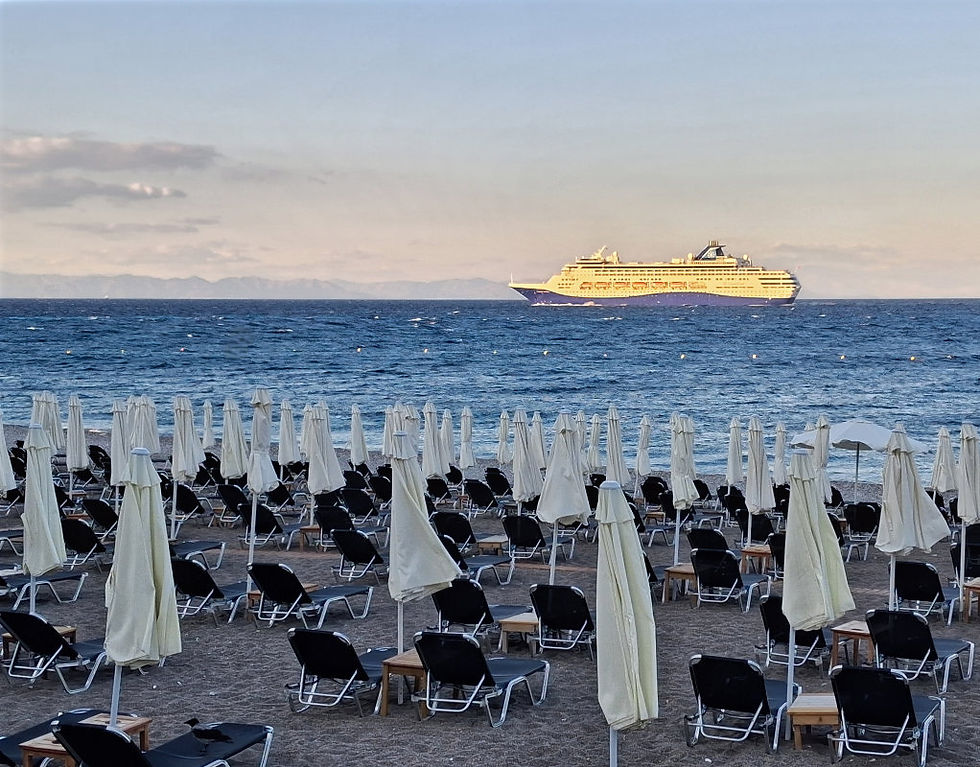
It is nearly dusk when all reputable cruise ships leave tiny islands and head off to the next Lindos coach park.
Here is a foggy tranquil scene in Dartmouth harbour.

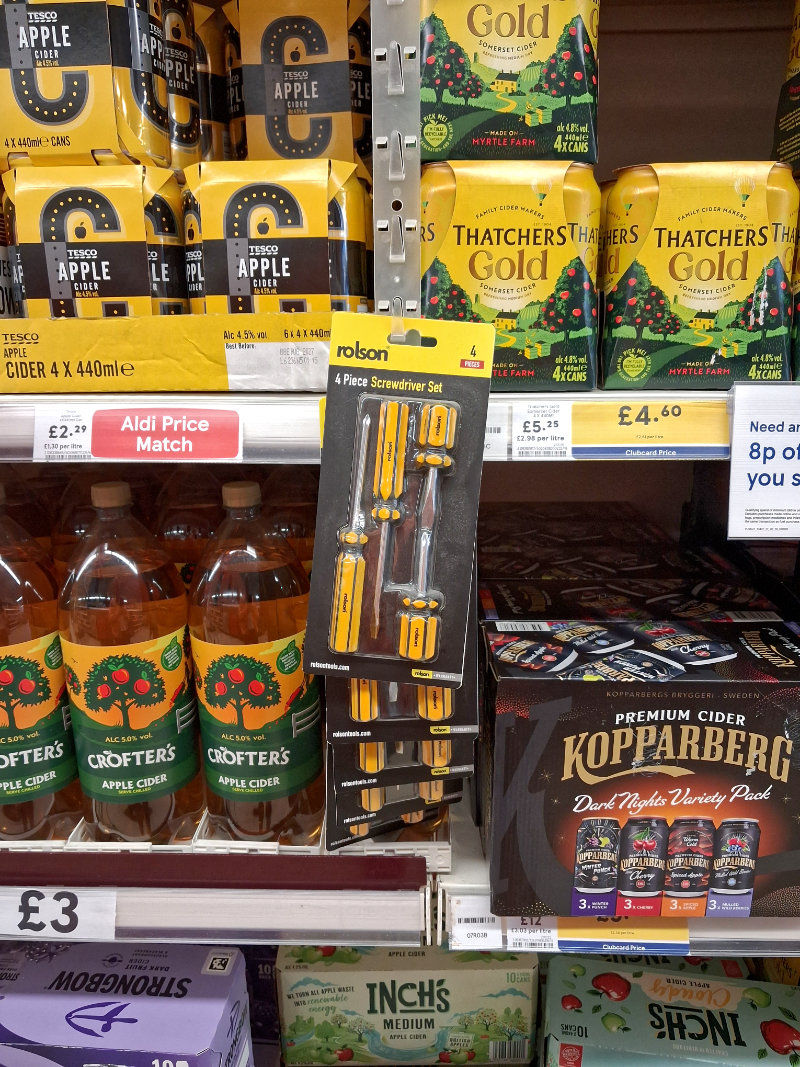
This is a weird one, and one of my favourite shots last month. Shopping in Tesco and this caught my eye. Supermarkets these days probably use computer algorithms or AI to come up with little wheezes to spark an impulse buy. They now routinely hang small packs of a product in front of another product that relates in some way, making some sort of connection. It is usually something like salted nuts with the beer. This is called Cross-Merchandising where complementary items are grouped together, and you are likely to have seen chips and dips for example.
But Cider and screwdrivers?
I promised that this post would be topped off with melted cheese, so here it is. The Swiss are well known for their precise and perfect machine making, producing the best watches and clocks for example. The Swiss also value their traditions and heritage, and so it is that somewhere on an Alp somebody with a woodpile and a spare, dark winter's night, came up with the plank and candle Raclette.
Raclette is essentially melted cheese, and you may have seen images of large pieces of cheese on various devices held close to open fires where the melted cheese surface is scraped off to be eaten, exposing un-melted cheese which act is then repeated until you can eat no more cheese. Earlier this year my brother who is actually Swiss now, gave me these state of the art woodpile whittled cheese melting wonders of engineering, complete with tree bark. You can imagine my scepticism when it came to predicting their value as cheese melters.
Thanks to Aldi supermarkets, I managed, last month, to aquire the specific Raclette cheese needed for this activity. Imagine my surprise when it turned out to be the world's finest way to melt cheese. Who knew cooking with candles was possible. How could I have ever doubted that a Swiss whittler could produce melted perfection with some kindling.


Comments