Teignmouth Photo Walk 5

This is the final part of my Teignmouth Photo Walk of January 2024.
The date is June 23rd 1690 and the day lives in infamy in Teignmouth. After the events of that day the Justices of the Peace concluded, "by the late horrid invasion there were within the space of 12 houres burnt downe and consumed 116 dwelling houses ... and also 172 dwelling houses were rifled and plundered and two parish churches much ruined, plundred and defaced, besides the burning of ten saile of shipps with the furniture thereof, and the goods and merchandise therein .."
A cannon ball from that event can still be seen today.

I am about to walk down French Street, the part of town that was built to replace the destroyed dwellings left by the French army, who brought ignominy upon themselves. More on that later.
First I come to this building.
"Audi, vide, tace" is a Latin aphorism meaning "Hear, see, [and] be silent". It is often used as a motto encouraging discretion, vigilance, and wisdom—suggesting one should gather information by listening and observing, but remain silent to live in peace (si vis vivere in pace)
What I didn't realise on the day of my walk was that this is the side door of the Masonic Hall, so it now makes more sense.

This is French Street and on the right is the town museum in whose walls are set the cannon balls discovered back in the 1930's during building work.

The attack on Teignmouth by the French which at first glance appears a bit random needs to be seen in the wider context of the Nine Years War. King William III had only been crowned a year before and this was Catholics versus Protestants. The French supported the exiled James II the deposed Catholic King of England but William was not only Dutch but also Protestant. This pitted the Anglo Dutch navies against the navy of France. France had just won the naval battle of Beachy Head so wandered freely along the English Channel looking for trouble. After a naval bombardment, French troops were landed, who then ransacked and burned the place, before leaving unmolested.

Anne Hilarion de Tourville intended to sail the French fleet to Ireland to cut William's lines of communication. However, they diverted into Torbay and decided to raid the place. Tourville’s ships dropped anchor and with the presence of the French close to shore, beacons were lit along the coast which roused up spirits of the memory of 1588. On observing Torbay's strong defences along with a strong force of militia lined up, he decided to leave his ships of the line where they were and sent several galleys Eastwards towards Teignmouth instead. The galleys were rowed by slaves carrying in total 2,800 sailors and troops which were designed for inshore work. Wikipedia

As a fan of ancient Devon churches, I was shocked to discover that there was one standing here until the 1820's, when it was replaced by St. Michael's Church, which was built between 1821 and 1823. The prominent tower, a landmark of the town, was added in the 1880's to celebrate Queen Victoria's Golden Jubilee. A side chapel was added in the 1920's. On the day of my visit it was locked so I wasn't able to photograph the interior. In 1044 a Saxon church existed near here and the demolished older church as recently as the 18th century is said to have had a 13th century Norman aisle and a thatched central square tower.
The earlier church met the fate of many churches in Britain at the hands of wealthy Victorian Church builders and restorers who damaged or destroyed much of our ancient heritage in the trend of gentrification and mis-judged rescuing or replacing of those buildings.
Flindell's Western Luminary - Tuesday 29 May 1821
We hear it is finally determined to build a new Church at East Teignmouth ; and that the Bridge across the Teign to Shaldon will also soon be undertaken.
St Michael the Archangel is Grade 2 listed and is currently in need of some rescue. A fund is raising money to save the tower which has been battered by the storms coming off the sea for 120 years. Parish church. 1821, by Andrew Patey in Norman style (dedicated 1823). Vestry 1885, west tower 1887-9 by RM Fulford in Early English style; chancel 1875 by FC Deshon.
Exeter Flying Post - Wednesday 11 December 1889
ST MICHAEL'S CHURCH,
TEIGNMOUTH.
OPENING OF THE NEW CLOCK
CEREMONY, THIS DAY.
Since the completion of the new tower of St. Michael's Church, Teignmouth, which was opened some two months since, considerable interest has been taken in the new clock, which was started for the first time this morning. The ceremony commenced with a short service conducted by the Rev. James Veysey, who gave an appropriate address, dwelling particularly on the necessity of punctuality in worship, and pointing out that time flies, and that the moments of life are precious.
The modern improvements ensure perfect accuracy in timekeeping. There are four dials, three of which are 5ft. across, the one on the south side being 4ft. 8in. The figures are gilded, and the hands, which are of copper, are also gilded. The movement of the clock is placed in a chamber in the tower, and fitted in a box with a glass front, the four dials being connected by means of rods and bevel wheels. The iron frame which carries the movements is cast in one solid piece, and the wheels are so arranged as to be easily separated from each other in case of repairs : all the wheels are of the best gun metal. The pendulum weighs 3 cwt., and is compensated in such a way as to remain at the same effective length in all states of the weather.

The United Reformed Church is almost directly opposite and also has a rich history, this time one of non-conformism. Here too was an earlier building the Zion Chapel of 1790 which was replaced by this Gothic Revival extravaganza in 1883 at about the time St Michael's was adding its tower.
Nonconformist - Thursday 05 October 1882
TEIGNMOUTH CONGREGATIONAL CHURCH.
THURSDAY, the 28th ult., was a red-letter day in the annals of Teignmouth Congregationalists, the memorial stone of their new church being laid with great rejoicing and thankfulness. For many years the religious labours of pastor and people have been greatly hindered by the existence of an old, unsavoury, and dismal sanctuary. Zion Chapel, built in 1790, and used as a burial-place for three generations, has disappeared for ever.
Among the contributors appear many of the most honoured names among Congregationalists. A luncheon was afterwards held at the Assembly-rooms, Mr. Morton Sparke presiding; The treasurer, Mr. Alsop, read the financial statement, from which it appears that up to the stone-laying the building fund amounted to £1,884, of which the congregation contributed £1,185, and the proceeds of the day amounted to £465. The amount of the contract is £3,247, excluding the pulpit and screen and the completion of the turret. (£215,000 today)

Western Morning News - Friday 27 July 1883
CONGREGATIONALISM AT TEIGNMOUTH.
The new Congregational Church which has been erected at Teignmouth at a cost of about £3,560, was formally opened yesterday, though not completed in every detail. The service with which the chapel was opened was largely attended, and was conducted by the Revs. J. Sellicks, of Newton (chairman of the Devon Congregational Union), Professor Anthony, of Plymouth, and the Rev. J. Johns, of Totnes, whilst the sermon was preached by the Rev. W. Pulsford, D.D., of Glasgow.
The choral part of the service was admirably rendered. A luncheon followed, and later on there was a public tea, after which another service was held. The proceeds of the day amounted to about £90, leaving £300 still to be raised.


Founded in 1883, the Teign Corinthian Yacht Club (TCYC), has a rich maritime heritage. Originally established as the Teign Corinthian Sailing Club, it initially focused on open centerplate dinghy racing. The club has since evolved into a premier local hub for both cruiser racing and year-round dinghy sailing.
Illustrated Sporting and Dramatic News - Saturday 23 June 1883
For sport, ample opportunity is here afforded. Mr. Whidborne, a resident gentleman, keeps a smart little pack of foxhounds, with which many a rattling run may in a good season be enjoyed, over one of the most beautiful countries in England.
During the summer months the spirited members of the Teign Corinthian Sailing Club-open to all gentlemen owning small craft-disport themselves in their miniature vessels in the smooth waters of the channel, or in the picturesque estuary of the Teign, all being kept well "in hand" by the genial commodore, Captain Burrowes, the vice-commodore, Captain Kersteman, and having their club interests well cared for by the hon. sec., Major McNab. The little fleet, when lying at moorings, ready to start for a race or a cruise, presents a very pretty picture.

National Coastwatch (NCI) watchkeepers provide eyes and ears along the coast, keeping watch and monitoring radio channels to provide a listening watch in poor visibility. When people find themselves in trouble, they are there to alert HM Coastguard and direct the appropriate emergency and rescue services to the casualty. NCI
In 1994, in Cadgwith Bay off the Lizard in Cornwall, a fishing boat unfortunately sank, and its two crew unfortunately perished.
This happened soon after many Coastguard lookouts had been closed down, and such was the depth of local feeling following the tragedy, the local community decided to establish a volunteer watch over that section of the coastline, and the National Coastwatch Institution was established.


Illustrated Sporting and Dramatic News - Saturday 23 June 1883
All along the seaward front of the town of Teignmouth there stretches an expanse of solid, safe, and gradually shelving sands, upon which are to be found, all the summer through, bathing machines, one-half of the beach being set apart for use by ladies and the other half for use by gentlemen. Here children, too, may be left to paddle about with impunity without fear of their suddenly getting out of their depth; indeed, these extensive sands are a veritable children's Paradise.

Illustrated Sporting and Dramatic News - Saturday 23 June 1883
Upon the beauty of Teignmouth scenery it would be difficult to bestow undue praise. Flanked on the seaward side by bold promontories and lofty cliffs of red sandstone, which have been curiously eaten away by the ceaseless ravages of the sea, hemmed round by hills, which rise grandly from the Channel and the estuary of the Teign, with a boundless view of the sea on one side and a vast expanse of purple hills and verdant valleys on the other, this town possesses scenery peculiarly its own, and remarkable alike for its freshness and its variety.

Wiltshire Times and Trowbridge Advertiser - Saturday 14 November 1908
TEIGNMOUTH SEA WALL DESTROYED.
At high water on Monday morning part of the promenade wall at Teignmouth collapsed, about 25 yards from the main line of the Great Western Railway. Over 100 yards of the promenade were washed away, together with the invalids' walk above. The Teignmouth Council has just accepted a tender of nearly £9,000 for repairing that portion of the sea wall wrecked by the gale last January.


Sherborne Mercury - Monday 03 December 1759
The John and Ann Sloop, Septimus Ford, late Owner, and Stephen Francis, Master, belonging to Falmouth, laden with Wine, sailed from Gibraltar the 14 of September last ; and on the 17th inst. there being a great sea, they stood in for the Mouth of Teignmouth in Devonshire, having then on board, the said Septimus Ford, S. Francis, W. James, and two Lads ; and a storm coming on, the Wind blowing S. E. being directly on the Bar of Exmouth, about four on Sunday Morning the 18th inst. by the Violence of the storm, the said sloop was driven upon the said Bar, where she struck, and soon beat to Pieces, and all the Persons on board, except William James, were drowned ; but ten Pipes and four Hogsheads of the Wine were taken up and are secured in the King's Warehouse at Exeter.
Pipe - A "pipe" is a traditional large oak barrel used for aging and transporting wine, most notably Port. As an official volume unit, a single pipe traditionally holds 550 litres or roughly 720 bottles of wine.
Hogshead - A "hogshead" is a traditional, large wooden cask and a historical unit of liquid measurement. For wine, a traditional hogshead equals about 238–240 litres or roughly 320 bottles of wine.
My ready reckoner makes the wine salvaged worth about £87,000 at today's prices if it was the cheap stuff. If it was the good stuff then it would have been nearer £350,000.

The Grand Pier, also known as Teignmouth Pier, was constructed between 1865 and 1867. It is 212 metres (696 ft) in length. Teignmouth Pier was built by Joseph Wilson, an engineering consultant from London. Initially, the pier was a landing stage; its purpose was to enable steamboat passengers to get to the shore. During the Second World War, a 60–foot section of deck was removed so that the Germans could not use it to disembark if they invaded England. Nearly all the piers on the East and South coasts were dealt with in the same way. Compensation was paid out for replacement of that section but many remained in that state for a considerable period. The Grand was not returned to its original width until the early 1960s. Wikipedia

Western Morning News - Tuesday 01 August 1865
TEIGNMOUTH NEW PIER.
Yesterday the first pillar for the new pier to be erected at Teignmouth was formally screwed down by the Right Hon. the Earl of Devon. The pier, for the erection of which Mr. Dowson, of Victoria-street, Westminster, is the contractor, is to be constructed at the eastern part of the Den, directly opposite the Assembly Rooms. About £6,800 will be the cost of its erection, and one-third of the capital has a already been raised. The site has been granted by the Earl of Devon, and the undertaking has the full support of the Local Board, the Improvement Committee, and the Harbour Trustees. The inclemency of the weather yesterday caused but few persons to be present to witness the ceremony. Earl Devon arrived on the Den about half-past four o'clock in the afternoon, accompanied by a number of gentlemen resident in the neighbourhood.........

.......The pier would be extended into the sea upwards of 700 feet, with a heading capable of affording accommodation to landing steamers and small boats, and would be wide enough to accommodate promenaders throughout its whole length. The pier would be constructed on columns of iron founded on the rock underneath, and would be a sufficient height from the sea at all times for persons to take advantage of it as a place of resort at the very lowest possible rate, for it was not proposed to charge more than one penny for entrance. He hoped that the undertaking which they sought to promote would tend to the prosperity of the town of Teignmouth.......

........The Earl of DEVON then assisted to screw down the first pillar of the new pier and said he had had the greatest pleasure in coming down there that day to co-operate with the promoters of the Teignmouth Pier Company in the endeavour (which he heartily hoped would be successful) to establish a pleasure pier at that place. He had always felt that the town of Teignmouth, notwithstanding its beautiful scenery, its healthiness of climate, and its being situate at the mouth of a navigable river, wanted one thing to make it a pleasurable resort, viz., an opportunity of easily landing and embarking in vessels of pleasure. He believed that the experience of watering-places in other parts of England shewed that such opportunities led to the resort of yachts and persons who enjoyed themselves by going out in pleasure-boats. He had no doubt when that pier was established that would be the case at Teignmouth. Another advantage would also follow from its erection. Persons would be glad of the opportunity of walking out over the sea and enjoying those balmy breezes, nowhere more invigorating or healthful than at Teignmouth.

Illustrated Sporting and Dramatic News - Saturday 23 June 1883
A fine promenade pier extends far into the sea from a point on the Den just opposite the Royal Hotel, and here again the seeker after seaside pleasures finds a peculiarly pleasant retreat. At one end of the Den are a lighthouse and a lifeboat-house, and in the harbour, just within the low, sandy bar that stretches almost across the mouth of the broad estuary (save where the stream runs under the towering "Ness") may be seen a fleet of fishing boats which at some seasons of the year are well employed.
These photos were taken in January 2024. Since then storm damage has further damaged the battered pier. At the time of this post I don't think any final decisions have been made about its future.

Devon and Somerset News - Thursday 10 August 1876
TEIGNMOUTH
Mr. Martin, who has opened numerous rinks in various parts of the country, on Tuesday opened the Teignmouth Pier for roller skating. A new pitch-pine floor has been laid down, and admirably answers its purpose.

Teignmouth Post and Gazette - Friday 18 December 1891
DEVON STEAMSHIP COMPANY LIMITED.
THE TEIGNMOUTH PIER
The first annual meeting of the Devon Steamship Company, Limited, was held at the Public
Hall, Exmouth, on Tuesday afternoon. Captain W. T. Lake, R.N., presided.......
The report was taken as read.
The Chairman, in moving the adoption of the report, alluded to the disabilities under which the steamer had labored owing to the absence of landing places at most of the places which she visited on the coast. At Teignmouth the Directors had been able to purchase the pier for a moderate sum for a landing place there. Some additions would have to be made to the pier and the Directors had instructed one of the best engineers in the country to prepare the plans. The pier was procured for something under £2,000 and he believed the receipts of the pier alone would bear a very fair interest on that sum.

Illustrated Sporting and Dramatic News - Saturday 23 June 1883
In the sea may be caught almost any-thing-bass, whiting, mackerel-all kinds and sizes, from the delicate shrimp to the silent oyster, and the amateur fisherman may experience all the pleasurable sensations of the sport, from the insinuating nibble of the dainty "dab" to the vigorous jerkings of the gigantic conger.

Exeter and Plymouth Gazette - Saturday 29 June 1839
Teignmouth .- The storm on the 20th instant, was very severe at this place. A correspondent says, " It is impossible to convey a correct or adequate idea of the unusally awful aspect of the heavens, both before and during the raging of the storm ; indeed, we have never before experienced such an alarming visitation of the Almighty power, nor have those who have resided in countries where similar storms are frequent, and we could only compare it to a volcanic eruption ; however, we are happy to state we have not heard of any serious accident or loss of life from its effects; but have been informed by some masters of vessels, who have arrived here since, that when distant 20 miles off Portland, about the same hour, they felt nothing of the storm except hearing a noise resembling the report of heavy
guns at a distance ; but that on Monday evening, when off the French coast, they experienced a similar Storm accompanied by a gale from the N.E. and they picked up off the decks hailstones of unusual size resembling pieces of ice. The night afterwards cleared off fine with a fresh breeze from the west; and on Friday the day was mild and cloudy.

Exeter and Plymouth Gazette - Friday 01 January 1909
WINTRY WEATHER IN DEVON.
HEAVY FALL OF SNOW.
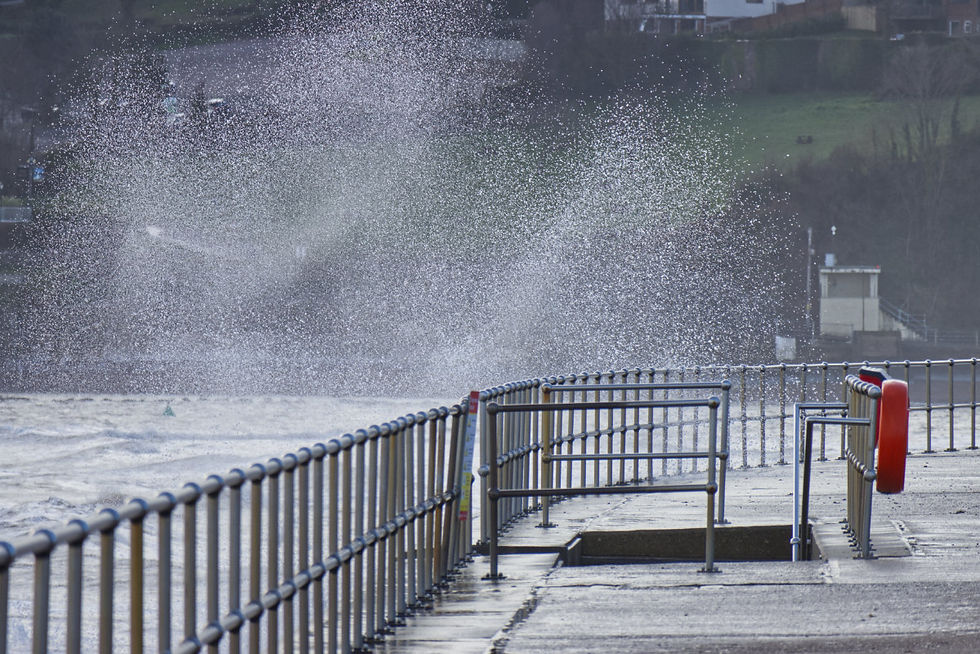
Devonshire has experienced severe weather during the last few days, and the heavy downfall of snow, which was practically universal, interfered considerably with business. In many places the removal of the snow, which was many inches thick, provided work for the unemployed. Some delays took place in the train services, and telegraph and telephone wires were affected. The seas were very heavy in North and South Devon. At Teignmouth the waves were 30ft high. At Dawlish the railway above the Coastguard Station was at times submerged. The blizzard was general all over the United Kingdom, and many deaths are reported through exposure.
At the end of the sea front, across the narrow gap of the Teign, Shaldon hoves clearly into view the other side, and my next series will be a walk around Shaldon. It starts right there in that view straight ahead. So when that starts we'll be looking back across the water. Shaldon may not be as exposed to the weather or the sea as Teignmouth but it has also weathered a few storms in its time.
Exeter and Plymouth Gazette - Wednesday 22 January 1913
SHALDON STORM EFFECTS
Rain and wind combined have caused the collapse of several chimneys at Shaldon. One at the house of Miss Matthews, Green End Cottage, fell at about 3.30 a.m. and caused great alarm to the inmates and neighbours. At about 8.30 another fell at the house of Mr. and Mrs. Winsborrows, Middle-street. Most of the debris fell through the roof on to a bed, where a few minutes previously Mr. Winsborrows just had been sleeping and then down into the sitting-room below. Luckily the wind blew the chimney-pot into the back yard, other wise more damage would have been done, as there were several people about at the time. A third chimney fell at Mr. Bartlett's, The Hill, but no damage was done.


Comments