The Faces of East Portlemouth

This is a selection of details from the 15th century painted figures on the rood screen of East Portlemouth church in South Devon, characterful faces that have peered out at the congregation for 500 years. Saints over the centuries acquired traditional manners of portrayal in an era when most people were illiterate. How they are dressed or what they carry are clues to their history, so I have added where possible brief descriptions. The church itself is covered in a separate post here.

St Andrew, initially a disciple of John the Baptist, followed Jesus and, recognised him as the Messiah, and introduced his brother Simon Peter to him. He is usually depicted as an older, bearded man, representing wisdom.

Saint Hubert (c. 656–727), the patron saint of hunters, mathematicians, and metalworkers, is most commonly depicted in Christian art experiencing his conversion in the forest. In East Portlemouth he is seen holding a hunting horn dressed in the attire of the Bishop of Liège. He is often depicted with a "key," a metal tool traditionally used to cure rabies, which is often shown as a small, T-shaped iron key.

Saint Quirinus of Neuss, a 2nd-century Roman martyr, is most commonly depicted in Christian art as a Roman tribune (military officer) or knight. His imagery highlights his conversion from a persecutor of Christians to a martyr, often showing him in, or accompanied by, Roman military attire. He is shown wearing Roman armour, frequently with a red cloak. He often holds a banner, flag, or pennant (sometimes with a cross) in one hand, representing his military rank and his victory in faith.

Saint George is most commonly depicted in art and iconography as a heroic, chivalric knight in shining armour riding a white horse and slaying a dragon with a spear. This iconic imagery symbolizes the victory of good over evil (or faith over the devil). In East Portlemouth he appears with what looks like a lion, a possible explanation is King Richard I, known as the "Lionheart," who sought the protection of St. George during the Crusades and adopted the St. George's Cross as a symbol, linking the saint to a king known by a leonine moniker.

There are two St's Cornelius but this one in Papal headgear is Pope Saint Cornelius (3rd Century). As a martyred pope, his depictions emphasize his role in the early Church, often featuring symbols related to his name or martyrdom: Because his name sounds similar to the Latin word for horn (cornu), he is frequently shown holding a cow's horn or a horn-shaped vessel.

St Winwaloe and St Dominic.

St Winwaloe is covered in more detail in my main post about the church and its history.

Saint Dominic (1170–1221), founder of the Order of Preachers (Dominicans), is most commonly depicted in Roman Catholic art wearing the traditional black-and-white Dominican habit and accompanied by symbols reflecting his life, preaching, and visions. He is often depicted holding a book (representing study and the Rule of St. Augustine). See the full image above, where he is holding a red book.


Saint Gregory the Great is most commonly depicted as a Pope and Doctor of the Church, usually wearing full papal pontifical robes, a triple tiara, and holding a patriarchal cross. Sometimes shown, as here, with a book, symbolizing his role as a Doctor of the Church and patron of teachers/musicians.

A Scholar (St Augustine). This character is not definitely identified as there aren't many clues. It is best guessed as St. Augustine.

Saint Mark the Evangelist is most commonly depicted as a winged lion, symbolizing the royalty, courage, and resurrection of Christ. As an author, he is portrayed as an older, bearded man writing his Gospel with a book or scroll, as in this case.

Saint John the Baptist is commonly depicted as a rugged, emaciated desert hermit wearing camel hair, often holding a reed cross, pointing to heaven, or embracing a lamb (symbolizing Christ). Alternatively, he is portrayed as a graceful, young, toned figure in the wilderness. Frequently holds a reed cross with a scroll.


The Choir of Angels and The Virgin Mary


The Virgin Mary is most commonly depicted in Christian art as a maternal, serene figure wearing a blue mantle (representing heaven/royalty) over a red garment (signifying love/passion). There are hints of blue in the cloak which may have faded over time. Queen of Heaven: Crowned and enthroned, highlighting her elevated status.
The aura, halo, or mandorla around the Virgin Mary symbolizes her sanctity, divine grace, and purity, often appearing as a luminous golden ring (nimbus) or a full-body radiant light (aureole) as in this image. Emerging in Christian art around the 5th century, these symbols signify her unique, honoured role as the Mother of God and Queen of Heaven.


A female martyr who is unidentified.

This figure is described at the church as St Peter. I have researched how St Peter is depicted and that doesn't seem to quite fit with this image. I have though asked the question, "which saint is depicted with a sword and a book?". This figure stands out in the church as being one of the most clearly depicted with no doubt that he carries a sword and a book.
The saint commonly depicted carrying a sword and a book is Saint Paul the Apostle. In Christian art, the book symbolizes his writings (the Epistles in the New Testament), while the sword represents the instrument of his martyrdom (beheading in Rome) and his role as a defender of the faith.

This figure carries a sacred heart, a book and wears a crown of thorns, so there is little doubt that it is St Catherine of Sienna.
St. Catherine of Siena is commonly depicted as a Dominican tertiary wearing a white habit and black cloak, often in intense prayer or receiving mystical visions. Key symbols include a crown of thorns (her choice for spiritual glory), stigmata (Christ’s wounds), a lily, a book, or a heart, reflecting her piety, purity, and intellectual contributions as a Doctor of the Church.

Edward the Confessor is primarily depicted as a pious, serene, and saintly king with a long white beard, symbolizing his role as a holy, albeit sometimes weak, ruler. As the last Anglo-Saxon king before the Norman Conquest, he is portrayed as a dignified figure, often associated with his foundation of Westminster Abbey and his canonization in 1161.
This figure is not decided and is thought to be Edward the Confessor. His childless marriage to Edith of Wessex directly triggered the succession crisis of 1066 and the Norman invasion. If this figure is not Edward then the next best guess is Roger Champernoun the donor of the church.
Roger Champernoun (c. 1411–1461) was a 15th-century English landowner and figure in Devon, known as a son of Sir Alexander Champernowne and Joan Ferrers. He was associated with the Beer Ferrers area and is sometimes linked in regional history to patronage, such as at East Portlemouth church in 1450, though some genealogical records suggest an earlier death.

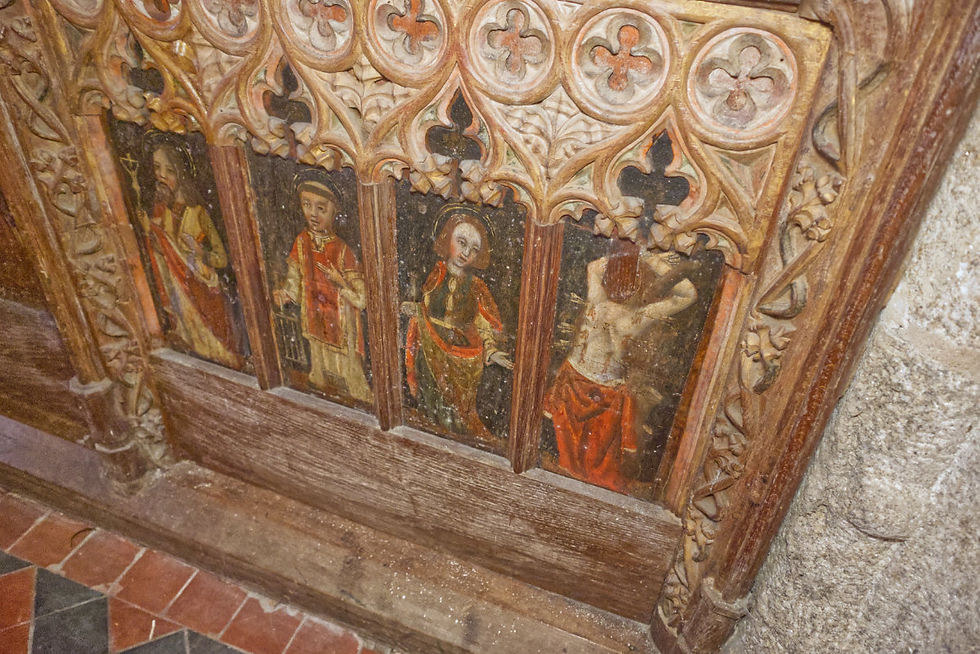
St. Francis of Assisi is typically depicted as a humble, emaciated friar wearing a coarse brown, grey, or undyed habit tied with a three-knotted rope representing vows of poverty, chastity, and obedience. He is frequently shown receiving the stigmata, surrounded by nature/animals, or holding a crucifix.

St. Lawrence is primarily depicted in Christian art as a young, tonsured (head left bare on top by shaving off the hair) deacon wearing a dalmatic (often golden or red), carrying a gridiron, which symbolizes his martyrdom by being roasted alive. He is frequently shown holding a book or palm branch, representing his faith and victory, sometimes accompanied by a putto holding a martyr's wreath.

The Gridiron: This is the most common attribute, symbolizing his torture under Emperor Valerian. He is portrayed as a deacon of the early Church, wearing a dalmatic, the type of vestment shown here.

St. Bavo of Ghent is typically depicted as a 7th-century nobleman or knight who renounced his wealth, often shown in transition from a military figure to a humble monk. Common iconography features him in armour (representing his past) while holding a falcon or in a monk's habit. He is often portrayed distributing his wealth to the poor, or being received by Saint Amand, reflecting his conversion.
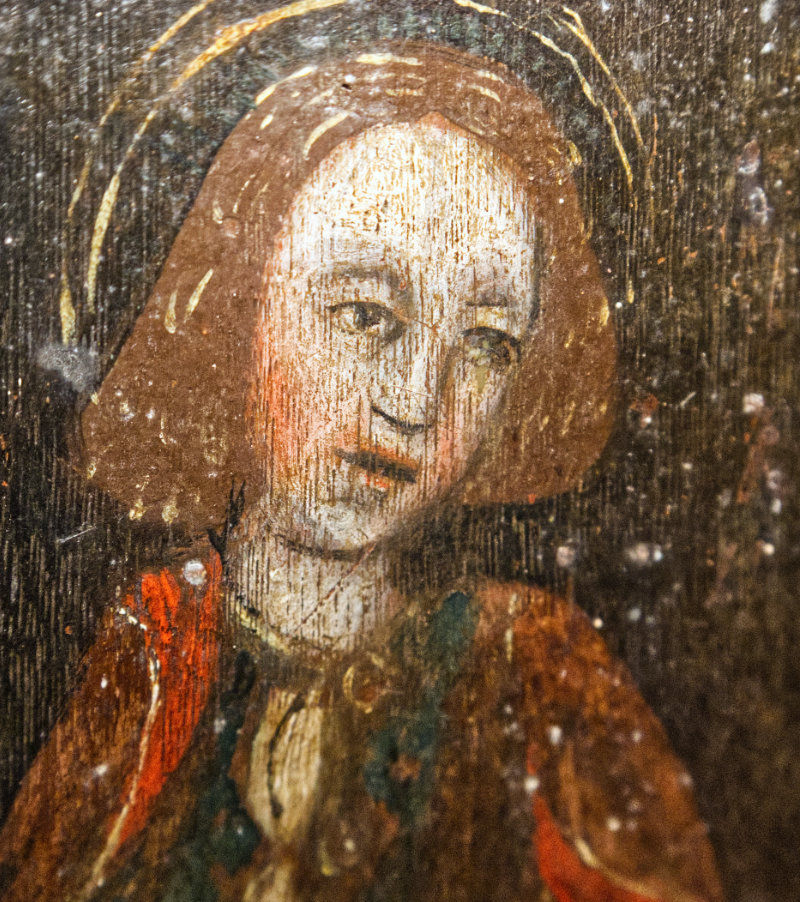
In this detail it is just possible to make out the falcon on his right arm.

Of St Sebastian there is no doubt, his depiction in art being so common. His body pierced with arrows is his signature martyrdom.
Saint Sebastian is most commonly depicted in art as a, young, handsome, and nearly naked Roman soldier, tied to a tree or post with his body pierced by arrows.

This figure is not mentioned in the church and there is very little left to identify who it may have represented.

Next in our panoply of saints are two unidentified women. Not being happy about their anonymity and with the importance of all the other saints established I described them to Google and this was what I found. Bear in mind that in this set of four images we have Jesus and St Jerome on the right, which makes it quite a select gathering. So who could these two unidentified women be?

The only things I have to go on are the fact that both figures hold what appears to be a chalice in their hands, and the figure on the left has an unusual wild headgear and long hair arrangement.
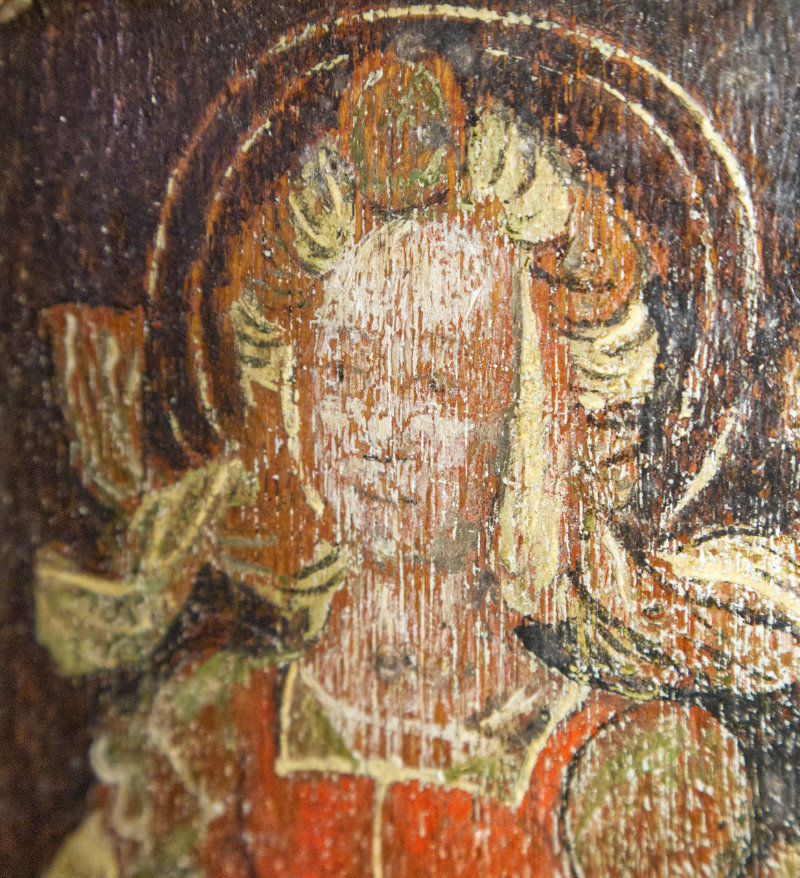
The two main suggestions from Google for female saints holding a chalice are Saint Barbara and Saint Mary Magdalene.
Saint Barbara: She is the most prominent female saint depicted with a chalice. In Orthodox tradition, she is often shown holding the chalice because of her prayer that those who remember her martyrdom would not die without confession and communion. St. Barbara is frequently portrayed in Christian art alongside Jesus, often signifying her role as a martyr who received the final communion. Common depictions include her holding a chalice with the Host (body of Christ), representing her desire for the last sacraments
Saint Mary Magdalene: She is sometimes portrayed in 16th-century Italian art holding a chalice, often interpreted as the vessel of precious ointment she brought to the tomb of Christ, she is shown in art with long hair.
So with that, and I am no expert, I leave you to consider these two possible suggestions.

This figure described as God the Son, or Jesus Christ, is a bearded man on a throne wearing a crown. There are only two figures in the church that appear to be surrounded with a sort of stylised aura, the other being the Virgin Mary.
The portrayal of Jesus on a throne, known historically as Christ in Majesty or Maiestas Domini, is a central image in Christian art depicting him as the ruler of the world. This iconographic style developed in early Christianity and remained consistent through the Medieval and Baroque periods, often showing Jesus as a king, judge, and divine figure.
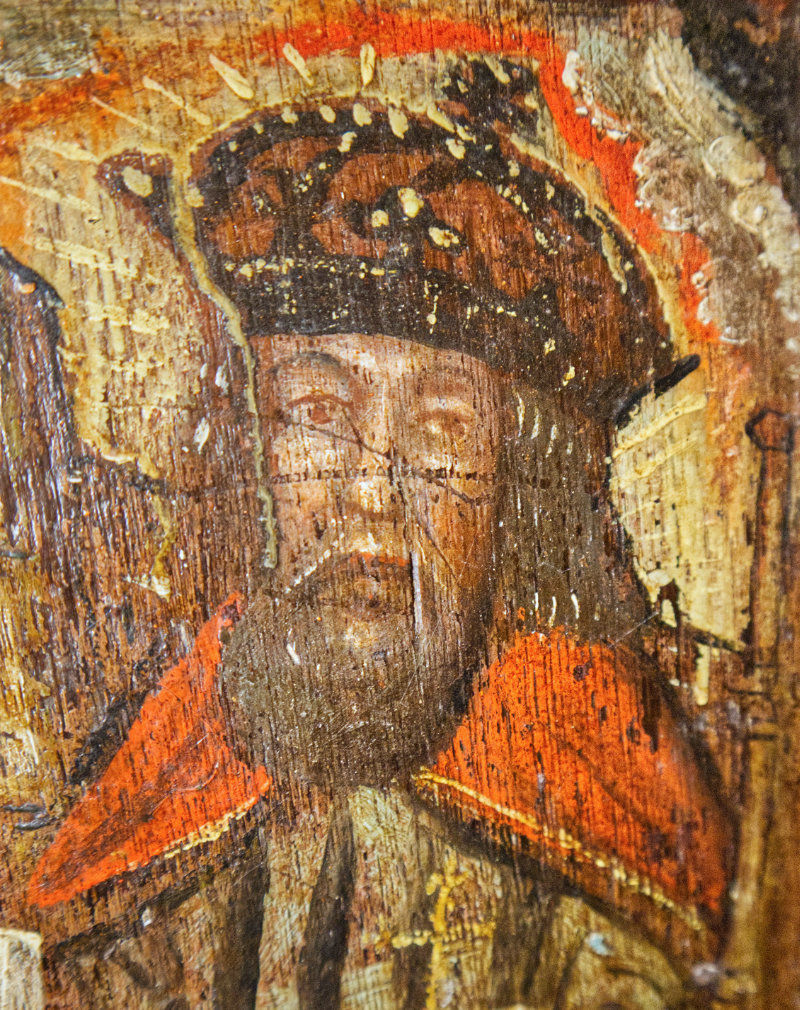
Two Natures of Christ: The two upright fingers (index and middle) symbolize that Christ is both fully human and fully divine.

On Jesus's left hand side is St Jerome. While living as a hermit in the desert, a limping lion entered Jerome's monastery. While other monks fled, Jerome approached the beast, removed a large thorn from its paw, and cared for the wound.
In gratitude, the lion remained with Jerome in the monastery, acting as a gentle companion and sometimes guarding a donkey owned by the monastery. In paintings and sculptures, the lion often lies at the feet of St. Jerome, symbolizing his dedication to scholarship (translating the Bible) and his taming of wild, angry, or passionate traits.
The Cardinal: Though he lived before the office of cardinal existed, he is frequently shown wearing a red cardinal's hat or robe, representing his service to the Pope.


The new altar, priest’s stalls and reredos (painted by Gerald Smith) were all designed by Sir Charles Nicholson in the 1934 restoration. The altar is of oak and walnut, bearing a carved and gilded design of wheat and wine, emblems of the Blessed Sacrament. The paintings in the reredos represent St. Nicholas, St. Hubert, St. Winwaloe, the Virgin Mary, St. Martha and St. Cecilia.
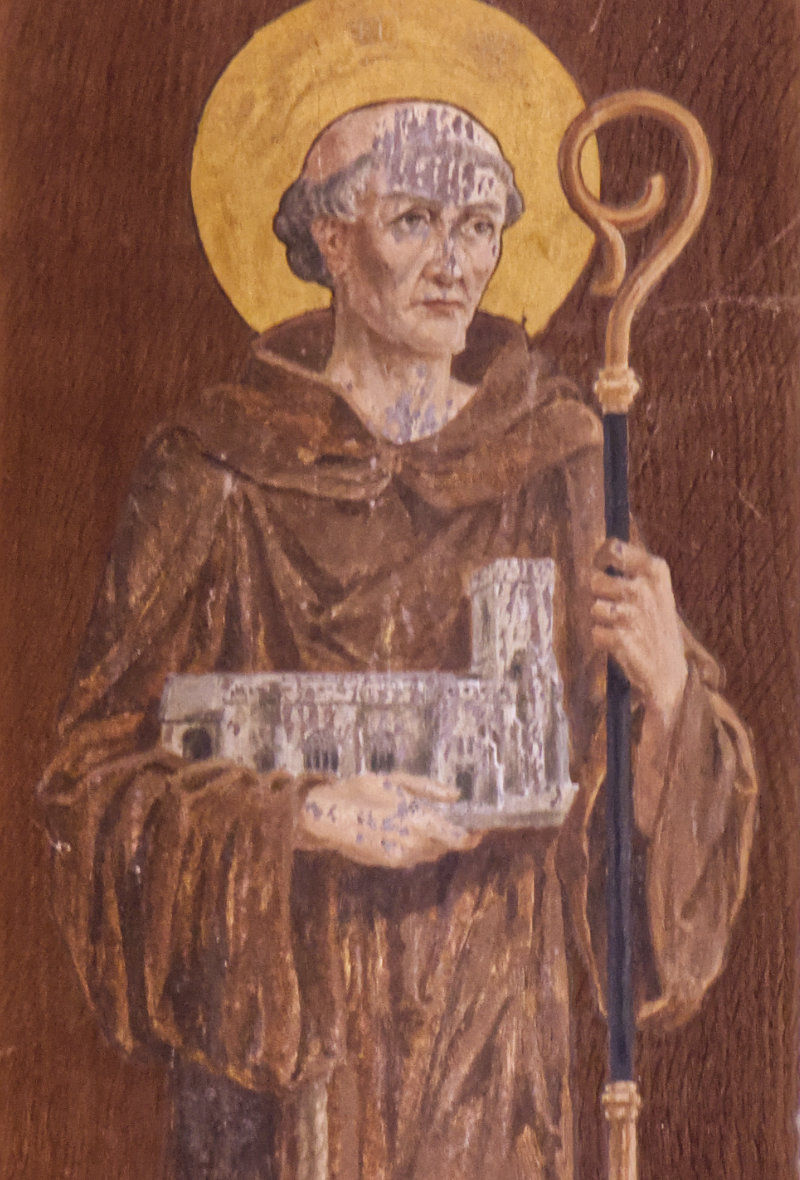
A word of warning about the paintings on the reredos. These have been here less than 100 years but something is seriously wrong with the way they have been applied, as you will see from the detailed images. Several of the figures have lost large areas of paint and at this rate of degradation I would suggest that the church authorities need to act pretty fast to have these assessed by a restorer before irreparable harm is done. Of course this may already be in hand.
Exeter and Plymouth Gazette - Friday 22 January 1937
BISHOP OF EXETER AT EAST PORTLEMOUTH
The Bishop of Exeter (Dr. C. E. Curzon) paid his first visit to the Woodleigh deanery on Saturday, when he dedicated a new altar, reredos, and Communion rails at East Portlemouth Parish Church. The altar which was dedicated is made of oak with walnut panellings, and was given by Mrs. H. Waterhouse. The reredos, on which are the figures of six saints, was also presented by Mrs. Waterhouse, while the Communion rails, carved from oak, were the gift of Messrs. A. G. C. Sutton and J. H Scrutton. The service was conducted by the Rector (the Rev. C. Avery), and among the other clergy present were the Revs. G E. Porter, R.D. (who acted as Bishop's Chaplain), H. C. B. Lethbridge, B. N. Adams, A. F. Minnitt, A. J Mills, and Preb. V. Young.
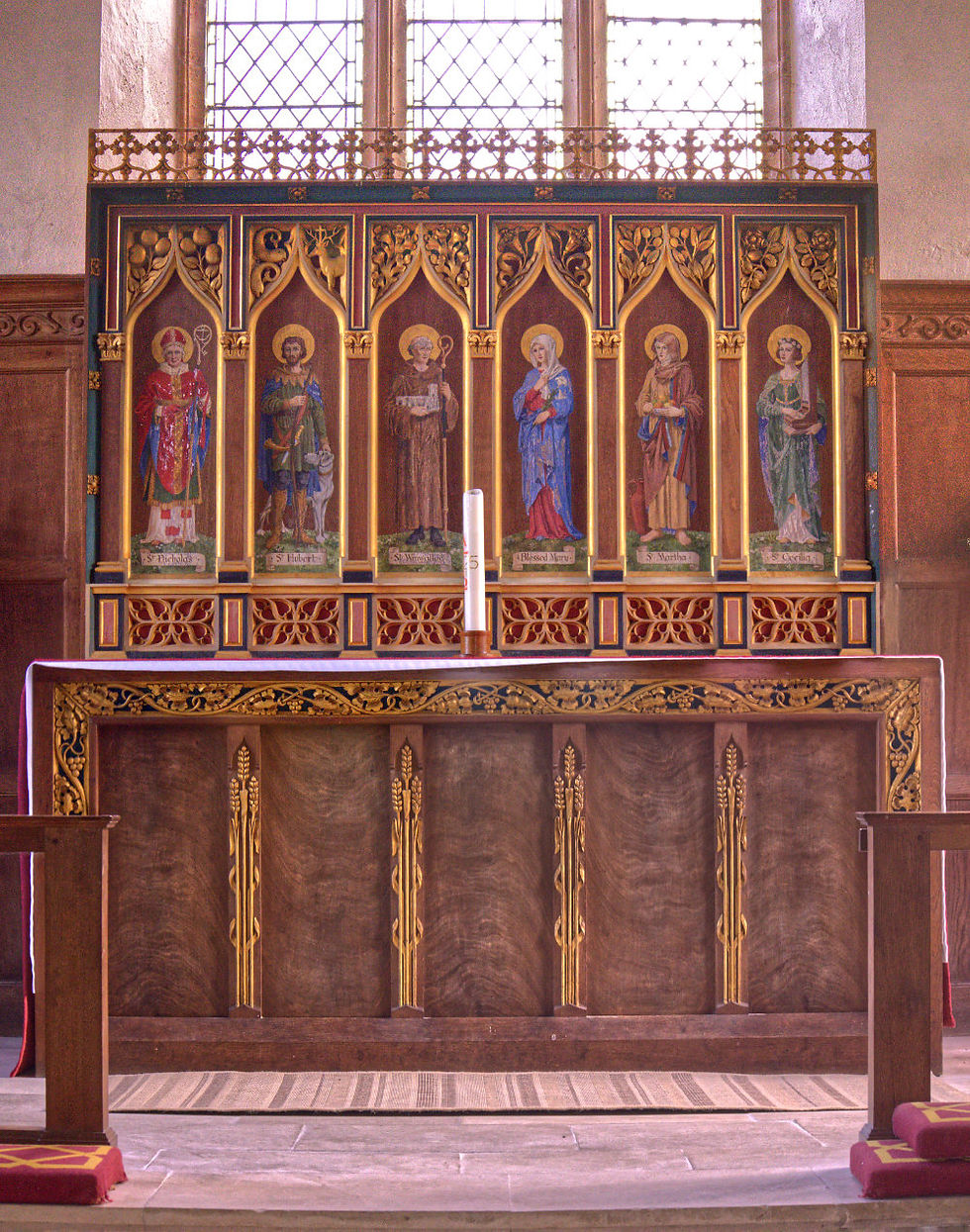
St. Nicholas, who was not only the protector of children but of sailors too. This could be why he is here in this community that has experienced much loss of life on the sea.
St. Nicholas is often portrayed holding or being associated with a boat because he is the patron saint of sailors, mariners, and travellers. In Christian iconography, especially in Eastern Orthodox tradition, he is depicted as a protector rescuing ships from stormy seas.

St. Hubert. The Courtier and Hunter: Before his conversion, he is depicted as a wealthy, aristocratic courtier, often dressed in elaborate hunting attire, such as a gold damask tunic, with his dogs nearby.

St. Winwaloe. See the main post here.
The Virgin Mary is most commonly depicted in Christian art as a maternal, serene figure wearing a blue mantle (representing heaven/royalty) over a red garment (signifying love/passion). Queen of Heaven: Crowned and enthroned, highlighting her elevated status.
The Madonna lily (Lilium candidum) is the primary lily associated with the Virgin Mary, symbolizing purity, virginity, and the Immaculate Conception. Frequently featured in Annunciation art, this white flower is often shown being presented by the Angel Gabriel.

St. Martha is primarily portrayed as the patron saint of hospitality, cooks, and servants, often depicted in art with symbols of domestic duty like a ladle, broom, or keys. She is the epitome of serving others.

St. Cecilia is primarily portrayed in art as the patron saint of music, often depicted playing a portative organ, viol, harp, or lute, frequently with a heavenward, ecstatic gaze indicating divine inspiration. She is typically dressed in noble, classical robes, sometimes wearing a small coronet or holding roses/lilies representing her purity and vow of virginity.


Comments