St Winwaloe of East Portlemouth

Updated: Mar 15
This was a story I was not expecting, not the least of which was discovering a Saint I had never previously heard of. The small church of St. Winwaloe in East Portlemouth in Devon is easily missed, even if you live nearby. I must have driven past it a hundred times over the years without really even noticing it, coated as it is in grey cement render, looking like a mid twentieth century council house, but that impression couldn't be more wrong. It's actual history goes back centuries. Here is Saint Winwaloe himself looking out at the congregation from the painted rood screen, from where he has looked upon the worshippers of this place for 500 years.

This painting of Winwaloe though, is a latecomer to this site because there is some evidence that there was a possible Saxon church right here even before the Norman invasion of 1066. The church yard is oval in shape, albeit with later squared off corners, while later Norman churchyards were square. Any Saxon church would have been constructed from wood and any evidence if there was some would likely be under this stone church built around 1160 to 1180. As we have seen with my other local church histories, this church is not visible from the sea but is hidden away from the prying eyes of passing raiders travelling along the English Channel. It is on the landward side of the Prawle peninsula and high up on the hill, a great refuge in times of danger.

Today's Portland cement exterior replaces the original lime render which used to cover the porous local stone, to keep out the worst effects of the stormy winter weather here in the south west.
At this point it is worth familiarising yourself with the relevant geography of this part of the world around the time this church was built and just before. Useful roads inland in places like Devon and Cornwall only arrived in about 1800 - 1850 as the toll road system was born and roads were widened and bridges built that could accommodate wheeled transport. In the centuries before this, transport was by boat which made the sea, the superhighway of its day.
Here is an image showing the Celtic Sea. It links Ireland, Wales, Cornwall, Devon and Brittany in France. This area of Europe was on the edge of Roman and later Saxon invasion. All of these modern politically separate entities today were once culturally and ethnically connected. Even in the 20th century Welsh language speakers were capable of conversing with native Breton speakers in France. This will help to understand our saintly story of Winwaloe.

So what does actual history prove about this church? The first known definite reference to it was in 1181 in a Papal Bull by Pope Alexander III. In fact Alexander died in that year too, so think about this, a man called Rolando born in Sienna in Italy who taught theology in Bologna and who became the Papal Chancellor and then Pope, the most powerful man in Western Europe was aware of this small church in this remote outpost of civilisation.
It was an interesting and dangerous time to be Pope and in fact during much of Alexander's time in office there was also an Antipope called Victor. Europe was split politically east and west and there were disputes and treaties aplenty, which saw Alexander receive the most support but not the ability to securely reside in Rome. The Holy Roman Emperor Frederick I Barbarossa was the trouble maker who supported Victor IV. Victor excommunicated Alexander and Alexander excommunicated Victor and Frederick in return, stalemate.
Eventually Frederick who had got too big for his boots was defeated at Legnano, where thousands fought a bloody battle and hundreds died, and consequently in 1176 he recognised Alexander as Pope. While all these events were taking place a small group of men were hewing local stone and building this small church. Not as we see it today, but we'll come to that.

There are three known churches dedicated to Winwaloe in England, two in Cornwall and this one in East Portlemouth. This is explained by the politics of the time and the geographical connections on The Celtic Sea superhighway. So who was Saint Winwaloe?

When Pope Alexander mentioned this church in 1181 it was the property of Missenden Abbey in Buckinghamshire which was founded forty eight years earlier. That Abbey was dissolved by Henry VIII and demolished, so you could say in a sense that East Portlemouth church is what remains of Missenden Abbey. The abbey was founded by William De Missenden, and you may have guessed with that name that he was part of the new Norman ruling class of England. The monks who helped found the abbey all came from France too. Abbeys were big business and the Normans turfed out all the Saxon landowners and created large property portfolios, which their business executives, the monks, ran.
In the Domesday Book this village was part of West Portlemouth and the history is confused about who was who. What is fairly certain though was that this land was owned by a an Anglo-Norman family, possibly with the name Sancto Claro, later Sinclair. We were now over a hundred years after the invasion, so Norman rule and culture are well established and links with Normandy were very strong. The Norman Lords and their religious orders now owned most of England.
We are so far back in time that it isn't certain why the church was dedicated to St. Winwaloe but even that name is confused by time. The saint is so ancient that his name changed over the centuries when illiteracy by the majority led to mispronunciations, mistranslations and misspellings. Winwaloe was also known as Gwenaloe, Wingualveus, Winwaloy, Walovay, Wincadoc, Onolaos, and in France as Guingalon and also Vignevaley. And the name changes didn't all happen centuries ago either, in the early twentieth century it was decide that Winwalloe had two L's while as recently as 2006 it was decided to drop one of those L's to give us the most recent Winwaloe.

The history of Winwaloe is also unsettled according to my research so I will go with the information listed at the church itself, make of it what you will. Winwaloe was born in Wales to a local family. The Romans had largely left Wales by 383 AD and in 462 AD the family was driven from their home by Saxon invaders and using the Celtic Sea superhighway, travelled to safer Brittany. This was around the time Winwaloe was born so there arises some question about his birthplace. Some accounts have him born in Brittany, but what is not in dispute is that he grew up there. As a young man Winwaloe found his vocation to religious life, becoming a disciple to Abbot Budoc on the Isle of Laure. He later built his own monastery at Landevennec just south of Brest. He died in 530.
Unusually for saints at this early stage of Christianity, his death was uneventful, he died of old age, while standing at an altar in prayer in his monastery. No arrows, fires or torture of any kind.
Many legends are linked to this man who clearly did exist and who clearly made a name for himself. He is described as "never dejected, never unduly elated. He never laughed at anyone, he was always modest, humble, calm and courteous, affable and kind to all, never angry".
Winwaloe is said to have healed a snake bite, cured the eyesight of his sister in a fantastical manner, instantly healed a broken leg, and appeared as a vision to a shepherd, keeping him safe from attacking wolves.
All of this was well before the Norman invasion though, so was there a church here earlier and was that already dedicated to St Winwaloe. After his death around 532 AD, his monks founded a monastery in Cornwall. His Patronal Day is the 3rd of March.
In Cornwall the reputedly, "oldest church in the county", is also dedicated to St Winwaloe at Gunwalloe and the original church on that site was 5th century, so well within the period when Winwaloe was alive or just recently deceased. That church was right on the beach with the Celtic Sea lapping at its foundations. We have to ask, therefore, if there is any connection between the church at East Portlemouth and that earlier time period, when the Romans had not long left England forever.
This part of Devon and the region down to the tip of Cornwall had very little Roman occupation, it was the edge of the empire, frontier territory, they had left Devon by 410 AD. The Romans conquered Brittany in 56 BC but Romanisation was superficial in what was again the extremities of empire. Romanization in Brittany was primarily concentrated in towns and along three main roads; the rural population continued to use Celtic languages and traditions. Roman rule in Brittany also faded out by 410AD. There was considerable migration from Britain to Brittany in the post Roman period and links were strong.
Many of Devon's traditional saints had Celtic origins, like St. Petroc, from South Wales, or St Rumon, from Ireland. To me it appears that the post Roman era saw these Celtic fringes around the Celtic Sea as a distinct community that clearly felt very connected, maybe even related.
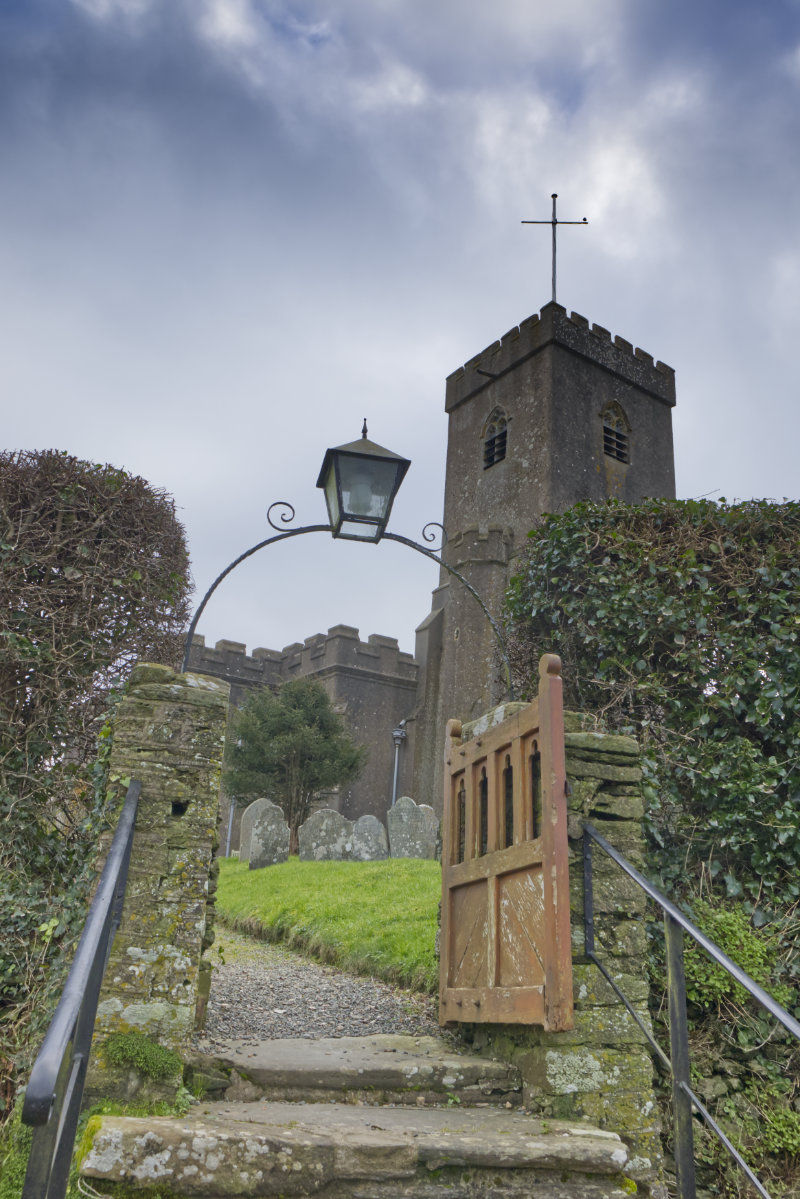
The church is listed Grade 2* by Historic England. Now we get to the details of the actual building, and we see this unusual exterior staircase to a room over the porch. These steps lead to a parvis or priest's room. Both the porch and parvis were added later in the 16th century. The church did not have a permanent priest so visiting priests would have arrived on horseback using the mounting block still present by the lych gate to dismount from their horses.
The tower was built between 1400 and 1450. The original church consisted of the nave and chancel with two small transepts. Two side aisles were added to enlarge it in about 1450 to 1500 followed by the porch and parvis.

The likely earlier wooden church may have been built in the 10th century during the reign of King Athelstan who had close contacts in Brittany. After Winwaloe died the monks from his monastery travelled to Devon and Cornwall founding monasteries and churches but it is seen to be unlikely that this was one of those. Of course we'll probably never know for sure.
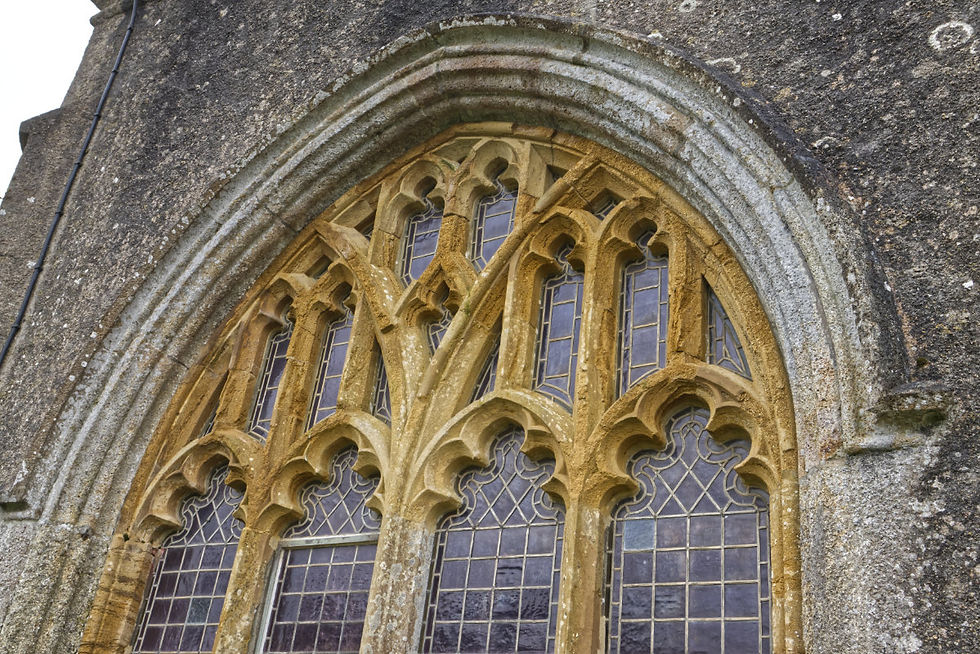
This window is in the north transept which houses the vestry.
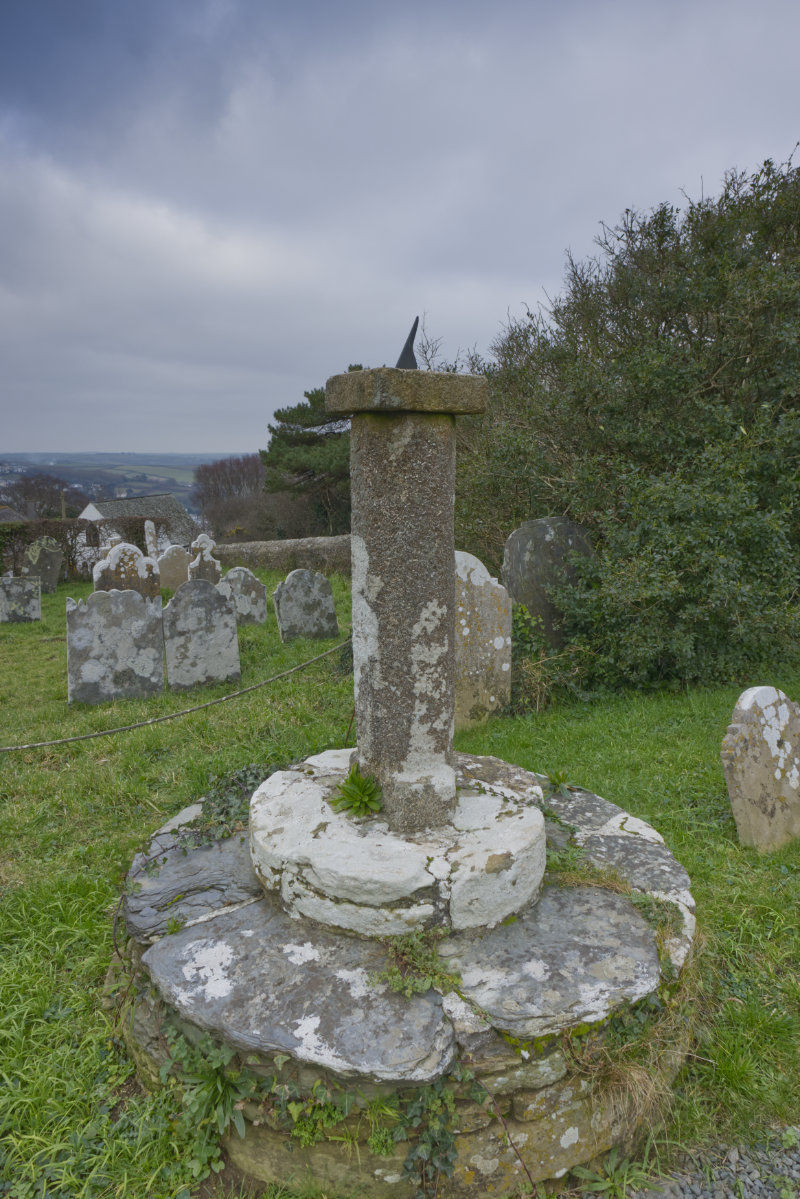
In the churchyard stands the remains of an early preaching cross that stood by the rectory. It was moved here in the 1980's and repurposed as a sun dial.
The porch has a richly moulded granite doorway with 4- centred arch and square hoodmould. There are stone benches inside on either side.

The porch houses a beautiful plain stone arch over the main door. In the Middle Ages the betrothal part of the wedding ceremony took place in the porch with guests seated on either side. After the betrothal ceremony the bridal party entered the church for the Nuptial Mass.

This interior view gives a good idea of the layout of the building. The original church of 1180 is the central area between the arches with the barrel roof. The two side aisles were added later in the 15th century as the population grew. This was very commonly done, although in some churches only one side aisle was added. This angle also gives a clear view of how the rood screen, late 15th century, runs the full width of the nave and side aisles. Not all churches have a full width rood screen still remaining.

The arch pillars, or piers, are today described as Pevsner A-type after Nicolaus Pevsner's classification from his Buildings of England series. Carved in granite there are 5 bays on each side of the nave. It is a commonly found 15th century pier design particularly in Devon and Cornwall. In this photo of the north aisle you can see the difference between the renewed roof of the aisle and the original medieval barrel roof of the nave. Being granite, the carved decoration of the capitals looks just as crisp as when they were made over 500 years ago.


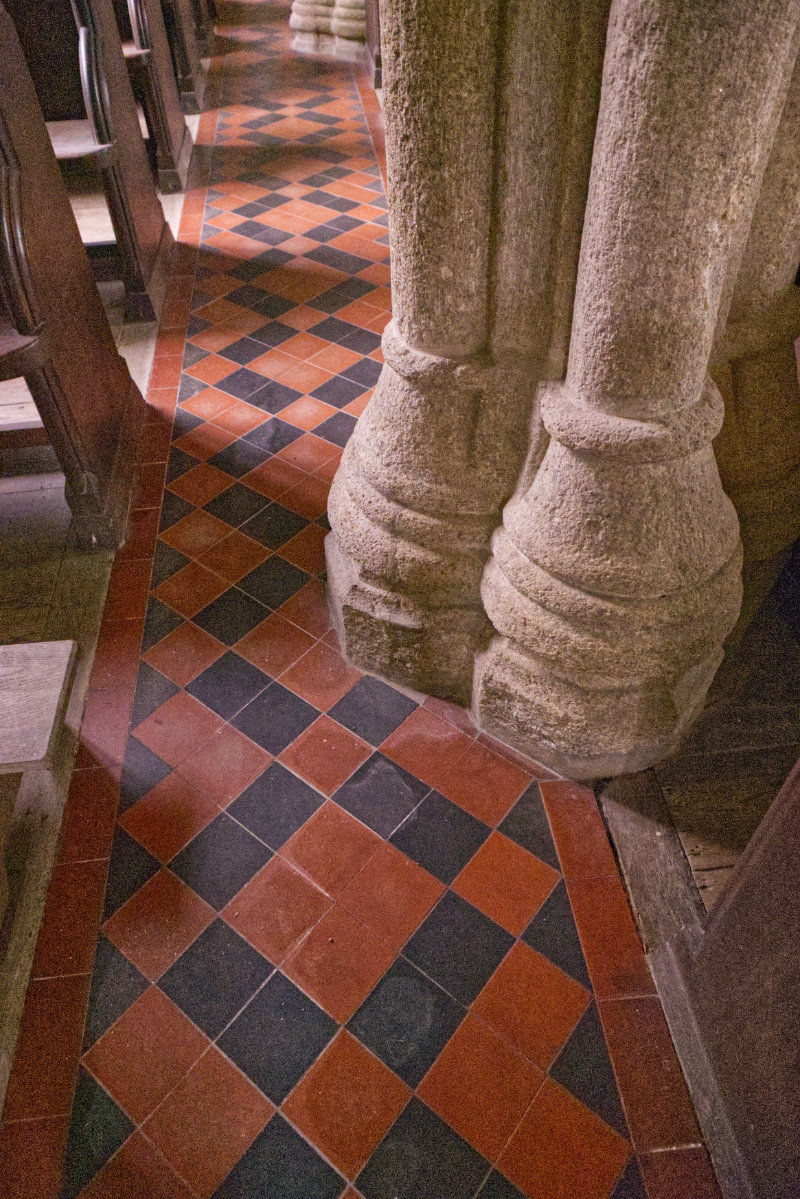
One curious feature of the bases of the piers is that they gradually appear with more detail as you walk up the central aisle, as you can see here in this series of photos. The reason is that the original floor sloped upwards towards the altar. This has since been covered by a level floor which reveals more of the original bases as you proceed towards the front of the church.



The octagonal font is beautiful in its rugged simplicity carved by a local stonemason in the 15th century. The panels are decorated with quatrefoils and shields.


The rood screen is much mucked about with, resembling an unfinished jigsaw, but is none the less an attractive feature that speaks and reeks of history. It is medieval and time has not been kind to its original parts which are interspersed with newer pieces added over the years.
Its last major restoration was in1934 with follow up work in 1962.

The chancel view of the screen shows much of its structure like an early anatomical study with the skin removed to reveal the very bones of it. This makes it all the more interesting to me.

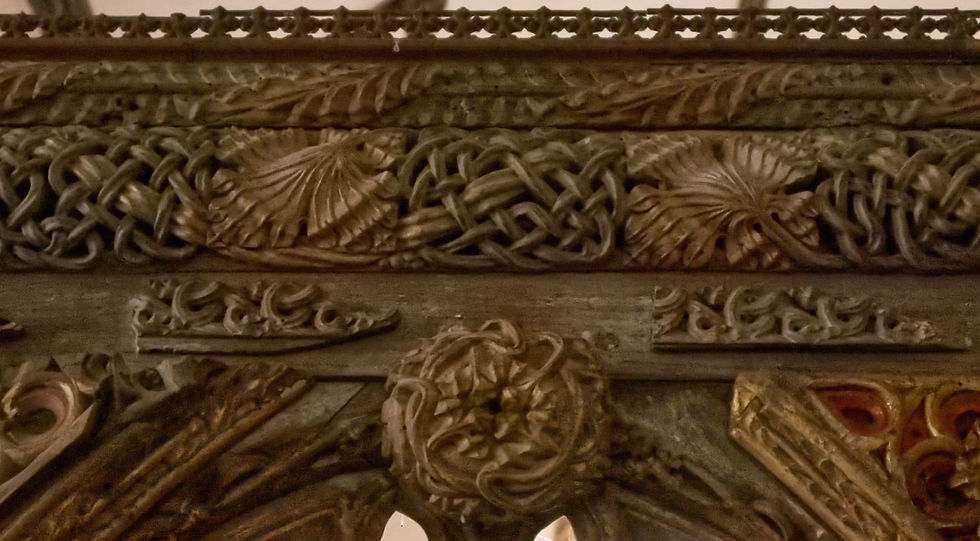
A decorative band of inhabited vine scrolling runs along the top of the screen, a decorative motif featuring a scrolling, twisting vine (vine-scroll) populated with figures, commonly birds, beasts, and sometimes humans, typically found in early medieval, Byzantine, and Anglo-Saxon art.

This motif often symbolizes the "Tree of Life". Below if you look carefully you can just make out another bird nestled in the vine, just right of centre, amongst vine leaves, tendrils and grapes.
There is a theory suggested by burn marks revealed on this structure that there was an attempt to destroy the screen by the Cromwellian forces encamped on Rickham Common in 1643-44.

In its original form, a rood loft or vaulting would have projected forwards and possibly backwards on top of the screen, to support a deck strong enough to carry choir boys for some services. Fragments of this decorative vaulting survive, nailed to the front of the screen arches.

The lower panels of the screen contain 26 paintings of saints. These faces of yesteryear peer out at their contemporary audience after 500 years. Although this is a common feature of rood screens in Devon they are rare in England. In panel number 6 stands Winwaloe himself holding a church to represent the monastery he founded.

This is the finest image in my opinion. The figure holds a hunting horn and a 3-layer cross. The information in the church describes this figure as a saint called Cornelius who is typically portrayed like this. Cornelius was the 21st Pope from 251 to 253 , Popes are traditionally portrayed holding a hunting horn and carrying the 3-layer cross. If you look at the headgear of this figure, you will indeed see that he wears the papal tiara. Popes since the 8th century have worn this triple crown, which has an interesting history. This has to be a rare survivor anywhere let alone here in this church, which does bear signs of presumed iconoclastic damage caused during the Civil War.

Iconoclasm in England, primarily occurring during the 16th and 17th-century Reformation and Civil War, was a sustained, often state-sponsored campaign to destroy religious imagery, stained glass, and, in some cases, monuments. Driven by Puritan, Protestant convictions against "popish" superstition, this movement focused heavily on removing items deemed idolatrous, such as crucifixes, statues, and paintings. AI Overview
Surely iconoclasts looking to destroy popish imagery would not have left the pope himself intact.

Were these paintings removed or covered during that period, or does the supposed damage attributed to Puritans have a different cause? We'll probably never know.
Here we see a choir of angels and the Virgin Mary. To see all of the painted panels in more detail I have made a separate post, Faces of East Portlemouth.

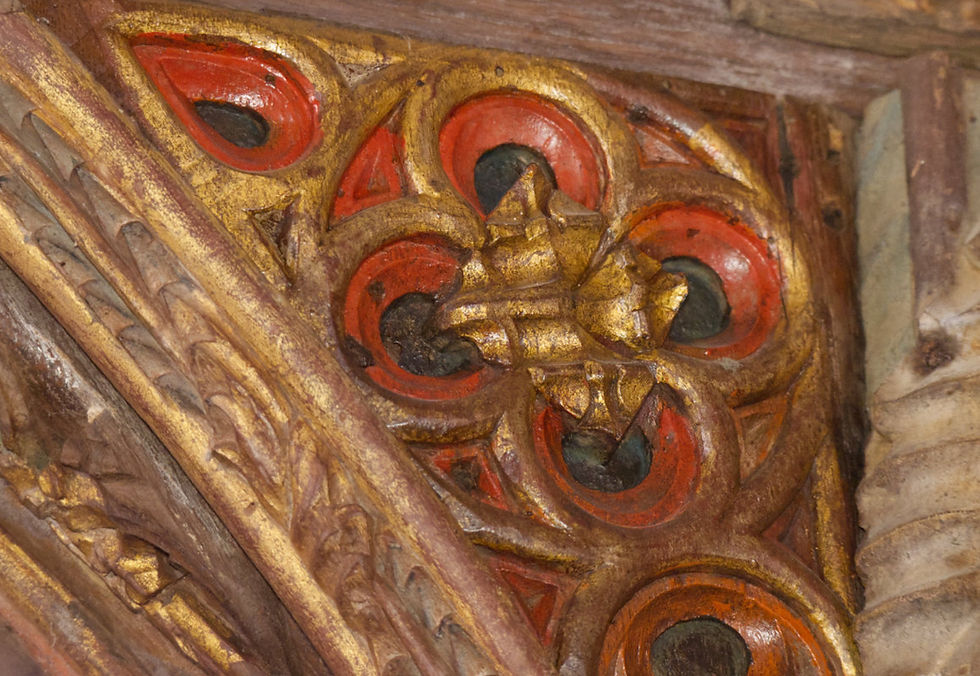
Along the top of the screen are a series of Tudor Roses. Parts of the screen still have original traces of colour.

Today East Portlemouth is out on a limb. The highway to the South West is no longer by sea but by motorway which starts in Exeter an hour away. As this excerpt shows though, as recently as 1898 mail connections were far better than they are today. Post a letter at 7.30 and it was delivered at 8.00, with two letter collections a day.
Totnes Weekly Times - Saturday 25 June 1898
Increased postal facilities have been granted to East Portlemouth, Kingsbridge. For the future the following will be the postal arrangements :- Deliveries-8 a.m., for the whole of Portlemouth District (local letters for this delivery should be posted at Salcombe sub-office before 7.30 a.m.), 3.15 p.m. for Ferry, Rectory, Holset, Rickham, and Portlemouth Village. Post local letters before 12.50 p.m. Collections from the wall boxes will be as follows :- Rickham, 11 a.m. and 4.10 p.m .; Portlemouth Village, 11.15 a.m. and 4.25 p.m .; Ferry, 11.20 a.m. and 4.30 p.m.

Even the local health body was improving its services,
Western Times - Saturday 26 June 1875
KINGSBRIDGE UNION.
A PUBLIC VACCINATOR WANTED.
THE Guardians of this Union will, at their Meeting to be held on SATURDAY, the 17th day of JULY proximo, proceed to elect a duly qualified PUBLIC VACCINATOR, for the 7th vaccination district of this Union, consisting of the parishes of East Portlemouth, Malborough, and South Huish, and containing a population by the last Census, of 3,233 persons. The fees will be, if the vaccinator's residence be under one mile from the station, 1s 6d ; if between one and two miles, 2s ; if above two miles, 3s. By order of the Board.
W. JARVIS, Clerk. Kingsbridge, 21st June, 1875

East Portlemouth wasn't exactly a major crime hub but there were crimes of a rural nature, that can be found in the archive. This court case is not dissimilar to some we see today with claim and counter claim, not to mention legal loopholes on offer.
Western Daily Mercury - Tuesday 02 September 1884
ASSAULTING A KINGSBRIDGE CONSTABLE.
At the Kingsbridge Petty Sessions yesterday, before Mr. T. H. Pitts (chairman) and Colonel Madden, county magistrates, John Cranch and Samuel Cranch were summoned for assaulting P.C. Waldron on August 9th. There was a cross-summons against P.C. Waldron for assaulting J. and S. Cranch .- P.C. Waldron said he had been asked by Mr. Ford, a farmer in the parish of East Portlemouth, to watch his orchard, and on the day in question he was there on duty when he saw the defendants come into the orchard and take some apples. He then went into the road and asked the defendants to give up the apples, which they refused to do. He then tried to take the apples from them, but on endeavouring to search them, the defendants caught hold of him and thrust him into the hedge, tore his tunic, and John Cranch threatened to strike him with a stick.
The defendants are, it appears, workmen of Mr. Ford's, and, on his being called, he said he had given the defendants leave to take apples to eat, but he did not tell the constable so .- Mr. W. DAVIES, who , defended for S. Cranch, stated that the only course open to the constable was to have arrested them, not to scare them, and that the defendants had a perfect right to resist, as it was only by the Game Act that a constable had the statutory power to search a person before arresting him on suspicion, and as there had not been an arrest in this case the defendants were quite justified in resisting, and consequently no assault had been committed .- The BENCH thought that an assault had been committed, and fined John Cranch 10s. and costs, and Samuel Cranch 10s., and 10s, towards mending the policeman's tunic and costs .- Mr. DAVIES applied for a case on the legal point at issue, and it was granted.

Here is another incident that ended up in court. Walking in the countryside also has its perils. To the positively Dickensian sounding Baronet Sir Lushington Phillips, this was a matter of honour.
Western Morning News - Wednesday 19 June 1889
THE VALUE OF A DOG.
At Kingsbridge County Court yesterday, before Judge Edge, an action was brought by Sir Lushington Phillips, Bart., to recover ten guineas, the value of a toy black and tan terrier dog, from Mark Whitman, of West Drayton, whom he alleged killed the animal by striking it with a stick .- Mr. Davies for plaintiff, and Mr. J. C. Carpenter for defendant .- For the plaintiff it was stated by Mr. Davies that defendant was walking on the hill at East Portlemouth when the dog ran out from a cottage and barked at him, whereupon he struck it with a stick causing its death.
The case came before the magistrates but was dismissed. Mrs. Partrige heard the dog bark and saw it was running after defendant. Immediately after she heard it cry and saw it go into the house. ' Defendant came up and said he waa sorry he hit the dog, but did not do it intentionally .- Sir Lushington Phillips stated that the dog was 16 months old. When brought to him by Partridge its eye was protruding, and upon its head was blood and foam : the next morning the dog died. Defendant went on his knees and begged him to forgive him, but he replied it was a wicked and cruel blow, and he would punish him as much as he could. He did not say he would ruin the defendant. It was a valuable dog; one similar be had sold for £40; it was not vicious-Mr. Carpenter, for the defence, said the dog was in the habit of snapping at people, and that it followed defendant sixty yards ; such dogs, he contended, should not be allowed at large .
The Judge : You don't mean to say that Devonshire people are afraid of a toy terrier pup .- The defendant deposed that the dog caught hold of his trousers, and as he was swinging his stick behind him it struck the animal .- Captain Yabsley knew the dog, and it had caught hold of his trousers twice . Mr. Davies, for the plaintiff, said Sir Lushington Phillips did not wish for any blood money. If the defendant would pay £3 to the Society for the Prevention of Cruelty to Animals, he would waive all the costs of the action .- The defendant agreed, and a verdict was allowed by his Honour to that effect.

This one is a very revealing case of a certain time and place and attitude. It all revolved around the strange question of when is a Rector a Gamekeeper. More rural intrigue, and this one involved a Duke and made the London papers.
Sun (London) - Saturday 04 October 1862
A CLERICAL GAMEKEEPER.
At the Kingsbridge petty sessions held this week, before a full bench of magistrates, Mr. John Adams, of Pinder Lodge, Kingsbridge, was charged by the Rev. Thomas Bury Wells with having trespassed in pursuit of game on a piece of land commonly known as Rickham Common, part of the manor of East Portlemouth.
Mr. Square appeared for the complainant, and Mr. Hurrell for the defence.
After Mr. Square had stated the case, The Rev. Thos. Bury Wells gave the following evidence :- I am the rector of East Portlemouth, in the county of Devon, I hold a deputation under the hand and seal of the Earl of Darlington, dated the 11th of October, 1827, appointing me his game- keeper for the Manor of East Portlemouth. I also hold a licence to kill game. On the 10th of September I was out shooting in a field called Stones Wall, in the occupation of Edward Burgain, part of the manor. I saw the defendant and a Mr. Soper with a gun and dogs there; one was a pointer, and the other a spaniel. I requested him to leave. He did not do so, but proceeded on as before. He then went over into Rickham Common. I saw his dog stand ; however, nothing then got up. I still followed and requested him to leave, but he went on as before. I saw partridges get up. He fired, and I saw a partridge drop and others fly away. I had never given him leave to shoot on the manor.
Cross-examined-I have never had any correspondence with the Earl of Darlington (now Duke
of Cleveland) from the time my deputation was granted until now. I have had no authority from him to institute this prosecution. I once instituted a former prosecution, but it was dismissed. The common is held with the different farms of the manor, and does not belong to any one more than another.
After evidence for the defence had been given to the effect that there was no reservation of game in the leases, and that there were no boundaries to the property,
The Bench considered that as the case constituted a question of right, it was out of their jurisdiction. They, therefore, dismissed it.
Mr. John Adams was then charged with having unlawfully refused to tell his name and address when required to do so by the Rev. T. B. Wells, the latter being the gamekeeper of the Earl of Darlington.
The Rev. Mr. Wells was again examined-He stated that some very angry language passed on the occasion of the refusal, and that the defendant had threatened to use his double-barrelled gun if he were molested in his pursuit of the game. Defendant held up an old envelope which he said contained his name and address, but he passed it back again so quickly into his pocket, that it was impossible to see what was written upon it:
Mr. Hurrell contended that the reverend game-keeper had been so much excited on the occasion as to be unable to give a correct version of what really transpired. The fact was, that the defendant had not only shown him the envelope, but had read him the address upon it, and moreover informed him of the name of the person next door to whom he lived.
The rev. gentleman seemed to think that, because he was the parson of the parish, he had a right to shoot everywhere. This, however, was not a right which could be exercised by him, even though he, as a Church of England clergyman, should be acting in the unaccountably strange character of gamekeeper to the Duke of Cleveland.
Mr. Richard Soper was called for the defence; after which, The magistrates considered that the case had not been proved. It was, therefore, dismissed. Mr. Wells essayed to address the Bench, but was immediately stopped.

By 1891 steam power had arrived and was in use in agriculture. Up to this point agriculture was hugely labour intensive and the rural population declined as farming became more industrial and intensive.
Totnes Weekly Times - Saturday 07 March 1891
EAST PORTLEMOUTH.
A serious accident happened to a labourer named Nicholas Yeoman, at Mr Ford's farm on Wednesday afternoon. The steam threshing machine was at work, the injured man pitching sheaves, and noticing that the belt connected with the engine was coming off, he tried to replace it with the prong that he was using. The belt caught the prong out of Yeoman's hands, and giving a turn it struck him in the bowels. Dr Twining, of Salcombe, was quickly in attendance, and the man is now lying in a very precarious condition.

As you may have noticed in the legal case already mentioned, the manor was owned by the Earl of Darlington, and the position of Rector was in the gift of the Patrons, the Countess Dowager of Sandwich and the Earl in 1839 when Thomas Bury Wells took over after the death of Samuel Wells.

In 1905 the Rector writing in the Exeter Flying Post, clarified the situation with the church's bells.
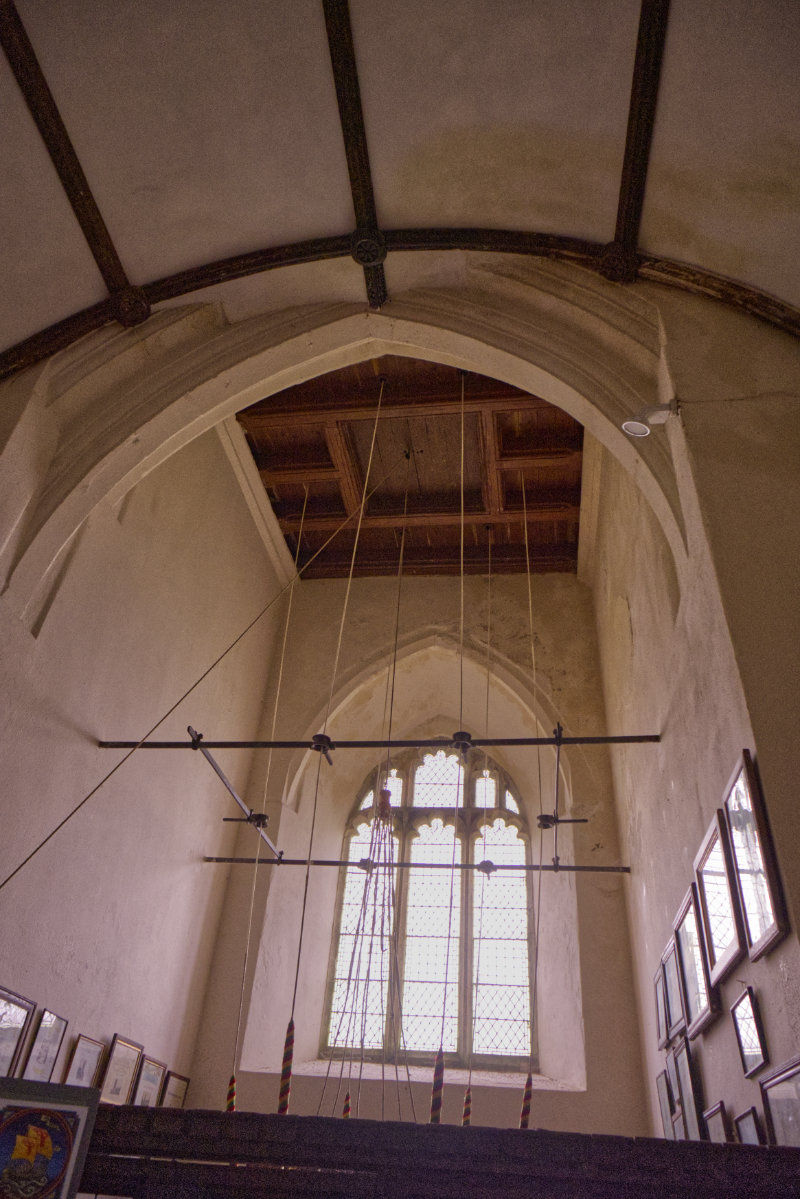
Sir,-Will you allow me a small space in your valuable paper to correct a false impression which may possibly arise from some statements in your "Local Gossip" column with regard to our church and bells, The reader might conclude from what is said that we have at present no bells. It is quite true that one bell lies, as stated, " on the floor of the tower broken into some three or four pieces." We have, however, three other bells, though only two can be used. The largest of these is a very ancient pre-Reformation bell, with the inscription in curious mediæval characters-
ME MELIOR VERE
NON EST CAMPANA SUB ERE
("There is, indeed, no better bell than me under
Heaven.")
Five bells were recast in 1912 by Taylor’s of Loughborough.
This memorial plaque, below, is dedicated to those who fell in the "Great War". Arthur Wilfrid Toovey died on the 1st December 1918, two weeks after Armistice Day, which is particularly tragic. He died in Cardiff from pneumonia. Robert Frank Michelmore died on 7th July 1916 and is buried at Lebucquierre in France near Calais. Arthur Lewis Tucker died in 1918.
John Parker Hannaford, known as ‘Jack’, was born on 2 October 1895, at Southpool, near Kingsbridge, Devon, but shortly afterwards the family moved to East Portlemouth, near Salcombe. He enlisted into the Devonshire Regiment at Exeter on 25 January 1915, arrived in France on 25 May 1915, and was killed in action on 16 September 1916. He is buried in Vermelles British Cemetery.
John Henry Powlesland died on 11th February 1917, and is buried in the Somme region of France. James Henry Favis died in Delhi on 24th September 1919. William Henry Wotton was an Able Seaman and died in May 1916, and served on HMS Indefatigable.

On July 1, 1916, the first day of the Battle of the Somme, British forces suffered a catastrophic defeat at Beaumont-Hamel, France. The 1st Newfoundland Regiment, attacking at 9:15 a.m., was virtually annihilated by German machine-gun fire, suffering over 80% casualties. The attack failed, marking one of the deadliest days in British military history. The 16th Battalion, Middlesex Regiment (part of 86th Brigade, 29th Division) attacked near Beaumont-Hamel, suffering 524 casualties during the failed assault on Hawthorn Ridge.


The organ was donated in 1903. Money was left in the will of Sir GE Hodgkinson, and nobody knows who he was or why he left the money. A firm of London solicitors informed the Rector of the bequest. The solicitors were also unable to explain the reason behind the bequest. It was rumoured that the gentleman had once been a visitor to Salcombe and had resided at the Marine Hotel there.
Exeter and Plymouth Gazette - Friday 29 September 1905
PORTLEMOUTH CHURCH
OPENING OF A NEW ORGAN
The new organ in East Portlemouth Church was opened yesterday afternoon, the event being combined with the harvest festival. The new organ is the gift of Sir G. E. Hodgkinson, who provided a sum of £500. Of this amount £475 has been spent on the instrument and £25 on the screen. The screen-one of the best in the district has been thoroughly cleaned and repaired. The organ, which is placed inside the screen in the south side of the church, is cased in wainscot oak, and is in keeping with the screen. The mechanism is part trocuer and part tubular pneumatic. Mr W. Beer, B.A., organist of St. Edmund's Church, Kingsbridge, presided at the instrument for the opening. Miss M. Yeoman, of Portlemouth, will be the organist.
The special preacher was the Rev. W. E. Burroughs, M.A ., B.D., of St. Andrew's, Plymouth, who based his remarks on Psalm ciii., 1. A tea was provided in the school-room, after which an organ recital was given by Mr. Beer. The sweetness of tone and the power of the organ were much admired. Mrs Mitchelmore and Miss Mirams rendered solos. At the evening service the Rev. W. Burgess, of Wembury, was the preacher. The church had been richly decorated, the screen being richly decorated with lilies. There were large congregations throughout the day.

The new altar, priest’s stalls and reredos (painted by Gerald Smith) were all designed by Sir Charles Nicholson in the 1934 restoration. The altar is of oak and walnut, bearing a carved and gilded design of wheat and wine, emblems of the Blessed Sacrament. The paintings in the reredos represent St. Nicholas, St. Hubert, St. Winwaloe, the Virgin Mary, St. Martha and St. Cecilia. For details see Faces of East Portlemouth.
St. Winwaloe, is again holding a model, in this case of the present church.

Here are the raw ingredients for bread and wine.

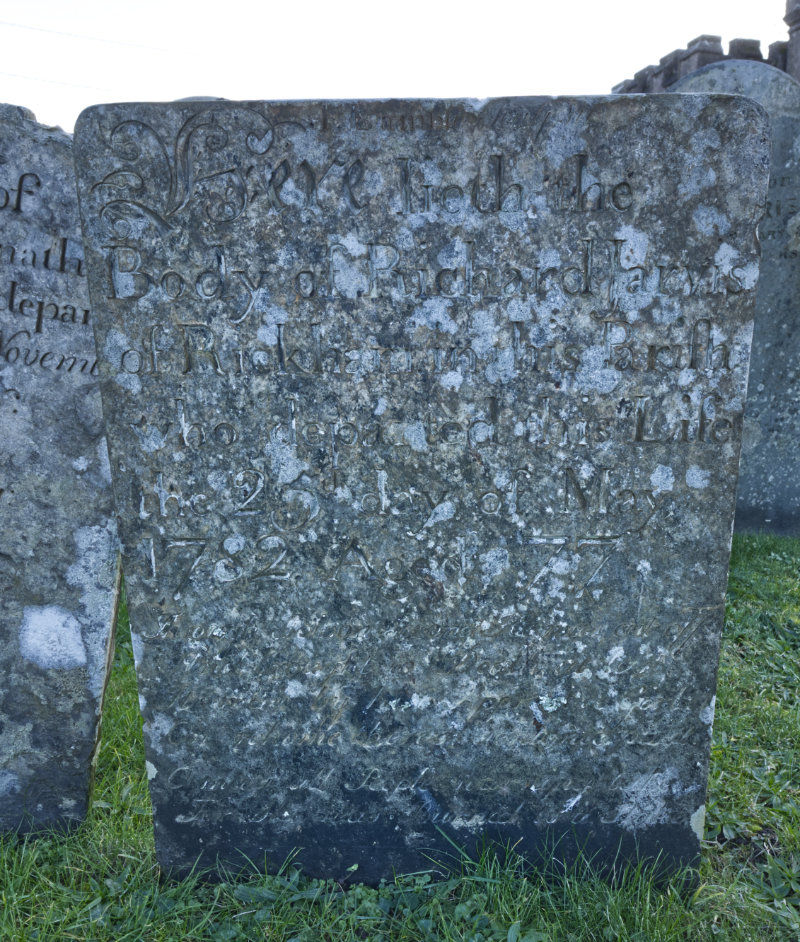
In the graveyard is this weathered tombstone bearing an unusual inscription,
Body of Richard Jarvis
of Rickham in this parish
Who departed this life
the 25th day of May
1782 Aged 77
Through Poison strong he was cut off
And brought to Death at last
It was by his Apprentice Girl
On whom there's sentence past
O may all People warning take
For she was Burned to a Stake
Yes, hereby lies a tale, as the saying goes, for Richard Jarvis was indeed poisoned by his apprentice who was found guilty of murder and burned at the stake. It only merited one sentence in the Salisbury and Winchester Journal, under the heading "At Devon assizes" because being burned at the stake, although not common by this time, was still not unusual.
Mention is made in some places that she was burned for being a witch, but I can't find any evidence for this as these contemporary accounts, below, reveal. In fact by 1780 women were not being burned for witchcraft so it is highly unlikely. At this time burning at the stake was still the penalty for murder. Rebecca was one of the last women in England to be burned at the stake as the penalty was banned in 1790. It isn't a lot of consolation but in fact executioners typically strangled the woman to death before lighting the fire. Being burned alive was exceedingly rare by this time, and more a result of negligence than deliberate procedure.
Salisbury and Winchester Journal - Monday 05 August 1782
Rebecca Downing to be burnt alive for poisoning her master, Richard Jarvis;
Newcastle Chronicle - Saturday 17 August 1782

The Rectory would originally have been close to the church but was moved, probably around the 15th century, to a fine site at Horse Pool Cove on the banks of the estuary. The 1840 Tithe map shows that a chapel had been built next to it. This would have been a private chapel for the rector, a not uncommon feature for Rectories some distance from the church.
The Rectory was rebuilt in the 19th century, but scandal was not far off, as we'll now see. By 1887 the then Rector was making headlines, but not in a good way. So I will end with this salutary tale.
Exeter and Plymouth Gazette - Friday 07 January 1887
THE AFFAIRS OF A DEVONSHIRE RECTOR.
The Rev. John Wheelock Goucher, Rector of East Portlemouth, near Kingsbridge, a bankrupt, appeared before Mr. Registrar Edmonds at the Stonehouse Bankruptcy Court on Monday .- In reply to the Official Receiver, the bankrupt said he was presented to the Rectory of East Portlemouth by the late Duchess' of Cleveland in June, 1879. Just before entering on the living the Duchess gave him a cheque for £600, and it was applied partly to clearing off his liabilities.
For context £600 then was about £40,000 today so he clearly burned through a lot of cash in only eight years, at a time when the cost of living was also comparatively much lower than it is today. The whole setup was a financial mess and he was juggling many funds from different sources clearly robbing Peter to pay Paul.
It's an appropriate phrase for a Rector in financial difficulties. Rectors served in what were termed "livings" and livings were given by landowners, quite often to family members of lower ranks or distant branches. Third or fourth sons, often got awarded livings. It was a gentrified welfare system for spare heirs. The phrase robbing Peter to pay Paul dates back to at least 1380. It may have originated in Middle English as a collocation of common names – similar to, for example, Tom, Dick, and Harry – with the religious connotations accruing later, or alternatively as a reference to Saint Peter and Saint Paul (who are often depicted jointly in Christian art and regarded similarly in theology). One reason for the frequent use of the two names in expressions is the alliteration they form. Wikipedia
The rest of the case is included below. It is an important revelation because it discusses the restoration of the church which was then in a state of "dilapidation". When taking on the living, reluctantly, according to him, Goucher claimed that he had informed the Duchess that the church and rectory needed £6000 at least, and the Duchess had agreed to foot the bill herself. It was a point of debate as to which building needed work first the church or the rectory but it was finally agreed that the rectory should be made habitable first as the rector was not allowed to live outside the parish. £1000 was spent on the rectory and another £460 from a fund was spent on the rectory "more being done than the assessment required". The registrar in the case, in fact, noted "the folly of building a mansion for a Rector with so small an income, the mere furnishing of which would cripple him".
These were staggering sums for the time, £6000 being nearly £400,000 today at a time when workmen were paid pennies. In fact the national archive currency converter suggests that this sum would have paid for 18,181 days of skilled labour let alone unskilled labour.

cont'd......
In London he was one of the Curates of St. George's, Hanover-square. At the time he entered on the living at Portlemouth the Diocesan Surveyor had estimated the dilapidations for which his predecessor was responsible at £788. The heirs of his predecessor obtained about £200 deductions in respect of pegs in cob-walls, slabs nailed up against cob-walls, and such things ; and from about the £600 they had to pay for dilapidations, they made large deductions in respect of grass seeds and unexhausted manures in the glebe. The matter was taken to the Court of Chancery, and he (bankrupt) had to pay the costs. Actually he received less than £400, but had to pay the full sum of $788 into the Queen Anne's Bounty Fund.........
(Queen Anne's Bounty, established in 1704 by Queen Anne, was a fund and corporation designed to augment the incomes of poor clergy within the Church of England. It redirected "first fruits and tenths"—taxes on church livings previously paid to the Crown—to increase the maintenance of underfunded livings. It was ultimately merged into the Church Commissioners in 1948.)
........To make up the difference he borrowed £350 from the Foresters, who now claimed for £313, he having repaid them £30 and £25. Until he had paid the £788 into Queen Anne's Bounty he could not get the living .- In reply to the Registrar, debtor said the rectorial tithes of his living were commuted at £347, but £60 had to be deducted in respect of the decrease in the value of the tithes, £30 was paid in Queen's taxes, and the Poor-rate was 2s 6d or 3s in the £. His nett income was not £200 a year.
Bankrupt said it was not true that he received large sums for writing sermons for other clergymen. He wrote articles for a few periodicals, but did not clear £10 a year by it ; indeed, after paying expenses the return was nil .- The Official Receiver did not oppose the bankrupt's passing. There was an impression abroad that the money borrowed for the purpose had never been paid into Queen Anne's Bounty, but that had been proved to be false .
- After the Registrar had remarked on the folly of building a mansion for a Rector with so small an income the mere furnishing of which would cripple him-the bankrupt was allowed to pass .- Answering further questions by the Official Receiver, the debtor said at first he declined the living absolutely, telling her ladyship that it would require £6,000 at least for putting the Church and the Rectory into anything like decent order. Her ladyship said she would do the work at her expense, the Church to be restored first. It was impossible for him to live in the Rectory unless a considerable sum of money was spent upon it, and the Bishop would not allow him to live out of the parish until the new house was built. Therefore, although the Duchess knew it would be money spent to waste, she agreed to the dilapidation fund being applied to the repairs of the old house, and to give £1,000 towards the new Rectory. The whole of the £460 received from Queen Anne's Bounty and other sums in addition were spent on the old house, more being done than the assessment required.


Comments