Brixham Stepping Out Part 2

Hang on to your hats, this is a tale of missing ships, Royal arrivals that changed the world, naughty boys with a football, a local genuine Oliver Twist, oranges and lemons, woolly mammoths, missionaries arriving to save Brixham's souls and lots and lots of steps.
In Part One of this series I had to go up a long flight of steps and in Part Two I will be going down a long flight of steps. For now though I am walking along the fairly level roads at the top of the steps.

This was the earliest map of Brixham I could find, showing the area of this part of the walk. It looks quite empty because none of what we are going to see had been built yet. The road running along the top of this map is Fore Street and it seems even parts of Fore Street on the south side are not yet developed. The area is just fields or vacant plots numbered for the tythe map. The map was made to record who owned what for tax purposes. A sort of modern Domesday Book. What you can see though are the country lanes above the town that would soon become roads and which would be lined with colourful houses.

Here are the houses along the main road called North View Road. There are several flights of steps down to the harbour end of town and from Mount Pleasant Road down into Fore Street. I hadn't decided yet which flight of steps I was going down.

This flight, Rea Steps is level with the harbour front and the Old Fish Quay, home of the replica Golden Hind. Station Hill rises up on the opposite side of town and I'll be exploring some of that in a later piece. In fact this name seems to have changed from Rae to Rea. At the top of the steps was Rea Hill and in 1903 there was still an old Ropewalk site there. The council planned to purchase it.

In this map you can see the ropewalk still marked. There are also two others shown at the top of the map and the bottom, and there was at least one on the other side of the hill in Furzeham. You can also see that Raehill is spelled in a different way too. These steps were also an issue.

Brixham Western Guardian - Thursday, 13 August 1903
The purchase of the old Ropewalk at the top of Rea Hill for the purpose of its conversion into a public thoroughfare is assured. The question of its purchase was deferred from the July meeting to await the opinion of residents in the neighbourhood thereon, with the result that about 120 petitioned the Council to purchase. The moving spirit in the preparation of the memorial was Mr. James T. Knight. Enough has been written and said pro and con on this acquisition to write further about it. Suffice it is to say that much needless talk could have been avoided at the Council meeting on Monday last, had the Surveyor been requested at the outset of the debate to supply his estimates for placing the steps on the front approach into safe condition.

Bay View Steps lines up with the short, Middle or Eastern Quay where the quayside becomes Overgang Road which curves round the waterfront to Furzeham. I'll be coming down Overgang at the end of the walk, and I'll tell you what an overgang is then.

Bay View Steps descend from North View Road and this area was under development in the 1880's. At that time development was a bit of a wild west system of piecemeal land sales and house building projects and it looks like the local authorities were having major issues in controlling it.
During this era, North View Road was actively being developed. The Brixham Local Board of Health (the local municipal council of the time) frequently dealt with infrastructure complaints from residents in these newly built terraced rows, including disputes over structural walls, boundary lines, and basic municipal access like scavenger carts (bin collections).
Totnes Weekly Times - Saturday, 2 November 1889
BRIXHAM LOCAL BOARD
The Surveyor stated that he had seen Messrs. Hazelwood on the matter of the North View Road, but they would not give him any answer, so he (the Surveyor) had commenced the wall, allowing 14.5 feet in the clear for a passage way. He further complained of the action of the Messrs Hazelwood in throwing their rubbish on the road there, whereupon The Board resolved to inform Messrs Hazelwood that it would not be tolerated.
Once people had moved in to North View Road there were different problems to be dealt with and many of them were called Harry. In fact there were so many troublesome Harrys that it was easier to abbreviate them to Hy when they ended up in the local paper. Alfred Hitchcock went on to make a film called "The Trouble with Harry", had he been to North View Road in Brixham? The sequel set in Brixham could have been called "The Trouble with Five Harrys".
Brixham Western Guardian - Thursday, 21 October 1909
BRIXHAM PETTY SESSIONS.
Friday .-
BRIXHAM'S YOUNG FOOTBALLERS.
Before a Juvenile Court, nine lads, Harry German, George Pine, Hy and Leon Holland, Ernest Edhouse, John Moore, Hy Binham, Hy Moore and Hy Bubeer, were each charged with playing football in North View-road on the 6th inst. All pleaded guilty. P.C. Elworthy stated he received instructions to visit the road in question about 9 p.m., and the boys, on seeing him, ran away. He saw the boys the next day and told them that in consequence of complaints he should report them. There was a lady lying ill in North View-road, and the doctor and her husband had both complained about the noise made by the boys. He understood the boys had been previously cautioned. The boys were warned by the Bench, and were each ordered to pay 2s. 6d costs.
That was nearly ten pounds per Harry at today's prices. I hope they got a lot of pocket money.

This view shows what used to be called the New Pier in the foreground, where a monument to William of Orange once stood from 1849 to 1988. The monument was moved in 1988 to the town's main quayside for the tercentenary of the landing of William of Orange, where it still stands today. I will give more detail about William of Orange in the final part of this series.
The New Fish Quay is in the middle distance with the Fish Market next door. You can read about the Fish Market in my separate post "Brixham Fish Market" here.
The Fish Quay moved here in the 1990's with a major redevelopment in 2011.

Further out is the Breakwater, started in 1843 and extended in 1909 with a lighthouse added in 1916. There are ruined remains of an oil jetty just at the end of the breakwater. This was built in 1920 as a refueling point for steamships. Fuel was piped out to this facility from oil tanks housed in a disused quarry where the breakwater meets the quay. Later during World War 2 the depot became a major strategic asset with the quarry tanks holding 4 million gallons of aviation fuel. The fuel was used for torpedo boats and also supplied RAF stations via the Brixham railway station. The fuel depot also supplied ships during D-Day and the Normandy invasion.

At the end of North View Road is another set of steps called Queens Steps and another steep road strangely called Garlic Rea, which was an area being developed in the late 1870's onwards. In 1878 the Local Board discussed new water supplies to Garlic Rea where a Mr Wyatt was laying out a new road in front of his building sites.
In local West Country and British surname/toponymic traditions, "Rea" names describe local geography or plots of land rather than a single specific historical event. In Brixham and parts of Cornwall, names incorporating "Rea" (such as Great Rea Road and Garlic Rea) mark old field systems, common lands, or plots where specific crops or wild garlic once grew or where pasture land met the town's expanding footprint.
In 1898 Brixham District Council discussed the dangerous steps leading up from the "Queen's Quay" in the southern part of the harbour. That part of the harbour would line up exactly where the Queens Steps are now, but according to Google there is no history of a "Queens Quay" in Brixham. Are the Queen's Steps the only reminder of that former quay? At least two other articles refer to a "Queen's Quay" one of them in 1888, that describes an amusing incident using a canon to call the Life Boat Crew to practice, to the resulting annoyance of anyone near the harbour.
Western Times - Tuesday, 2 October 1888
BRIXHAM.
THE LIFE BOAT .- The Brixham Life-boat was launched on Saturday for quarterly inspection and trial. A very poor practice is carried out in calling up the crew on such occasions. A mortar placed on the Queen's Quay is fired and the report from this is most alarming. On Saturday morning last it lifted the mud from the streets, splattering the glass in shops on the opposite side of the Harbour. In one case the large fanlight over the door of Mrs. Jefferies' shoe shop was smashed to pieces with the concussion. Such a means of calling the crew may be the best in case of emergency, but it is worse than ridiculous when they have all previously had notice. To persons lying ill the shock is more than likely to have fatal results. Abreast the Quay, where the gun is fired, there are generally a number of fish hawkers' horses standing, and on Saturday there was a lot of trouble to hold them, as to the best nerves the effect is most startling.
Totnes Weekly Times - Saturday, 26 November 1898
BRIXHAM DISTRICT COUNCIL
The next matter was that of putting the steps at the south side of the harbour near the Queen's Quay in a good condition as a means of communication from the harbour to the south side of the town. Mr J. B. Williams said it was a most dangerous flight of steps and a disgrace. He wondered that the fishermen passing that way had not broken their necks. The Committee were of opinion that the steps when repaired would be a great boon to a large number of fishermen living on the south side of the harbour and ought to be done. On the motion of Mr Dickers, seconded by Mr Crowte, it was resolved that the Harbour Committee repair the steps.
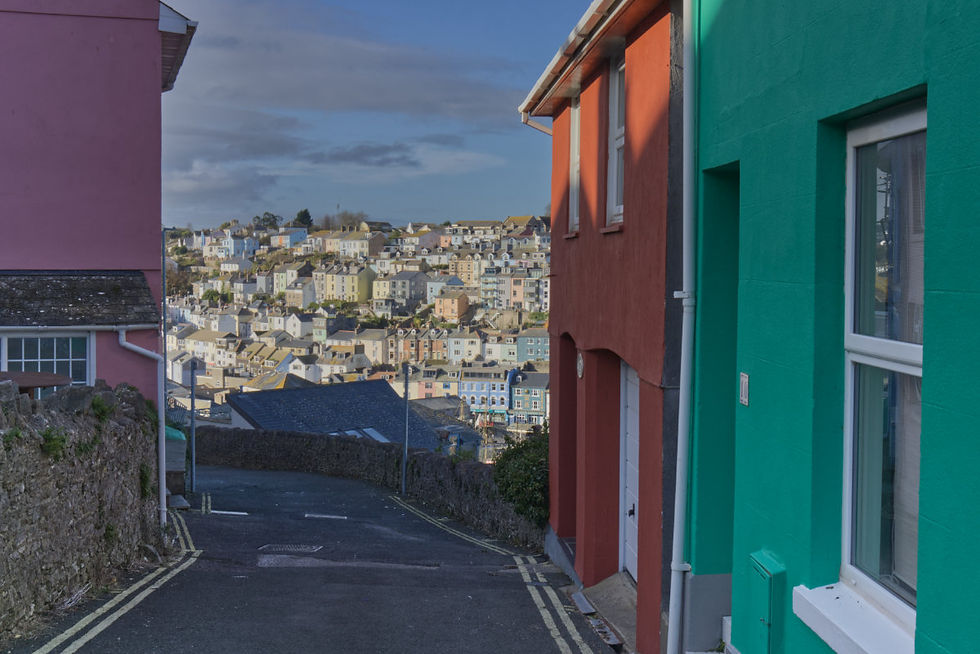
Now I walked back along North View Road. Jarvis Knowles of North View Road got very crabby with The Fishery Officer back in 1910 and made quite a hullabaloo and nearly started a riot at the fish market.
Western Times - Friday, 17 June 1910
Jarvis Patey Knowles, of North View-road, Brixham, was charged with exposing for sale at the Fish Market, Brixham, an edible crab carrying spawn contrary to Section 8 of the Fisheries (Oysters, Crabs, and Lobsters) Act, 1877. Defendant was also charged with resisting and obstructing Thomas Brehout, the fishery officer, contrary to the Sea Regulations Act, 1888 .- Mr. H. Ford, Clerk to the Devon Sea Fisheries Committee, who prosecuted, said the case was the first of the kind ever brought at Brixham.
The crab, of course, had absolutely no value at all, but the preservation of such a class of crab was vital to the well being and upkeep of our fisheries. It was an extremely foolish thing for anybody to take such a crab, which ought to be returned to the sea to fulfil its natural functions. There was an element of cruelty in the fact that the crab had part of the spawn stripped away .- Thomas Brehout, the Fishery Officer, stated that he saw defendant put some crabs on the market for sale. The one in question was among them. Witness called attention to the fact that the crab was carrying spawn, and that a portion had been ripped out.
Defendant observed that he did not know that.
Witness seized the crab, and defendant snatched it out of his hand, telling him to "clear off before he was laid out."-
P.S. Moon deposed to seeing defendant offer the crab for sale .-
Defendant denied that he offered the crab for sale, or that it was a spawny crab. There was always a little to be seen after a crab had spawned.
John Bulley, fisherman, deposed that he laid the crabs down on the market, and that defendant had nothing to do with it. Witness had been fishing over 40 years, and he never knew it was a spawny crab. W J. Sanders, a member of the Devon Sea Fisheries Committee, stated that there was a very excited and strong feeling among the fishermen over what occurred. A crab was brought to him, and nobody would judge it to be a spawny crab. There was not the fortieth part there of an ordinary spawny crab.
The Bench adjourned their decision until hearing the other charge. Mr. Ford said this was a more serious case. Defendant refused to give up the crab, refused his name and address, and threatened the officer with personal violence. There was a hostile crowd, and they were using threats of throwing the officer into the sea.
Thos Brehout, the fishing officer, bore out the advocate's statement.
P.S. Moon corroborated, but he did not think that the crowd on the whole was hostile towards the officer, although some were threatening him.
Defendant denied that he snatched the crab from the officer, or threatened him.
The Bench fined defendant 10s for the first offence, and £1 for the obstruction. (£117 today)
"Hostile but not threatening" sounds like a recent BBC news headline about mostly peaceful burning down of cities in France.

This is the view in North View Road.

In 1939 a tragic mystery was solved.
Torbay Express and South Devon Echo - Friday, 28 April 1939
BRIXHAM SMACK LOST
A Brixham fishing smack was lost with all hands nearly two years ago. It is now reported the other vessel believed concerned, the Italian oil tanker Portofino, has been arrested at Gibraltar.
The smack Sunstar, owned by Mr. Alfred Friend, North View-road, Brixham, was lost off Start Point on the night of July 2, 1937, but it was not until about 12 months ago that Devon Sea Fisheries Committee, through their clerk, Mr. Noel Ford, received an intimation from the Foreign Office that the log of the Portofino showed she on that date had been in collision with a vessel off the Devon coasts.
Devon Sea Fisheries Committee, in conjunction with Plymouth officials of the Ministry of Agriculture and Fisheries, got in touch with the owners to get compensation for the trawler and for the lives lost. About two months ago Mr. Friend took steps to obtain the arrest of the Portofino when she was in British waters.
There were five other smacks fishing in the neighbourhood of the Sunstar at the time of the disaster is believed to have occurred, and the skippers of these vessels reported fog was so dense that visibility was reduced to 200 yards. Sunstar's skipper was Mr. George Hoare. 56, of St. Peter's-hill, Brixham:

Running parallel to Temperance Steps is St Peter's Hill Steps, and right at the top is the old St Peter's Church also known as The Fisherman's Church. The church was built in 1874 and gave its name to the former Sheepy or Sheppy Lane which was the lane that sheep were brought down to be loaded on to ships in the harbour. It seems highly appropriate that this lane leading to a new church has served two purposes in its life, both symbolically connected in Christianity, serving shepherds and fishermen.
From early on, this new venture of "The Mission of St Peter the Fisherman", of Brixham had close links with the new church of St John's just built in Torquay. Before St Peter's opened the first Confirmations of fishermen of the Mission were held at St John's in Torquay. That church in Torquay could not have been more different to this humble Fisherman's Church in Brixham. You can see what I mean if you have a look at my separate post on St John's which was palatial by comparison.
Part of the reason I do the research I do is for the joy I get in unearthing archive pieces like this one that follows now. Written by an eye witness at St John's Torquay it describes the Mission work in very poetic language and heartfelt detail, with great empathy shown for the poor and hard working fishermen of nearby Brixham. Remember the context of Dickensian England and witness how our newly transformed industrial society with its increasing wealth and desire for social change was happening right here in Torbay.
Tenby Observer - Thursday, 1 January 1874
THE MISSION OF ST. PETER THE FISHERMAN, BRIXHAM, DEVON.
THE FIRST CONFIRMATION.
" On Sunday, Nov. 2nd, 1873, the promoters of this loving work, were gladdened by the first Confirmation held in connection with the mission. It was held at St. John's, Torquay, the Bishop of Exeter having made a point of coming, at great inconvenience to himself, because it was the only day on which the fishermen could come as they were out at sea all the week. A delightful sight it was, and doubtless one that gladdened the hearts of the usual worshippers at that church (well known in its neighbourhood for the grandeur of its architecture and the beauty and order of its worship) to see those rough men and boys, most of them in blue Jerseys, kneeling one after another before the Bishop.
But thus it should ever be. The more beautiful the church, the more frequent and hearty its ordinances, the more it should be the centre of mission work, as well as of worship. The Bishop was most fatherly, and it was with evident emotion that he spoke the solemn words of precatory blessing as some grey-haired fisherman knelt before him, 70 years old (the rite neglected in his youth now given after all by God in old age); next would come a boy in blue Jersey with gait suited to the deck of a trawling vessel in a storm, with charmingly simple manner withal. The remarkable thing about these boys was their reverence and evident reality, this was shown in their behaviour, and even in their figure as they knelt, in a special attitude of their own, fishermen like, one does not know how to describe it-like a figure in an old fresco.
" It was their Harvest Festival at St. John's, and these fishermen and boys might be regarded as the first fruits of the land. The Vicar of Lower Brixham and the Missionary Curate of the mission, might be pictured by fancy's eye to be the fishermen dragging the net full of fishes, and beckoning to their partners in the other ship to come and help them, lest the net should break, and the clergy of St. John's, who were handing them on to the Bishop, might be the disciples in the other ship answering the call.
"It would be interesting if one could look into the minds of those rough fishermen, accustomed to stormy seas and rough sights and sounds (the Brixham trawlers are known all over the coast of England, and right away up to the North Sea, as among our hardiest and best sailors), as they knelt before the Bishop in that Sanctuary, with its blaze of beauty, grapes and flowers and harvest decorations, and its wealth of sweet sounds (the new organ was opened that day), a little clue might perhaps be gained from the remark of one of them to a friend afterwards, 'That he was quite capsized.' "
The writer of these lines looked out seaward on the Monday morning after the Confirmation, and saw the sea thickly studded with fishing vessels going out. 'There,' thought he, 'are some on whose heads holy hands have been laid.' The morning smiled with exquisite sunlight over the charming bay; was it not a type of God's favour smiling on the work of His people? Does He not smile on those who love Him? Surely, yes! Not always by giving success, but always by giving His blessing. ."May God prosper the work! May both Brixham and Torquay workers go on working as vigorously as they do now."
Western Morning News - Tuesday, 30 June 1874
MISSION CHURCH AT BRIXHAM, - A church built in St. Peter's-lane, Brixham, for the benefit of the fishermen and trawlers of the port, was opened on Saturday. The Rev. E. L. Salisbury, the harbour chaplain, having been requested by the committee of the Torbay and Dartmouth Mission and Orphan Home to give up his work among the trawlers, the vicar of Lower Brixham, the Rev. R. B. F. Elrington, set on foot the mission of St. Peter the Fisherman, and his appeal for assistance was so liberally responded to that schools for men and boys have for some time been in existence, and now, at length, a chapel has been opened for their use.
The building, which has so far cost £900, has only a wooden chancel, but it is intended, when the funds will permit of it being done, to build a chancel, together with organ chamber and vestries. The building will accommodate 320 persons, and on Saturday it was tastefully decorated, whilst on the altar were candlesticks and candles, vases of flowers, and a large gilt cross. The opening services began with an early celebration of the Holy Communion, after which a full choral service was held, with a sermon by the Ven. Archdeacon Earle. The Rev. Canon Robinson and the Rev. J. Hampshire, who have worked energetically in the cause, assisted at the service, as did also the Rev. R. B. F. Elrington.
The collections at this service and at the early celebration amounted to £112. The Rev. O. Elrington, of Chard, preached in the evening to a crowded congregation of fishermen and their wives. Since the mission has been established upwards of forty fishermen have been confirmed, and most of them are regular communicants.
Torquay Directory and South Devon Journal - Wednesday, 18 April 1877
ST. PETER THE FISHERMAN, BRIXHAM.
MONEY is urgently needed, to pay off the DEBT on the MISSION CHAPEL, now completed. It has been crammed from end to end by the fishermen and boys and their families on SUNDAY nights. "COME OVER AND HELP US." Donations received by the Rev. R. FENWICK ELRINGTON, Lower Brixham ; Rev. C. E. R. ROBINSON, Beausite, Torquay; Rev. W. K. HAMPSHIRE, Beach House, Torquay.
Brixham Western Guardian - Thursday, 18 October 1906
ST. PETER'S CHURCH, BRIXHAM
RE-OPENING AFTER RESTORATION.
It was some 32 years ago that St Peter's Church, familiarly known as the "Fisherman's Church" was erected at a cost of £2,000 to augment the means of administering to the spiritual welfare of the Brixham fishermen. Although each priest in charge attempted and did something to beautify the interior, yet the scheme lacked in finality. During the association of the late Rev. A. G. B. Stallard much was done. In addition to ritual ornaments the chancel was beautified with costly panels, a screen erected, and stained glass windows placed. Other priests in charge made laudable efforts in similar work, notably the decoration of the screen and painting the walls during Rev. F. E. Godden's period of priesthood, and latterly, in addition to the "Stallard" window memorial, the Rev. A. Baring Gould, the present priest in charge, with the assistance of the leading members of his congregation, projected and carried into finality the longwished-for work of completely redecorating the interior, the cost of which has involved an outlay of over £200, of which some £170 was raised prior to the re-opening service on Saturday last.
The church was deconsecrated in 1977 and the lower half converted into three flats in the 1980's. The upper half was a metal workshop and was converted later. In 2014 it featured in the TV show The Restoration Man with George Clarke. The specific episode is titled "Fisherman's Church" (Series 4, Episode 3), which originally aired on January 15, 2014. A follow-up "revisit" episode was later broadcast in February 2017.

On the side wall of the restored chapel are these incongruous giant oranges and lemons. Brixham was born a sea port but most people only associate it with fish, without realising that there was a brief period in history when it was also renowned for a trade in citrus fruits from the Azores, Portugal and Spain. Ports like Dartmouth and Brixham were in the front line of European trade and the shops of these small towns bristled with exotic produce of all kinds from a very early date.

Dartmouth & South Hams Chronicle - Thursday, 24 December 1874

Brixham has its own Dickensian past as we'll see from this news article. Please Sir, can I have some more oranges?
Western Times - 6th March 1852
BRIXHAM.
A boy named James Morey, an orphan, living with his uncle, Mr. Owen, entered the premises of Mrs. Rennels, grocer, late on Wednesday, or early on Thursday morning, and stole from the till the sum of 4s together with sweetmeats and oranges, &c., some fishmongers passing the place at the time, seeing the door open, aroused the inmates, who found that some one had entered by a ladder into the back garden, thence into the house. Suspicion having fallen on the prisoner, search was made for him, and he was found in an outhouse asleep, with the money in his pocket. On Thursday he was brought before the Rev. J. R. Hogg, who proposed that he be sent to Totnes Union, until the County Sessions, the prisoner being under 10 years of age, this was opposed by Mr. Blackmore, one of the Overseers of the Parish of Brixham, and the prisoner was committed to the County Jail.

Business was booming and ships were launching from local ship builders to cash in on the trade. At its peak in 1854, the island of São Miguel (St Michael) in the Azores exported roughly 60 million oranges and 15 million lemons to the UK alone. This massive operation required a fleet of several hundred specialized, fast-sailing clipper ships—known as "Salcombe fruiters"—and employed several thousand sailors to race the highly perishable luxury fruit to Victorian markets in London, Liverpool, and Bristol.
Western Times - Saturday, 28 July 1860
BRIXHAM
On Friday last a fine clipper schooner named the Star of Peace was launched from the yard of Mr. John Upham. She is intended for the fruit trade, and is 140 tons register.
Western Times - Saturday, 27 October 1860
BRIXHAM.
SHIP LAUNCHES .- Last Monday week a fine schooner, named the Esmeralda, 140 tons N.M., was launched from the building yard of Mr. Richardson. She is owned by Messrs. Shears and Co., and is intended for the fruit trade. On the same day a beautifully modelled schooner was launched from Mr. J. Dewdney's yard. She was named the Alfred Vittery, is 122 tons register, and owned by Messrs. Vittery and Smerdon. She was built for the St. Michael's trade and will be commanded by Mr. Thos. Tyrer.

The citrus fruit trade was not to last for long and the ships mentioned above were late to the event. In 1860 the first accounts of a devastating insect pest arriving in St Michael were seen. The insects were an accidental introduction from Brazil and they laid waste to the citrus groves causing a collapse in the fruit harvests.
Technology was also about to overtake the speedy schooners as more reliable steamships started to take over. The Brixham fruit trade morphed into the more gruelling Newfoundland fish trade.
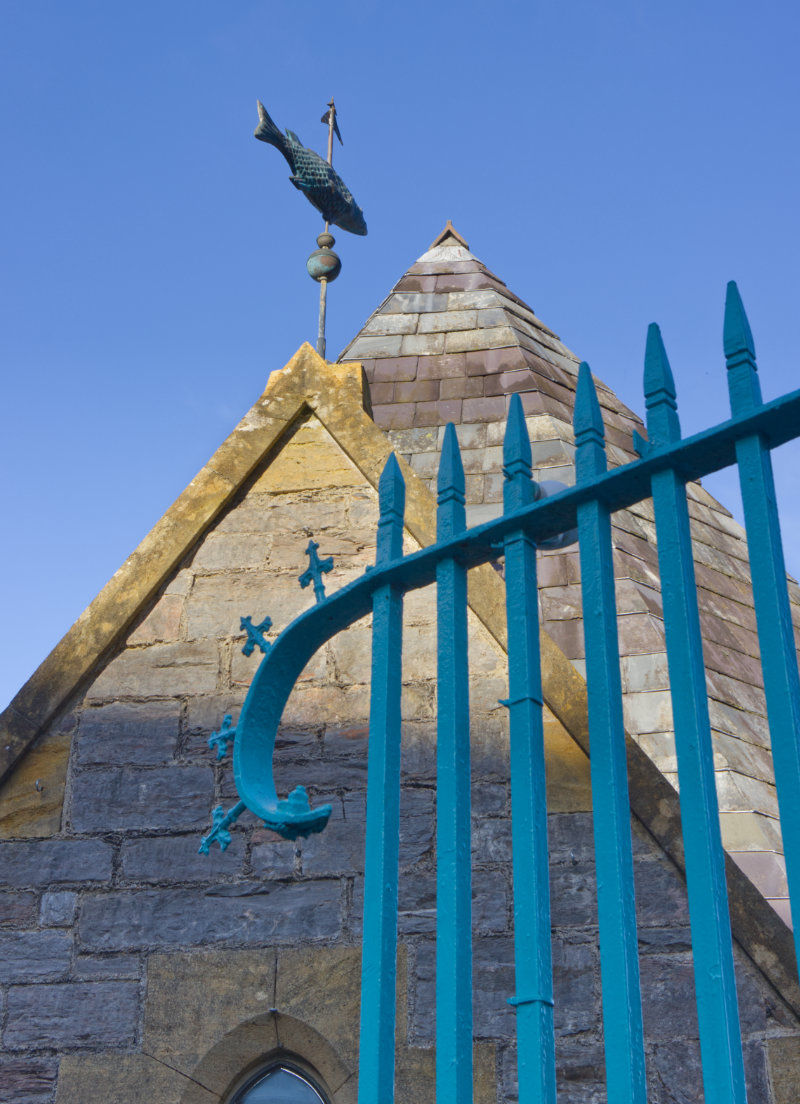
North View Road becomes Mount Pleasant Road, a very narrow bit of road indeed.

From Mount Pleasant Road I now have a choice of which steps I descend, into Fore Street, down below. I opted for Shinner's Steps to continue my journey. Maybe I should have read this article first.
Totnes Weekly Times - Saturday, 23 March 1895
BRIXHAM NOTES
Nor before time, hand rails are to be fixed to long flights of steps that are considered dangerous of descent. I should like to know what long flights of steps in our town are not dangerous, especially to old people. Brixham is noted for its steps. Ask a visitor what he knows of Brixham and he is sure amongst other things to say "It is a pretty little funny place with any amount of steps.'
BRIXHAM steps have the peculiarity about them of falling forward much, very much, so that in order for one to keep his equilibrium in coming down over them a back ward angle of about 15 degrees is absolutely necessary without which you run the risk of being precipitated over from 100 to 120 steps without a break. "Shuting the Shutes" at Earl's Court is not in it when compared to the descent from Rea, to Fore Street, via Lake's, or Shinner's steps.
Shuting the Shutes was a new phrase to me. It seems that what we would probably call a log flume at a theme park, is something that existed as far back as 1895. A "shoot the chute" (or shoot-the-chutes) is a classic water-based amusement park ride featuring flat-bottomed large boats that slide down a steep ramp or flume into a lagoon or river, creating a massive splash for riders and spectators. The ride was invented in the 1880s by J.P. Newburg at Watch Tower Park in Rock Island, Illinois, adapted from winter toboggan slides.
There are caves under them thar hills. Cavern steps gets its name from limestone caves that were accidentally discovered back in 1858. A little further along Mount Pleasant Road is a small entrance under one of the terraced house which leads into a large show cave which was open to the public as recently as 1977. It is now a scheduled ancient monument.
Philp's Cave was discovered by John Lane Philp who was building the houses along this road when a pickaxe hit a hole in the ground. Investigations led to the discovery of a limestone cave which was professionally excavated and produced evidence of early human use. Animal bones which had been split to extract marrow were some of the finds. 1100 bones of 20 species were discovered including mammoth, cave bear, rhino and reindeer. The discovery which predated the now famous Kent's Cavern in Torquay was the first to prove that early humans coexisted with extinct Ice Age animals in Britain.


Even though you can no longer see the wonders that are under the terraced houses of Brixham, here is a guided tour of what was on offer in 1885.
Torquay Times, and South Devon Advertiser - Saturday, 25 July 1885
Going down past the Bolton Hotel you are quickly in front of the Police Station, and find it hardly necessary to inquire the way, for facing you is a road up the hill appropriately called Cavern-road, the ascent of which brings you right up to the house where resides Mr. Philp, the owner of the Cavern. On a recent visit, a few minutes were occupied in looking over some interesting polished specimens of stalagmite and madrepore kept in a little parlour, while the guide was preparing himself for a descent into the Cavern, the entrance to which is a few paces from his door.
Immediately upon entering the spacious mouth of the Cavern, we were confronted by some glass cases containing specimens of the bones, &c., found in the Cavern, carefully arranged and labelled. Whilst we occupied ourselves in making a hasty examination of these, our guide was busy lighting a number of candles, one of which was handed to each of the visitors. We were now ready to start for the black-looking opening in front of us ; before doing so, however, attention was directed to the small hole in the roof, which was the opening accidentally made when the proprietor was quarrying for the foundation of the house above, and through which, Mr. Philp himself was the first to descend and hastily explore this mausoleum of many now extinct species of the carnivorous animals which in the dark and pre-historic times roamed over the hills and through the dales of our beautiful Devon.
The first object which struck the solitary explorer was the stalagmite floor in all its original beauty intact. Here and there in places where the floor covering the bone-bed was thin, by the aid of a solitary candle, he could see protruding through the stalagmite, bones and teeth of creatures such as the hyæna, rhinoceros, &c., also the antlers of the reindeer.
Most of the floor has now disappeared. Close by, reared against one side of the Cavern
stands a large slab of the original stalagmite floor, showing portions of the bone-bed, and containing remains of bones, and teeth with the enamel upon them still perfect. In one spot we were also shown the gravel which formed the bed of the cave when a stream of water rushed madly throngh it, hollowing out the rock on both sides of the Cavern, as though some hugh cheese knife had been used in the process.
Close by is the outlet for the water suitably called the Steep Slide-Hole, down which the torrent rushed and finally reached its destination-the sea. Having poked our down the dark recesses to satisfy ourselves that no live carnivora lay hidden ready to follow us, we are ushered into the Reindeer Gallery, certainly the most spacious, and perhaps the most interesting, of any of the numerous galleries of the Cavern.
On our left stood a large column of stalagmite, which during past ages gradually reared its apex until meeting a corresponding stalactite, the two became joined, making a solid column from floor to roof. When struck with a walking stick it resounded like "Big Ben." Here too we could see high up in the roof remains of an older stalagmite floor than the one which had covered the bone-bed, clearly indicating that the Cavern must at an early period have been filled up with substances which succeeding flood-water washed completely out, leaving only the floor to record the fact. A sharp turn brought us to the "Flint Knife" gallery, where ranged in rows we could examine and admire a host of fine stalagmite formations.
Upon reaching the "Southern" gallery a great treat awaited us; by a clever little manoeuvre our guide after depriving us of our lights placed them in a recess of the rock and revealed to our admiring gaze a beautiful miniature Cavern in situ, showing on a small scale just what the larger Cavern appeared like before the pick and shovel of inquisitive geologists compelled it to disgorge its treasures to furnish objects for cases in the British Museum.
Perhaps the most striking illustration of the result produced by the formation of the stalagmite in the Cavern, is to be seen in the "Druid's Font" where the forming process can be easily traced. Alongside a beautiful tiny pool of water which has filtered through some 30 feet of hard rock, stand forms and figures of various shapes, one of them being a good representation of a female in the act of stepping into the water, only requiring the blush upon her cheek at beholding so many onlookers to impart an appearance of life to the figure. Even the Eddystone is not left unrepresented in the forms to be seen here. The next point to which our attention was directed, was the opening through which the Royal Geological Society worked out the Cavern; this was the original inlet for a volume of water which had left clear traces of its having at one time rushed down in an immense cascade, before the deep valleys outside had been scooped out to their present level. In returning to the spot where we entered, our guide, leaving facts drew upon his fancy, and as we traversed the different galleries, pointed out to us the remarkable formations of the stalactite which on account of their resemblances he has designated "The Goose in the Larder," " Lord Salisbury," "The Pig's Ears," "The Butcher's Shop," and even "The Grease from an Overflowing Frying Pan."
Altogether the visit to the Bone Cavern was a very pleasant one, made the more so by the intelligent explanation given by our guide of all the leading features of this wondrous temple of nature's own building.

With 190 steps, Shinners may not be the longest flight of steps in Brixham but it is one of the steepest, as local myth tells of warnings to children using the steps to take care for if they tripped going down they would "skin the flesh right off your shins". In fact the name actually comes from the Shinner family who owned a bakery on Fore Street at the bottom of the steps.
The steps lead down toward Fore Street, where E. Shinner first opened a popular family bakery back in 1867. The shop and its adjacent production units remained a staple of the Brixham community for generations. Because locals would regularly walk up and down these steps to buy bread or chocolates from the Shinner family, the staircase naturally adopted their name. Older locals still fondly recall collecting fresh bread directly from Mrs. Shinner. Credit to Francesa Lee Knifton


At the bottom of Shinner's Steps is yet another Brixham Mural. "A Helping Hand" features silhouettes of people helping each other to climb a mountain. Very appropriate if I were walking back up. It was created by Devon Mural Designs and commisioned by Brixham Future.


Now I am at harbour level again, almost. In Fore Street, several buildings have murals both on their fronts and their sides. This one is a real spectacle.

At it's centre it features a map of the harbour and the date 1615. It was also commissioned by Brixham Future and purports to be a reproduction of an authentic historical treasure map of 1615.

It is painted on the end wall of Doble Jewellers which seems appropriate as it features jewels as part of the treasure. Whether anyone ever found the treasure we don't know. Would they have told us if they had?

This mural was painted by a prominent Cornish street artist Sketch86. I will end Part 2 of my Brixham Stepping Out photo walk series here and there are more steps and murals to come in Part 3.


Comments