Car Tour 5 Part 2 Cullompton to Chevithorne

Updated: Aug 21
This car tour took place in September 2024 which seems light years ago now and so much has happened since then. I have started the series with a piece about St. Andrew's church in Cullompton so you can start at the beginning if you like, here. At the end of that piece I was moving on to a tea break at a nearby café so that is why this post starts in a tea shop. Yes, café from coffee and tea shop from tea are interchangeable words here in Britain. You can get tea in a café or coffee in a tea shop. Don't worry I am not a TikTok food photography obsessive, so I'm not regaling you with my comestibles, instead here is the beautiful tiled floor in the entrance. The feather was a plus, and if you know me then you know it isn't staged, I don't do that.
The beauty in life is the unexpected and the unplanned, or serendipity. This black and white feather fallen on a black and white patterned floor was my serendipitous moment that day. It could have ended up my ceylonitous moment but history had other plans for the word.

The word Serendipity is itself a wondrous thing. It didn't gradually swerve and dodge through the centuries from place to place evolving as it went like many of our words, although its roots did. The English language dominates human culture today because it is an island language that evolved in an almost unique way. It was open to change, like its people. It was a system of merit not something state controlled, like the French language still is today. If there was a gap and a new word worked in that gap it was adopted by its own success in filling that gap, if a new word did an existing job more successfully it won the day. The English Language is merit writ large and wide.
I Googled the newest English word at time of writing and got this. Recent popular additions and slang include rage bait (online content made to cause anger), omega block (a trapped high-pressure weather pattern), and aura farming (acting cool on purpose).
I love "aura farming" and am definitely going to try that.
Serendipity is a rare word because we know exactly when it was created and by whom. The English author Horace Walpole coined it in 1754 when writing a letter to a friend. I hope that friend didn't live too far away because letters took weeks to travel the country back then. Post boys had to carry letters in leather bags on horseback and if you received a letter you had better hope it was not written on too many pages or had come too far because that all added up to a bill you had to pay on receipt. Letters travelled at an average speed of three miles an hour, and we are almost back there. Post boys were vulnerable to being held up by highwaymen too.
But I digress, and I haven't done that in a while, especially while in the middle of a digression. In an ancient Persian fairy tale the three princes of Serendip were heroes, constantly making fortunate discoveries by accident, and Horace Walpole, who was obviously very well read, decided to call that event Serendipity.
More than this, it turns out that even the Persians travelled far to find that word, as it was their name for modern Sri Lanka. This means the roots of the word go as far back as the 4th century. But it doesn't end there because the Persians were mispronouncing the real name in Sanskrit of Siṃhaladvīpa.
When the British arrived in the Indian Ocean they used the anglicised version of this name as Ceylon, as early as 1796, and it later morphed into Sri Lanka in 1972. It was called Sri Lanka (Resplendent Island) by a Marxist political party and the Marxists eventually took control in the 1970's, misrule and dangerous ideology following, with war and general catastrophe and food shortages, worsened by the insane idea that the country should transition to organic farming. Fertiliser was banned and pesticides were banned, and if nothing else they proved that organic farming is just another luxury belief of the elites who can always afford food whatever the crisis. Not so resplendent once they had finished. Definitely not a serendipitous event.
The World Bank did very nicely out of the Communist failure and we'll never know how many people died, as rice production fell 30% and the Resplendent Island went from self-sufficiency to having to import hundreds of millions of dollars in food from countries using fertiliser and pesticides to grow it.
In a parallel universe Horace might have come up with Ceylonity or Srilankaty. I think we can all be glad though that he actually came up with serendipity. Srilankaty might be a good word to describe a situation of man made disaster inspired by Marxist ideology.
Speaking of Sri Lanka, this is the tea room and that mural could almost be there.

I mentioned in part one of this tour that a team of men were in the process of digging up Cullompton when we did this tour so Cullompton itself will have to wait for another visit. We managed to escape by the back door and our route continues to Tiverton.

There are two notable steep hills down to Tiverton from Cullompton so it is a surprise to now find out that Tiverton is at a higher elevation than Cullompton. How does that work? The red triangle confirms that this is a steep road down.

On the way down, the Exe valley opens up below. It seems we are descending from a ridge which lies between Cullompton and Tiverton. This route is the traditional ancient route between the two towns. Cullompton is on the river Culm, so I suspect that the town may once have been called Culmtown or the river called the Cullomp, who knows? The Culm joins the Exe nearer to Exeter and is its longest tributary. That's your geography lesson for today.

This is a quick drive by shooting at Tiverton as we didn't even stop the car. It looks like an old industrial spot which it must be as it has something rare in Devon, a canal. All of these photos are taken through the windscreen. I was about to find out a lot of history relating to one very influential family who moved here and changed the place forever.
In fact I now discover that the town is where the river Lowman meets the Exe which means it once had two fords to cross, hence Twyford then Twyfordton and ultimately Tiverton. Having two crossing points usually indicates ancient occupation and so it goes that many flint tools discovered in the area denote Stone Age occupation. There is even an Iron Age hill fort and a castle and a Roman fort nearby which pretty much proves how geographically significant this spot was for trade and defence.
Just visible in the distance is a clue to pretty much everything we are just about to see in the rest of this post. That red brick building with the letters HEAT on it is in fact a factory, and that is a fact.

The HEAT is only the first part of the name Heathcoat. We'll come to the Heathcoats shortly. I am lacing this post with hints. Tiverton owes its early success to the wool trade of the 16th and 17th centuries. Most of Tiverton's wool exports ended up in the "Low Countries", or the countries we call today the Netherlands, Belgium and Luxembourg. It also included bits of France and Germany at a time when borders were not cast in stone.

The people of Tiverton were seriously accident prone it turns out. Most large towns have a history which includes "The Great Fire of....." add the name of choice. You can divert at this point to my post on the Great Fire of Chudleigh if you care to.
Tiverton, however had three Great Fires of..... The Great Frying Pan Fire of Tiverton and the Great Dog-Fight Fire of Tiverton came first. The Great Frying Pan Fire is sort of self explanatory and took place in 1596 when Elizabeth I was on the throne. The entire town burned down but the inhabitants didn't cash in their chips which would have been a different sort of chips anyway to the ones you fry. In fact potatoes had only arrived in Britain three years earlier so may not have reached Tiverton by the time this frying pan caught alight.
By 1612 the people had clearly rebuilt enough of Tiverton for it to burn down again. This time, apparently, a dog fight distracted everyone long enough for a furnace to catch fire. It must have been some dog fight. Whether it was some random pair of dogs just kicking off on a street corner or an organised dog fight for gaming and entertainment I am not sure. After all they didn't have the "trusted source" of the BBC to distract them back then. It probably didn't take a lot to distract people who had nothing. I'm saving great fire number three for later.

Tiverton even had a siege during the English Civil War to contend with in 1645, they had had a few years to rebuild the place since the dog fight. This was a far more serious fight. Most of the Royalists had fled to Exeter but they left a defending force behind at the castle. The Parliamentarians turned up on the 17th October and started bombarding the castle with artillery for two days. On Saturday afternoon they packed up their kit for the Sabbath but it didn't stop them reinforcing on the Sunday with more artillery ready to start work again early Monday morning.
The people inside the castle were just penning a future hit called "I Don't Like Mondays" when the guns started going off. An accidental hit of one of the drawbridge chains saw a quick access gained and it was all over.

Before democracy was introduced in Tiverton there was the Tiverton Corporation. Established by Royal charter under James I the corporation was an early form of local government. The self-selected body of the great and good, and who was going to argue, supplied the town with a Mayor, Aldermen and Councillors. These men, because women hadn't been invented yet, controlled justice, taxation, markets, education and charitable endowments. We might view this development through a critical lens today but compare it to what came before and you can see the attraction. It played a prominent role in regulating the vital wool trade.

The town made good during the early years of the wool trade but as the wider Industrial Revolution rolled out across the country the town went into decline. Riots followed, and Unions followed on from those. Societies of woolcombers and weavers gathered to try and protect jobs and wages. Trying to protect markets artificially from the wider external market never works as we now know. Terminal decline followed.
As if they missed the good old days the locals decided it was time for another Great Fire. In June 1731, 298 houses burned down, causing £58,000 of damage. This was £6.8 million in today's money which is quite a lot when you think that virtually nobody had any property worth valuing. To most people in 1731 their feather bed and bedlinen were the most valuable things they owned.
Street widening was introduced and yet more riots followed.

By 1815 John Heathcoat had bought an old woollen mill on the river Exe. Unions and strikes elsewhere were good news for Tiverton. Luddites in the pay of Nottinghamshire lacemakers smashed up Mr. Heathcoat's machinery in Loughborough so he moved lock stock and barrel to Tiverton. Many of his workers ended up walking the 200 miles from Loughborough to Tiverton and it turned around the fortunes of the town. Tiverton became an industrial centre for the south west and the canal and railway soon followed.
The Luddites started their activities in late1811 in Nottingham and it spread to other parts of the country. The misguided workers saw increasing mechanisation as a threat to jobs rather than a road to expansion and increased jobs. Thinking they could turn back the industrial clock they smashed up looms and factories, actually putting people out of work. Reality proved the Luddites seriously wrong after John Heathcoat who had employed 500 in Loughborough moved operations to Tiverton where he ended up employing 2000.
Johnson's Sunday Monitor - Sunday 04 March 1827
List of Patents, which, having been granted in March 1813, expire in the present month of March 1827.
- 29. John Heathcoat, Loughborough, for improvements in the machine for making bobbin-lace, nearly resembling foreign.
By 1847 democracy of a sort had arrived but not as we know it. We all know that women, now invented, didn't have the vote but most people don't realise that most men didn't have the vote either. Out of nearly 8000 people in the town only those 400 with wealth and or property could vote. This is something the elites today would love to bring back. By 1867 the town had an MP with the name Heathcoat-Amory from the family who now owned much of the property and land in and around Tiverton. The town had a Heathcoat-Amory as MP until 1960. I am going to end my history of the town there as it is a good point to move on in the tour.
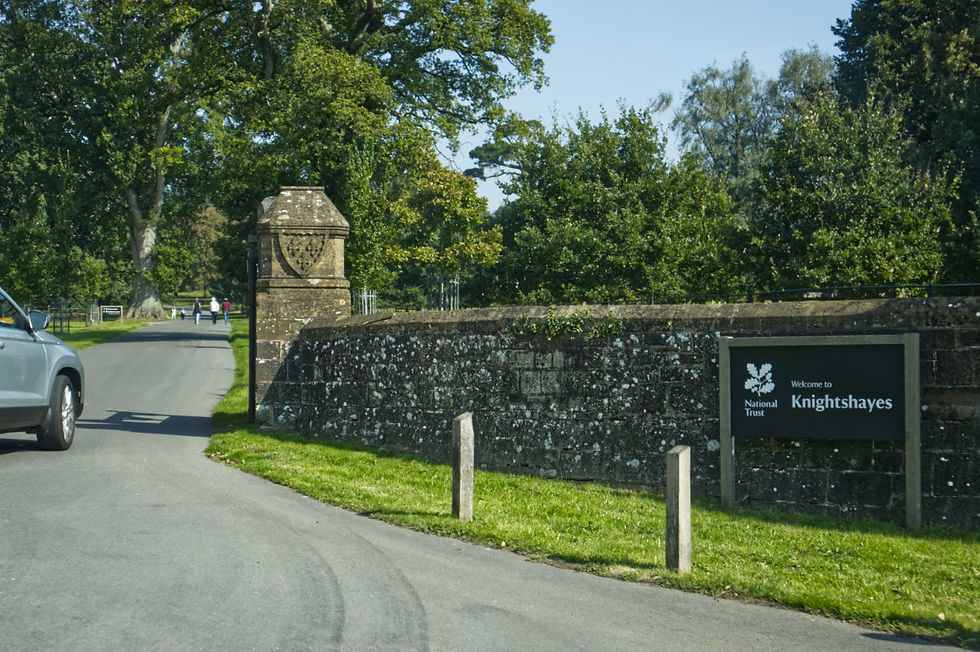
Next on the tour we pass the ancestral home of the Heathcoat- Amory's, Knightshayes Court.

Knightshayes is well worth a visit, which you are now able to do as it is owned by The National Trust. Expect a major display on slavery because the National Trust are obsessed with slavery, so I am sure they have shoehorned in something about it somewhere somehow. They probably have information explaining how clever Luddites were. Luckily we have no time on this tour to be accused of oppression so we'll move on.
The Heathcoat-Amory's bought the estate in 1868, promptly knocked down the house built in 1785 and replaced it with one designed by the prominent architect and designer of the day William Burges. Burges and Heathcoat-Amory fell out and most of Burges's designs for the interiors never saw the light of day. In fact thinking about it, most National Trust interiors don't see the light of day anymore as they keep the blinds and curtains drawn to stop them fading.
Although very wealthy, Heathcoat-Amory objected to both the designs and the extreme cost. Burges was more used to working for coal barons in South Wales with bottomless pockets, like Lord Bute who commissioned Cardiff Castle and its design excesses. Knightshayes remains as the only surviving Burges medium sized country house.
Only three miles from Knightshayes is the church most closely associated with the family. St. Thomas the Apostle Church, Chevithorne. Listed Grade 2 by Historic England.
"A beauty, yet the vast majority of folk will pass by without enjoying this tiny delicacy." Devon Churchland
Described as neogothic and almost a "fairytale cottage", this is well worth a small diversion and a brief stop, brief, only because it is tiny.

It was originally a small chapel but was rebuilt as a parish church. Designed by Benjamin Ferrey who worked mostly in the Gothic Revival style which was so popular in the mid to late Victorian era.
After he left school Ferrey went to London and it is no surprise that he studied under Augustus Charles Pugin, whose son Augustus Pugin achieved world fame by designing the Palace of Westminster, home of the British Parliament. Ferrey had his own very successful practice and built over 100 English parish churches.

Right next door to the small church is the vicarage also designed by Burges in 1869. It was commissioned by Sir John Heathcoat-Amory and constructed in 1870-71.

This is the serendipitous sight on a beautiful cobbled path between the church and vicarage.

This village did not originally exist as a parish in its own right. This was part of the Tiverton parish. When the Heathcoats arrived on the scene things took a major change. After the now enobled Sir John bought his country estate he wanted his own church so in 1889 he had the power and influence to help Chevithorne become a new parish by Act of Parliament. He built the vicarage to get on the right side of the vicar and the rest was history.
It was William Rayner the priest who started the ball rolling back in the 1840's though by stumping up most of the cash to build what was officially a chapel at the time.

The new style at the time was neo-Gothic but there were changes going on in the church too and things were moving back towards decoration and away from clean lines and bare walls. Henry VIII and Elizabeth I after him had wiped out idolatry and popery but it was starting to sneak back in by the reign of Victoria. Here on one side of the porch is, reputedly, the young Queen Victoria herself.

The main feature of this small church is the rose window which was Rayner's brainchild. He came up with most of the money to pay for it. The whole church cost £1000 and Rayner paid £300 of that himself. It is probable that Rayner was earning around £100 per year so he presumably had independent means. He also endowed the chapel with £60 per annum.
The central section of the window features the symbols of the four evangelists, Matthew, Mark, Luke and John.

Top left is the Lamb of God, to the right what looks like a swan but is more likely meant to be a pelican. The pelican is an ancient symbol for Jesus Christ. It's highly likely that the glass artist had never seen a real pelican.
Middle left and moving anti clockwise around to middle right are, a winged man symbolising Matthew, a winged ox symbolising Luke, an eagle symbolising John and a winged lion symbolising Mark.

You couldn't get more mid Victorian than this font, of 1843, carved from Caen stone. The inscription around the rim reads, "By our spirit are we all baptised into one body (Corinthians XII:XIII)"

Here we have some beautifully done stencil work which may not be original as it has a definite, later, Art Nouveau feel to it, but it works really well in any case.

This window is a feature of a small side chapel north of the nave which was added to the original church building by the Heathcoats to serve as their own place of worship.

This view from the nave into the chancel shows how church interiors were changing. Clear views through to the altar, and a light and open design with light wood and white walls and as much natural light as possible. It contrasts with earlier church interiors where screens masked off the chancel from view. Going almost unnoticed is the unobtrusive pulpit, small and on one side. The pulpit and the long sermon now becoming less of the focus of the service than previously.

There is the common sight of hand embroidered kneelers or hassocks with many different eclectic designs the most unusual for me being the children's favourite Bob the Builder. You might say about Rayner himself, "Can he build it", "Yes he can", and he did.

Here, against the lectern is a corn dolly cross, a traditional harvest decoration, protection talisman, and Christian symbol woven from the final stalks of cereal grain. Ancient European farmers believed the spirit of the grain lived in the fields. When the final crops were cut, a cross or dolly was woven from the last sheaf to give that spirit a safe home through the winter.
So here we have Animism meeting Christianity in cultural traditions that never die out, no matter how much political and ecclesiastical change there is over the centuries.
Animism is the world-view that non-human entities, including animals, plants, rocks, and rivers, possess a distinct spiritual essence or internal soul. Derived from the Latin word anima (meaning breath or soul), it treats the natural world as a community of living persons rather than inanimate objects. AI Overview

A series of images in the windows hark back to churches of the era before Henry VIII since when, symbols connected with Christ's crucifixion were frowned upon. It is the main reason Elizabeth I had the roods or crosses showing the crucifixion removed from the rood screens all over the land. You can see what I mean about rood screens in my post from the church in nearby Atherington which has a much older pedigree.
This window panel represents Gethsemane, with Judas and his silver, a sword, a cudgel and a lantern. It tells of the betrayal and arrest of Jesus. Judas received thirty pieces of silver for the betrayal while the lanterns were carried by the mob who hunted for Jesus in the garden of Gethsemane as they carried cudgels and swords.

Here is the simple but elegant Heathcoat-Amory chapel, featuring a series of memorials to the various Heathcoats and Heathcoat-Amorys. I couldn't find any information about this chapel although Historic England in its listing implied it was an addition to the original building. I spent a full hour trawling through the newspaper archive, when I eventually found this article.
Western Times - Tuesday 12 January 1892
At a cost of fully £1,400 Sir John and Lady Heathcoat Amory have restored the Church of St. Thomas, Chevithorne Tiverton. The work of restoration has indeed been thorough and complete. The Church has been re-seated, a wood flooring laid, a wing added containing a vestry, an organ chamber and the Amory Chapel, and the chancel floor has been lowered and re-laid with marble and Portland stone. These are but the chief alterations ; the work includes many details of importance, including the addition of a new organ, also the gift of the munificent benefactors of the church. The Vicar (Rev. H. Davis) and Canon Trefusis officiated at the opening service on Friday.
May the stencilling around the windows have been added during this restoration? It seems highly likely. The early 1880's saw the earliest examples of what was to blossom into Art Nouveau. The Modern Style had its roots in the earlier Arts and Crafts movement.
Across Britain, 1890s church interior touch-ups frequently substituted rigid geometric patterns with free-flowing stencilled friezes of lilies, vines, and symbolic flora reflecting the aesthetic of William Morris. The London Archives

The first memorial tablet here is to Sir John Heathcoat Amory who built this chapel. Much was written about him after his death. He served on many public bodies and institutions, member of the town council, later Mayor of the town council, The Commission of the Peace for Devon, The County Council and later Alderman, Chairman of the Governors of Blundell's School and the Heathcoat Elementary School founded by his grandfather, The Tiverton Infirmary, also founded by his grandfather, The Volunteer Force, and he was First captain of the Tiverton Rifles. He covered the expenses of more than a score of his employees as volunteers. He was a Trustee of the market, and of various charities and a local magistrate and churchwarden.

But it had all started with plain Mr. John Heathcoat, Sir John's grandfather and inventor of the machine that was to make lace a mass-produced material. John had no surviving son so the estate passed to his daughters and their families. His grandson Sir John took over the running of the family firm after his death. Sir John his grandson had been born John Amory but later adopted the additional name Heathcoat by Royal licence.
This was how it all began.
Derby Mercury - Wednesday 30 January 1861
John Heathcoat was the son of a small farmer at Long Whatton, in Leicestershire, where he was born in 1784. He was apprenticed at an early age to a frame-smith, named Samuel Caldwell, at Hathern, a neighbouring village. During his apprenticeship he acquired a complete practical knowledge of the business, and of all the mechanism of the stocking frame, and warp machines. Some parts of the latter he improved by his own invention, when yet a boy. And it was by the application of a clever apparatus to one of those machines, whereby "mitts" of a lace-like appearance were produced, that his attention was first turned to mechanical lace making.
"Point net" lace had been extensively wrought by machinery. This was a looped mesh, and therefore slight and frail ; but the attention of very ingenious mechanics had been turned for some years to the question of making a mesh or lace of threads twisted round each other in the formation of the mesh. Hitherto the problem had baffled their endeavours, reducing all who made them to poverty, and driving some into insanity. ' Mr. Heathcoat, after having served his term of apprenticeship, settled in Nottingham, and commenced business on his own account. as a "setter up" of hosiery and warp frames, in the machine shop of Mr. Leonard Elliott, in Broad street.
Elliott was a man of superior mind and skill, and through him young Heathcoat became acquainted with the sanguine ideas then afloat in the proverbially ingenious mind of Nottingham mechanics. Among these was how Buckingham or French lace could be mechanically produced, and to this he gave undivided attention. Elliott described him to have had a thorough practiced knowledge of mechanical powers and contrivances; as inventive, persevering, undaunted by difficulty or mistakes, and consequent temporary want of success; patient, self-denying, and very taciturn, but having surprising confidence that his application of mechanical principles would be crowned eventually with success. His great object was to construct a machine that should do the work of the pillow, the multitude of pins, the threads and bobbins, and the fingers, and to supersede them in the production of lace, as the stocking-loom had superseded the knitting needle.
In 1816 the factory at Loughborough, in which Mr. Heathcoat's business was carried on, was attacked by the Luddites and, the lace frames destroyed. This caused the removal of the manufacture to Tiverton, where it restored the prosperity that had been lost by the decay of the woollen trade. The establishment of Mr. Heathcoat and his partner, Mr. Boden, employs about 2,000 persons. For the benefit of this population schools have been established, a church built, and their welfare promoted in many ways, in addition to the great advantage of profitable employment.

Here we see the memorial to Sir John and his younger son Ludovic who died in France very near to the end of the First World War, or The Great War as it was then called. He died of his wounds in battle in the Somme at Bayonvillers. His death was the result of fighting in what became known as The Hundred Days Offensive.
With the Hundred Days Offensive, the tide finally turned on the Western Front. The period known as the Hundred Days Offensive spanned from 8th August to 11th November 1918. Also known as the Advance to Victory, the Hundred Days Offensive was a series of Allied advances and victories that pushed the Imperial German Army back to the battlefields of 1914. The advance, while gruelling and casualty-heavy, essentially broke the German Army’s will to fight, leading to the Armistice and end of the fighting on the Western Front in November 1918.
Before his death Ludovic had three sons who all died tragically young. Patrick was killed in action in the next Great War, in Libya, while Michael was killed in an air crash, and Edgar was also killed in action in Normandy.

Various Heathcoat Amory's became MP's and Lords including Derick Heathcoat-Amory, 1st Viscount Amory, who became Chancellor of the Exchequer, while the last Heathcoat Amory in parliament was David Heathcoat-Amory who lost his seat by 800 votes in June 2010.

From the time of the very first move of the family to Tiverton they have been closely associated with the area and are famous for their generosity and community spirit.
Evening News (London) - Thursday 12 November 1964
Surprise - a gift FOR the Amorys
(BUT THEY'LL GIVE THIS AWAY TOO)
TEXTILE magnate Sir John Heathcoat Amory and his younger brother Lord Amory, the former Chancellor of the Exchequer, who have given away more than £100,000 to their home town of Tiverton, Devon, have been on the receiving end for a change.
Their surprise - a long-handled silver spade used by their grandfather, the first Sir John Heathcoat Amory, back in 1880, to start off the Exe Valley North Railway.
Whether the first Sir John mislaid the ornate spade no one knows. It disappeared for 80 years, then turned up in a private museum at Watermouth Castle in North Devon.
Four Tiverton businessmen arranged to buy it and restore it to the Amory family as a gesture of appreciation for all they have done for the town.
But the Amorys have got the giving habit. No sooner had their family spade been recovered than they announced they would present it to Tiverton Museum.
Ironically, the railway which grandad opened has just been closed again by Dr. Beeching-who believes in calling a spade a spade.

Devon and Somerset News - Thursday 04 June 1914
THE LATE SIR JOHN HEATHCOAT AMORY
BART.
FUNERAL AT CHEVITHORNE
SIMPLE BUT IMPRESSIVE OBSEQUIES.
It was the wish of Lady Heatheoat Amory and the members of the family that the funeral of the late greatly esteemed and respected baronet (whose death we regretfully announced in our last issue) should be of as simple a character as possible........
.....This wish was observed, and simplicity was the keynote of the obsequies at Chevithorne churchyard on Saturday afternoon. Nevertheless, quite one thousand persons, representing all grades of society in the district, were present to thus pay their last tribute of respect to the memory of Sir John, who in life was beloved by all, and was never happier than when he was administering in one way or another to the happiness of others.
The ceremony was timed for three o'clock, but people began to assemble in the road outside the churchyard and en route from Knightshayes an hour in advance of that time. Those at Chevithorne meanwhile witnessed the arrival of wreaths in advance of the cortege. The wreaths were conveyed in covered vans and deposited near the grave, which had been opened in the north-west corner of the churchyard, where a considerable piece of ground is railed off for family use on the two inner sides by low pallisading, covered with creeping roses, the other fencing being the ivy-clad boundary walls of the churchyard.
The family burial spot slopes gently to the south, and the overcast sky and becalmed atmosphere of Saturday afternoon seemed to harmonise perfectly with the surroundings and the solemn ceremony about to take place. The grave was moss-lined, relieved with trailers of the white-flowered jessamine, the work of the head gardener at Knightshayes, Mr. A. Johnston.

The Luddites that caused everything that followed at Tiverton were a dangerous, violent bunch of men who have since been much romanticised.
Leicester Chronicle - Saturday 13 July 1833
Died
On Saturday last, at Nottingham, aged 62, Mr. Benj. Badder, framework-knitter, a person well known in the days of Luddism, having been tried at Leicester with James Towle and John Slater, for shooting at John Asher, at Loughborough, when the machines of Messrs. Lacey and Heathcoat were broken. Towle was convicted and executed, but Slater and Badder were acquitted.


Comments