Car Tour 5 Part 3 Chevithorne to Wellington Monument

I am fair whizzing along on Car Tour 5 now after a two year delay. It might be time to remind you what "Car Tour" is all about. This quote is from my very first Car Tour.
I recently bought a small second hand book for £3 called, "South Devon and Dartmoor Car Tours".
Get it while you can. Books promoting driving cars will probably soon be illegal. This small book was published in 1995. Often when you are given books like this they prove to be disappointing but in this instance it proved to be a great little find.
Another reminder which is particularly apt is to let you know the rules of Car Tour, which are not at all like the rules of Fight Club. I snap away in the passenger seat and you get the photos pretty much unedited apart from some adjustment of light and contrast, I don't straighten them up or crop them. This means you get wing mirrors, bits of dashboard and windscreen flare and even sometimes, a slight lined effect across the image which amazingly is from the miniscule wires that heat the windscreen in winter.
So we are now leaving Chevithorne on the way to the Wellington Monument, with a pub lunch on the way. A pub lunch is a major element of Car Tour, but don't worry I don't usually photograph my food, I wouldn't put myself, or you, through that. I only photograph food when the whole object of the post is the food in question. Like my post on The Full English.

The first half of this piece will mostly be views of narrow and sometimes deep Devon Lanes. Like a funnel we go down, they get narrower and narrower until grass appears in the middle. I call these G Roads, one remove below B Roads, with the G for grass. At some point we cross the border into Somerset.

Car Tours of South Devon and Dartmoor continues, " The lane pursues a very tortuous course for the next two miles. Ignore turnings to the left, pass through a farmyard......", you get the general idea.

"Come to a major road at Uplowman where you turn right into the village". Names like Uplowman along with Sampford Peverell and even the nearby Craze Lowman are giving some insight into the ancient history of the area.

Up: Indicates the upper settlement or higher portion along the water stream compared to other locations downstream like Crazelowman. Crazelowman's name combines the river designation Lowman with an Anglo-Norman manorial affix (Craze), corrupting from the medieval
Lowman (Loman): Derived from the Brittonic/Celtic root for elm trees (lem-) or a term for a sluggish watercourse (lowmene).

The name Sampford Peverell combines Old English and Norman-French origins, meaning "the sandy ford belonging to the Peverell family." Recorded as Sanforda in the 1086 Domesday Book, the first part evolved from sand and ford, while Peverell was added later after the manor was granted to the Norman Peverel family.


We are only four miles from the large town of Tiverton but it feels much more remote.

This is Whitnage Chapel, below. The Chapel is a former red-brick Methodist chapel built in 1888 following years of outdoor and cottage services in the small hamlet of Whitnage. The building was renovated in 1936, served the community for over a century, and later closed around 2000 before being converted into a private residence. Life in Whitnage was historically dominated by tenant farming, local laborers, and pastoral work tied closely to neighbouring Tiverton markets and the rural Culm Valley.
Methodist cottage services began in the 18th century when early itinerant preachers and local believers gathered small groups for worship in private homes before dedicated chapels were built.
Back when people still worshipped here, times were hard as this report suggests. The house referred to was the workhouse where paupers were taken in. Browse wood was essentially the pruning of small branches or leaves for fodder for animals or firewood.
Western Times - Friday, 23 January 1874
TIVERTON.
BOARD OF GUARDIANS-Tuesday.
Number of paupers in the house, 116; corresponding week last year, 105 .-
Amongst the many applicants for relief was a man named Melhuish, an agricultural labourer working at Whitnage. The application was for a pair of boots. Melhuish, who appeared not of a very robust constitution, had, according to his own statement, a wife and four children. His wages are 8s a week, out of which sum he paid 1s a week house rent. Had browse wood for cutting it, but paid 6s a bushel for wheat. He had cider supplied to him, and would rather have it than payment in money. The boots applied for were refused.
His admitted liking for cider probably weighed against him.

Whitnage is a former tithing in the parish of Uplowman. Dating back to before the Norman Conquest, its lands were originally held by Saxon tenants-in-chief like Alnoth under Gotshelm, later evolving into a close-knit agricultural community centered around farming.
From Whitnage, on some very windy lanes to Westleigh and the approaching Somerset border. Westleigh has Saxon roots and became prosperous in the 16th and 17th centuries. Historically, local trades included quarrying building stone which carries on to this day.

If these lanes look horrific, they are nothing compared to the British 1970's horror film The Shout, filmed in Westleigh with locals featuring as extras. The Shout is a 1978 British horror film directed by Jerzy Skolimowski, starring Alan Bates, Susannah York, and John Hurt. It was based on a short story by Robert Graves.

Crossley, a mysterious travelling man, invades the lives of a young couple, Rachel and Anthony Fielding. Anthony is a composer, who experiments with sound effects and various electronic sources in his secluded Devon studio. The couple provides hospitality to Crossley but his intentions are gradually revealed as more sinister. He claims he has learned from an Aboriginal shaman how to produce a "terror shout" that can kill anyone who hears it unprotected.


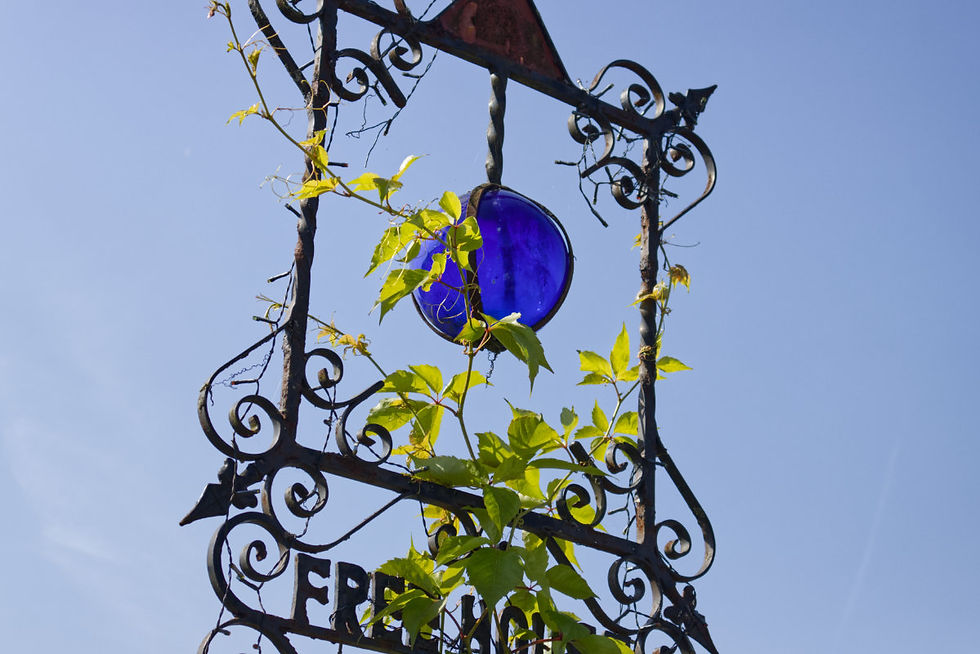
The route has mostly been in lanes with villages so small, blink and you miss them but there are plenty of interesting names. One local curiosity is names like White Ball, Red Ball and Blue Ball, with this being the unusual sign for the Blue Ball pub, in Sampford Arundel.
Red Ball is a small locality in Mid Devon, close to the Somerset border. Like nearby colour-themed cluster names (such as White Ball and Blue Ball), local folklore and regional naming history link these unusual names to 19th-century railway construction gangs, where work crews famously drew coloured balls from a bag to designate their operating sectors.
The British tradition of inn signs has always been related to the majority of the population being illiterate. Most feature painted images of a scene or well known personage like King George, or Wellington or Queen Victoria, but some rarer ones are more literal like this great example.
Crossing from Devon into Somerset, the landscape dramatically opens up across the Blackdown Hills National Landscape, shifting from high-hedged, winding lanes into high, sweeping plateaus and vast panoramic views over the Somerset levels and rolling vales.
Which is just as well at this point, because we can now see in the distance the pinnacle of the Wellington Monument. That is where we are headed.
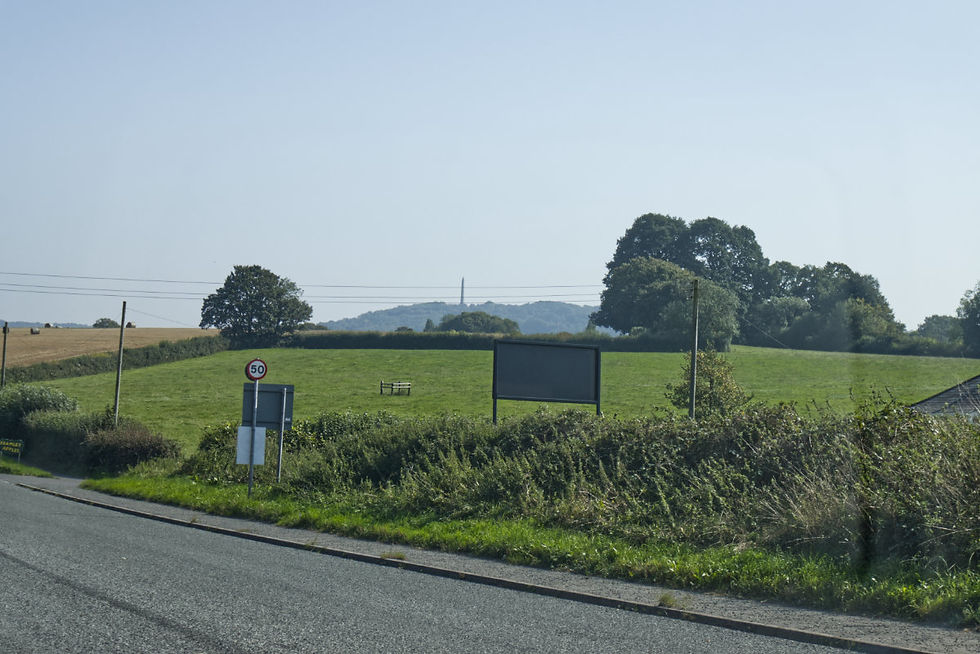
This scene couldn't be more of a contrast with the G Roads we have just been along. This is the M5 motorway. It is the main route down from the rest of England to the South West, and in summer it is where every caravan in the nation heads for their holidays.

From the car park at the Wellington Monument is this very old lane to the monument itself. It's a beautiful shady spot on a hot dry day.

You can tell how ancient this lane is because the trees in the hedgerow are growing parallel to the ground. It may not be something you have noticed before. We all know that trees grow straight up, so what is going on here?

Traditional hedges were made from the living wood and so called laid hedgerows were different all over England.
Even though we are now in Somerset, we are only just over the Devon border and this is a photo of a Devon style laid hedge. There is a North Somerset style but not in this area. It isn't difficult to see how a living hedge cut from saplings becomes.....

.....this, after enough years have passed.
Hedges in Devon are normally laid on top of a bank. The high earthwork and brashy top and sides together form the barrier to livestock. Unlike styles that use stakes for support, the pleachers are laid so they are almost horizontal and in contact with the ground. Where possible, they are laid to form two “combs” on either side of the top of the bank. After laying, the earth that has slumped from the bank is “cast up” to fill the gap between the combs. This encourages the pleachers to establish roots along their length and reinforce the bank. The densely packed brush and the now vertically sided bank is designed to keep sheep and lambs secure. National Hedgelaying Society
I would say this is the perfect example of what is described.

The Wellington Monument is a 175-foot-high (53 m) triangular obelisk located on a point of the Blackdown Hills, 3 km (1.9 miles) south of Wellington in the English county of Somerset. It is a grade II* listed building and is the tallest three-sided obelisk in the world. The monument was designed to commemorate the Duke of Wellington's victory at the Battle of Waterloo. Construction of the original design commenced in 1817.
Now in the care of The National Trust it was restored and reopened in 2021. The land on which it stands was originally part of the Wellington estate bought by the Duke after his ennoblement included with which was a grant of £100,000 from a grateful nation, the equivalent of £4.6 million today.
The title and money were the gift of the nation for the victory at the Battle of Waterloo. Wellington was in fact the chosen name used for the title for Arthur Wellesly as 1st Duke of Wellington even though he had no local connection to the area. Wellington the town in Somerset was chosen by his brother while Arthur Wellesly was still abroad with the army because it sounded similar to the family name Wellesly. The Duke of Wellington had in fact never visited the place before.
The monument's design was inspired by an Egyptian obelisk, but in the shape of the type of bayonet used by Wellington's armies, a spike of triangular cross-section rather than a normal blade. From initial proposal to completion it took 39 years. Proposed cast iron statues at the base, and one of the Duke on top were never added. Various proposals for cannons around the monument came and went and some even appeared over the years to be subsequently removed. The one cannon on the site, from the Battle of Waterloo, was brought to the monument in 1977 and finally installed in 1984.

Taunton Courier and Western Advertiser -Thursday, 23 October 1817
WELLINGTON MONUMENT.
Monday last, pursuant to public announcement, the ceremony took place of laying the Foundation Stone of the Monument, to be erected on Blackdown Hill, in honour of His Grace the Duke of Wellington.
Lord Somerville - "The spot chosen for this purpose is well suited to keep alive the remembrance of the splendid victories gained by this Hero, and cannot fail, at the same time, to perpetuate the invincible courage and skill of those who fought under his command. It will, moreover, form a most prominent feature in a part of England, already ornamented by the pillar raised by the celebrated Earl of Chatham, and by the tower built at Stourhead, in commemoration of the spot where Alfred the Great first erected his standard."

The nature of every country decides what should be the form and character of its public buildings. Where the surface is level, and the object is easily approached, embellishment is required, and consequently more expence is to be incurred; but in a country like this, bold in its features, and contrasted by the extreme fertility of its vale, and the grandeur of the hills which overlook it, simplicity with striking effect and durability, are chiefly to be sought.

The Pillar we are now about to found, is supposed to comprehend these objects; on these obvious principles, it has been submitted to the investigation of very many persons of skill and taste. Their free judgments have been courted, and in no instance has an objection been made .- As far as mortal effort is permitted to go, we will endeavour to perpetuate (for very many ages to come at least) the grateful recollection of events as beneficial as they are glorious.

Immediately where the Pillar or prism rises from its base, the breadth of each face of the triangle will be at all events, 20. feet. and the height will be 103 feet, which is 13 feet higher than the celebrated Pompey's Pillar in Egypt .- To this height of 103 feet will be added the triangular pedestal, and Colossal statue of the Duke of Wellington, which is designed to decorate its summit .- Being cast in pieces, it may at any future period be safely placed on the Pillar, should the funds justify such an addition .- In the mean time, the Pillar, by being thus allowed to bind together and harden, will be more secure to receive the superstructure now contemplated. A further elevation of 27 feet may also be added to the Pillar itself, without violating the just proportions of architecture.

For general view, the natural advantages of the situation are peculiarly happy. It proudly marks the line of the horizon; it overhangs the great and direct road through the south west district of England; no eye can escape it, it will be seen from sea to sea .- There can be but little doubt therefore, that in the course of a very few weeks, the whole of the fund requisite, in addition to the 1,700l. already subscribed, will be contributed.
The form of the Pillar which has been fixed upon in pursuance of the proceedings of the Committee, is triangular, or that of a prism gradually converging from the base towards its summit.

Ten acres including the highest part of the Blackdown Hills, overhanging the Vale of Taunton, and on which the Pillar is to be erected, are already secured by the sale of that portion of the Common, to defray the expenses of the enclosure, and stand in my name; I purchased, and now hold them in trust. They immediately adjoin the Wellington estate, and will prevent future obstruction of the views.

The best artificers have been procured, who have been accustomed to work hard stones and flints, such being the materials with which this Pillar must in great part be built.

His Royal Highness the Prince Regent, has been graciously pleased to sanction the design, and to order a certain number of heavy ordnance, most appropriate for the occasion, to be selected from those either captured in the Peninsula or employed there, under the Duke of Wellington, for the purpose of constructing the emblematical ornament of the base; 4 brass 12 pounder cannon, taken at the battle of Waterloo have also been granted, and selected with that promptitude, which marks every proceeding of the Board of Ordnance.

Taunton Courier and Western Advertiser - Saturday, 11 May 1957
Magnificent View
Before it was closed, it was an adventure to climb the 235 steep steps to the top by the light of a candle. The reward for the climb was a magnificent view of the Vale of Taunton for miles around. The monument, which stands 175ft. high and 900ft. above sea level, was erected to commemorate the military achievements of The Duke of Wellington. The foundation stone was laid in 1817. It was taken over by the National Trust in 1934.


Comments