Odds and Sods November 2025

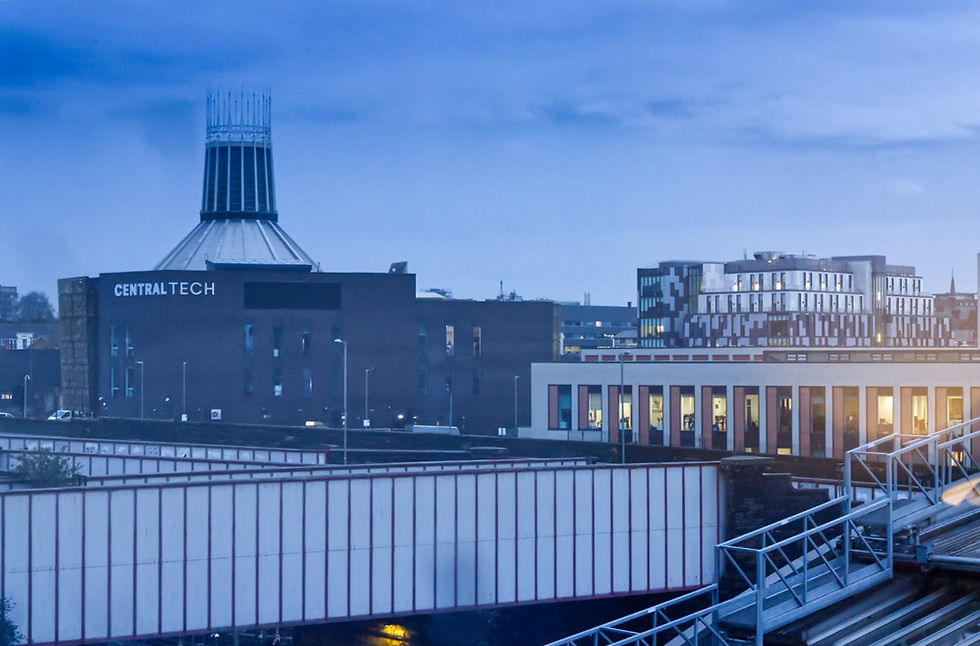
This month's selection are mostly taken from a trip to Liverpool. I have already posted a history of the iconic Liver Building here. Before going, the weather forecast was dire, rain and more rain. It was just a case of whether the rain would be bad or terrible. On this occasion the forecast turned out to be way off the mark, and our winter clothes never left the car. It was grey but dry and very mild. So here is a selection of dark grey views of Liverpool. This one was a view from our hotel window and features the other iconic Liverpool building, the Catholic cathedral. I have previously made a post about that too, here.
Looking in the other direction and the spectacular roof of Lime Street railway station dominates the skyline with St. John's Beacon piercing the clouds.
The construction of St Johns Beacon began in 1965, its main purpose to provide a ventilation shaft for the shopping complex below, its completion coming in December 1969.
There is a viewing gallery at the top that runs right around in a circle giving 360 degree views of the city (closed as I write this). I went up the tower in 1978 and I can't believe now that at that point it had only been open about ten years.
At that time, the viewing gallery was open air, but it seems to have been glassed in since then. It was a day not unlike this one shown, apart from the fact that it was also very windy. Like most thin and tall towers they are built to sway with the wind and it had the unnerving effect, when on the circular balcony of collecting a large puddle of rainwater and swirling it around the viewing area. This meant that with every swing of the tower the puddle rolled around the balcony, circling the building, maybe every 30 seconds. So the puddle would disappear around one corner and then come back around the other. If there had been a hole in the middle, I might have been sucked down it like a giant whirlpool. This is probably why they eventually closed it in with windows.

Last time we stayed here we also had a feathered visitor at the hotel window, but I have checked the markings on the plumage and this is a different one.

Liverpool has a treasure of atmospheric old pubs and while we don't aim to use them all we're certainly trying out any easily reached candidates on our explorations of the city. Here are two historic hostelries. This is The Vines in Lime Street.


The Baltic Fleet dates back to the 1850's and sits opposite the old docks.

You could say it is ship shaped for a ship shape clientele.

Inside, the prow of the ship is a nice feature.

Next door to the Liver Building which is one of the "Three Graces" is the second of those buildings the Cunard Building. The other being The Port of Liverpool Building. The three stand as a unique feature on the waterfront, making the city instantly recognisable to any new arrivals. Most new arrivals came by sea as this was at one time the world's busiest port.
A statue on a column at the front of the building seems to include a Viking long boat. The Grade II-listed statue was designed by Arthur Davis and unveiled in 1921 by the Earl of Derby.

Hampshire Advertiser - Saturday 29 October 1921
A CUNARD MEMORIAL.
The Earl of Derby on Saturday unveiled at the Pierhead, Liverpool, a memorial which has been erected by the Cunard Steamship Company as a tribute to members of its staff who laid down their lives during the war.
The memorial, which occupies a position in the square fronting the Cunard Offices, is a monolith granite column, surmounting which is a bronze statue designed by Mr. Henry Pegram, A.R.A., representing Victory in the form of a youth poised on the prow of an ancient galley.

I don't know if his fig leaf was an original feature because it looks like it was rivetted on as a prudish afterthought. Having since slipped out of place, one can now see how it is fixed and the line, let's call it his tan line, which shows its original position.

On the other side of the building are some seats decked out as memorials for various Cunard ships of the past. I must take a closer look at these next time.
The Scotsman - Saturday 20 July 1918
CUNARD LINER CARPATHIA SUNK
FIVE MEN MISSING.
The Central News says the Cunard liner Carpathia has been sunk.
The Carpathia was sunk by a German submarine at about 9.15 on Wednesday morning.
All of the passengers and crew were saved, with the exception of three firemen and two trimmers who are supposed to have been killed by an explosion in the engine-room. The survivors number 215, including 36 saloon and 21 steerage passengers.
Members of the crew whom the Central News interviewed state that just after the passengers had breakfasted, a torpedo struck the vessel slightly forward of the engine-room, and a minute or two later a second torpedo crashed into the engine-room. There was no panic on board. Both passengers and the surviving members of the crew got away in small boats without difficulty.
The Carpathia looked like remaining afloat for a long time, but then the U-boat came to the surface and fired a third torpedo. The liner filled rapidly, and sank about two hours after the firing of the first torpedo.
After her disappearance the submarine approached the Carpathia boats, but did not fire
on them.
The Carpathia was a steel twin-screw steamer of 13,603, gross tonnage, and was built by Swan & Hunter. Newcastle, in 1903.

Nearby is the Art Deco gem, which was built for the Mersey Tunnel Company. I have showed some photos before but here are some more details.

The George's Dock Building as it is known, was built in the 1930s in the Art Deco style, and designed by architect Herbert Rowse. Occupants of the office space now include, Merseytravel, The Liverpool City Region Combined Authority, Mersey Tunnels staff and The Mersey Tunnels Police. It also houses ventilation machinery for the Queensway Tunnel and the Mersey Tunnels Tour Offices. Wikipedia
Above the main door is the figure of 'Speed, the Modern Mercury', carved in high relief and standing approximately 23 feet from base to top.

One original occupant of the building was the Royal Automobile Club.
Liverpool Echo - Friday 17 May 1940
A CALL TO MOTORISTS
'A' call is being made to motorists in Liverpool which should meet with a ready response. Briefly it is an invitation to them to provide transport for soldiers, sailors and airmen coming on leave from overseas, who arrive during the hours when normal transport is not operating.
To-day, all car owners, whether members of any organisation or not, are being invited to co-operate. It needs little imagination to realise the plight of the soldier arriving in Liverpool after midnight, after travelling for many hours without a break, burdened with his heavy equipment, and finding himself then faced with either a long tramp to his home or a weary wait on the station until the early trams and buses commence to run.
It is felt that there must be hundreds of car owners who would gladly give up an occasional night's rest to stand-by at the stations and run these men to their homes immediately they arrive. Such a service is beyond price to those for whom it will be rendered. The district secretary of the Royal Automobile Club, whose address is George's Dock Building, Liverpool 3, invites all motorists who wish to take part in the scheme to register with him.
Along the top of the engine house runs the decorative frieze, comprising a repeated geometric pattern flanked at each end by a winged horse, also seen here above a door.


The west façade on Georges Dock Way has the main entrance, flanked by two fluted niches with free-standing sculptures representing 'Day' and 'Night'. Each is just over three feet in height and executed in black basalt.

This building was not only the head office for the Mersey Tunnel Company but the site of the first digging of the first shaft. The building still has a ventilation shaft forming its tower.
Shields Daily News - Thursday 17 December 1925
MERSEY TUNNEL
Princess Mary Turns Gold Key
at First Boring.
With a gold key, Princess Mary, yesterday started 14 compressed-air hammer drills on the excavations for the two-mile Mersey tunnel which is to connect Liverpool and Birkenhead.
The ceremony took place from a platform overlooking the disused George Dock in the bed of which the first shaft is being sunk, and was watched by thousands of people.
The Princess, who was accompanied by Viscount Lascelles, was met at Lime Street railway station by Lord and Lady Derby, and received a civic reception from the Lord Mayor of Liverpool. The Royal party drove in a closed car to the dock.
THE GOLD KEY.
Sir Archibald Salvidge, chairman of the Mersey Tunnel Joint Committee, handed the gold key, which was the model of a drill and bore a design of the tunnel to Princess Mary, who placed it in the valve-releasing mechanism.
Immediately the compressed air rushed through the 14 armoured tubes and the rattle of the drills on the sandstone began. The Princess leaned over the platform rail and watched the workmen 50ft. below at work in the two large chalk-lined circles marking where the shafts are to be sunk preparatory to two borings, each of 15ft. by 12ft: one above the other, as a preliminary to constructing the tunnel.
Sir Archibald Salvidge said that the Tunnel would provide improved transport facilities between Lancashire, Cheshire, North Wales, and the Midlands. It would also be the largest tunnel in diameter in the world-44ft .- and on the central roadway would carry four lines of traffic.
After calling at the town hall, Princess Mary drove with Lord and Lady Derby to Knowlesley. She wore a black fur coat and closely fitting hat.


At the corners of the north and south facades are four bas-relief panels, depicting 'Civil Engineering' and 'Construction' , and 'Architecture' and 'Decoration'.
This sculpture appears to show a figure standing atop the tunnel cross section with two rock drills on either side. The George's Dock Building was listed at Grade II on 10 October 1980.

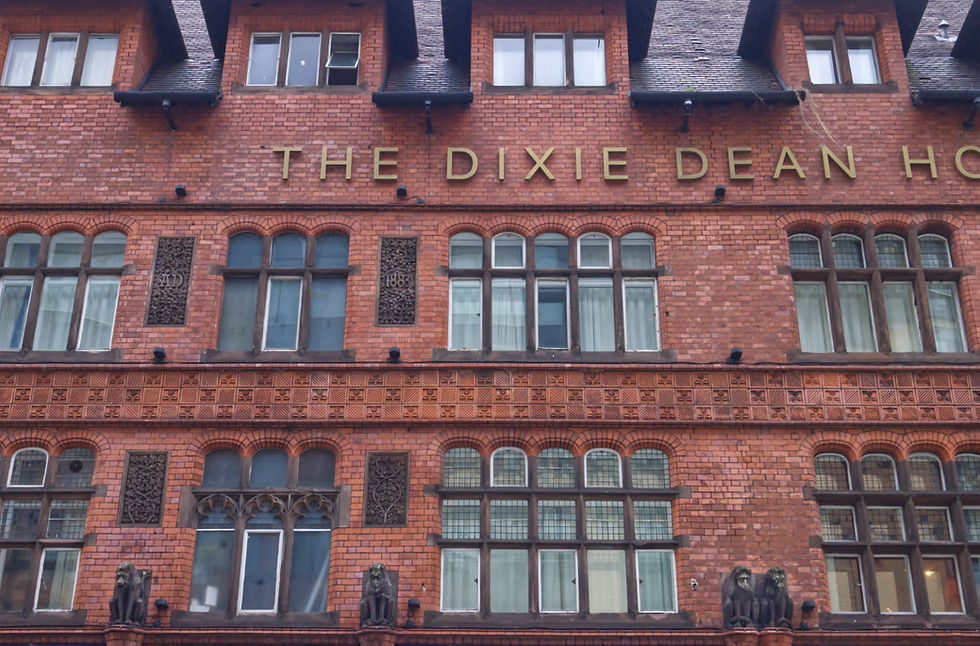
This listed building, below, now forms the Dixie Dean Hotel. It was part of the original Carlisle and Jerome Buildings built in 1883 - 1885.
Between the years of 1883 and 1885, the Jerome and Carlisle Buildings were designed by architect John Clarke on the instruction of iron founder H Rankin. The Jerome Building was built first, in 1883, followed by the Carlisle Building in 1885. Both of the buildings are identical above the ground floor and really form a single composition.
Rankin’s Union Foundry was close by in Manchester Street, and it supplied some of the ironwork used in these and other neighbouring buildings. Built in the Gothic style, these buildings are made up of Red Ruabon brick from North Wales with red Runcorn stone dressings from Cheshire, which was a popular combination in 19th century Liverpool.
The former Adelphi Bank of 1892, now a coffee shop, with bronze doors of reliefs by Stirling Lee. The reliefs show pairs of Famous Friends, David and Jonathan, Achilles and Patroclus, Castor and Pollux, Roland and Oliver. Only two panels showing here on the right hand door.

Now a few more shots from Ringmore church in South Devon, after a recent series of posts about the history and contents of this ancient building. Ringmore Church.


Details from the Nativity window.


Comments