The Charterhouse Chapel

This my 8th and final post from my July 2025 London photo walk.
Charterhouse Chapel is a glorious accident of survival in the middle of bustling London, only a five minute walk from the massive Barbican complex and the Smithfield meat market. The chapel as it looks today is part of a larger group of buildings most of which have Tudor origins. It is a joy to discover something like this, that you never knew existed, when just strolling around a large ancient city. It is free to enter and an almost silent haven set back in a leafy square, well away from the normal mayhem of a busy metropolis.

The site was originally a Carthusian priory founded in 1371 on top of a Black Death burial ground. The priory was dissolved in 1537 in the sweeping away of Catholicism by Henry VIII. From 1545 onwards it was rebuilt as a Tudor courtyard house by Thomas Sutton. Sutton was a businessman and "the wealthiest commoner in England". He established a school and an almshouse on the site and although the school moved in 1872 the almshouses remain to this day. There are fragments of buildings from the monastic era but most is Tudor.
The Charterhouse name itself is also a survivor as it derives from the Carthusian origins of the Grande Chartreuse, their original monastery near Grenoble in France. The original occupants of the priory suffered just as much as the building, at the hands of Henry. The members refused to recognise Henry as the new Head of the Church of England, the sort of thing that didn't go down too well with the King.
The fact that these men are today referred to as the Carthusian Martyrs of London, tells you all you need to know. The prior John Houghton was hanged, drawn and quartered at Tyburn while his monks were taken to Newgate prison where nine of them starved to death. The tenth monk who survived starvation was executed three years later.

Thomas Sutton was the mover and shaker of his day, which was no easy task when people were routinely being hung, drawn and quartered. He got an Eton and Cambridge education at a time when education meant just that, going to Eton and Cambridge. At that time Cambridge was a respectable palace of great learning, it isn't anymore, sadly, as we have recently discovered. He got important jobs, and married well, and he was a favourite of many of the highest officials in the land including the Dudley family who were in turn favourites of Elizabeth I. Sutton bought what remained of Sutton House, later known as Charterhouse, from the Earl of Suffolk.

In 1588 Sutton contributed £100 to defend England from the Spanish and he may have sent a ship "The Sutton" out of Weymouth which captured a Spanish vessel with a cargo worth £20,000. If it was his ship as supposed, his £100 investment paid off very well indeed. That's £3.5 million today.

Sutton left part of his great fortune to establishing an almshouse for 80 impoverished gentlemen and a school for 40 boys on the site of his house right here.
Alms are donations of material goods, money or shelter to the impoverished, carried out as an act of charity or religious duty.
Charterhouse School as it became known moved out in 1872. The site suffered some damage during the Second World War as vast swathes of the neighbouring Barbican area was flattened in a single night of German bombing. There was restoration carried out in the 1950's. There is more about the Barbican here.
After Sutton's death there was much scandal and controversy. His charitable bequest was one of the largest in history and distant relatives were not happy about it. His will was challenged by his nephew and a major court case ensued which ultimately involved the Archbishop of Canterbury himself who defended it. Critics of his bequest were not so much envious, wanting the money themselves, of course they weren't. They were more worried about the elaborate and showy giving of money for prestige and vanity. Believe that if you like.
“Wealth begets envy and the contents of a will produce disappointments as well as gratitude, whilst such an overt demonstration of his wealth could be construed as vanity, even though applied to benefit the disadvantaged.”
Nobody would want poor people being fed and housed if it might look vain would they? In any case Sutton won the day, even in death, and the rest is history.
On the 12th December 1614, two years after his death, Sutton's remains were moved from Christchurch in Newgate in an elaborate and probably "vain" candle lit procession, to his brand new "showy and prestigious" tomb in Charterhouse Chapel. Many believed that the tomb was "pretentious and thoroughly inappropriate" for someone of his social standing. So there is an explanation of sorts. Don't forget that this man was a commoner, the son of an official from Lincoln, he was not a titled man.

Here is Thomas Sutton, a commoner, lying in grandeur and splendour, more than 400 years after his death. The total costs for his funeral, including for carrying his corpse by candlelight (25s and 4d) was £514 19s and 4d. £70,000 in today's money, which seems like a bargain. Of course costs, like labour rates for skilled masons and artisans, to construct something like this were far less than they would be today, so it's more likely several hundred thousand pounds.
The inscription above his polychrome effigy reads,
“Sacred to the glory of God, in grateful memory of Thomas Sutton, Esquire.
Here lieth buried ye body of Thomas Sutton, late of Castle-Campes, in the countie of Cambridge, Esquire, at whose only costes and charges this hospital was founded and endowed wth large
possessions for the relief of poor men and children. Hee was a gent. borne at knayth, in
ye county of Lincoln, of worthie and honest parentage. hee lyved to ye age of seventy-nine
yeares, and deceasd ye 12th of December, 1611.”

One of the knock on effects of Henry VIII's changes to the religion of the day was that there was also a change in artistic styles as Italian Popish artists fell out of favour and artists from the dissenting Protestant Low Countries took refuge in England. The monument is therefore Flemish in style.
Two Jacobean soldiers in full military dress flank the inscription panel. Their presence is there to demonstrate Sir Thomas Sutton’s position as Master of Ordnance in the North Parts of England between 1569 and 1594. The polychromed carved alabaster inner-side walls of the recess are also decorated, depicting grapes on a vine alongside pomegranates.

The central polychromed bas-relief panel is known as the ‘Preacher Panel’. It depicts 52 figures including a preacher. The number of figures is likely to reflect the 52 weeks of the calendar year and is in keeping with the monument’s theme of the cycles of life. The carved panel has strong Protestant imagery with the emphasis being on the pulpit and not the altar that was popluar before the Reformation. Two carved alabaster lion heads sited just above the panel oversee the congregation. Eskdale restoration


If you were ever in any doubt about money buying respectability, even in death, witness this description of the Founder's Day event 300 years after Sutton founded the school. Virtually every top figure of importance in 1843 gets a mention in this celebration of the charity of a lowly commoner. I also love the vision conjured up by the "decayed merchants and gentlemen" who were the beneficiaries long after his death. (Oppidans are fee paying students)
Morning Advertiser - Wednesday, 13 December 1843
ANNIVERSARY OF THE FOUNDATION OF THE CHARTER-HOUSE.
Yesterday being the "Founder's-day," the event, pursuant to ancient custom, was celebrated at the Charter-house with the usual formalities, in the presence of several noblemen and gentlemen who have been educated at the school, either as " oppidans," or on the foundation. At four o'clock the scholars and pensioners entered the chapel, and after the governors, masters, and other officers of the institution, together with a number of the metropolitan clergy, had taken their seats, a sermon was preached by the Hon. and Rev. Robert Leddell, after which the company repaired to the Governor's room, where Herbert William Fisher, grandson of the late master, delivered the Latin oration. A collection, for the purpose of defraying the expenses of sending that young gentleman to college, having been made, a large party of the visitors adjourned to the hall, and dined together.
The school as present consists of 165 pupils, of whom forty four are on the foundation, and are entirely clothed and boarded. There are also eighty decayed merchants and gentlemen annually receiving "respectable maintenance" in the institution, each having an income of £26 per annum, and in addition to their lodging, a dinner, besides other "commons," is provided for them daily in the hall. Gowns, &c, are also supplied them. The nomination of these " pensioners" is vested in her Majesty, his Royal Highness Prince Albert, her Majesty the Queen-Dowager, and fourteen Governors, who exercise the privilege in rotation. Several livings and other patronage are in the gift of the Governors, and there are a number of exhibitions to the Universities attached to the school.
The Governors are the Lord Chancellor, the Archbishop of Canterbury, the Archbishop of York, the Bishop of London, the Duke of Wellington, Earl Grey, Earl of Ripon, Viscount Sidmouth, Viscount Canterbury, Lord Cottenham, Lord Wharnolifle, Lord Chief Justice Tindal, Sir Robert Peel, and the Venerable Hale Hale, Archdeacon of London.

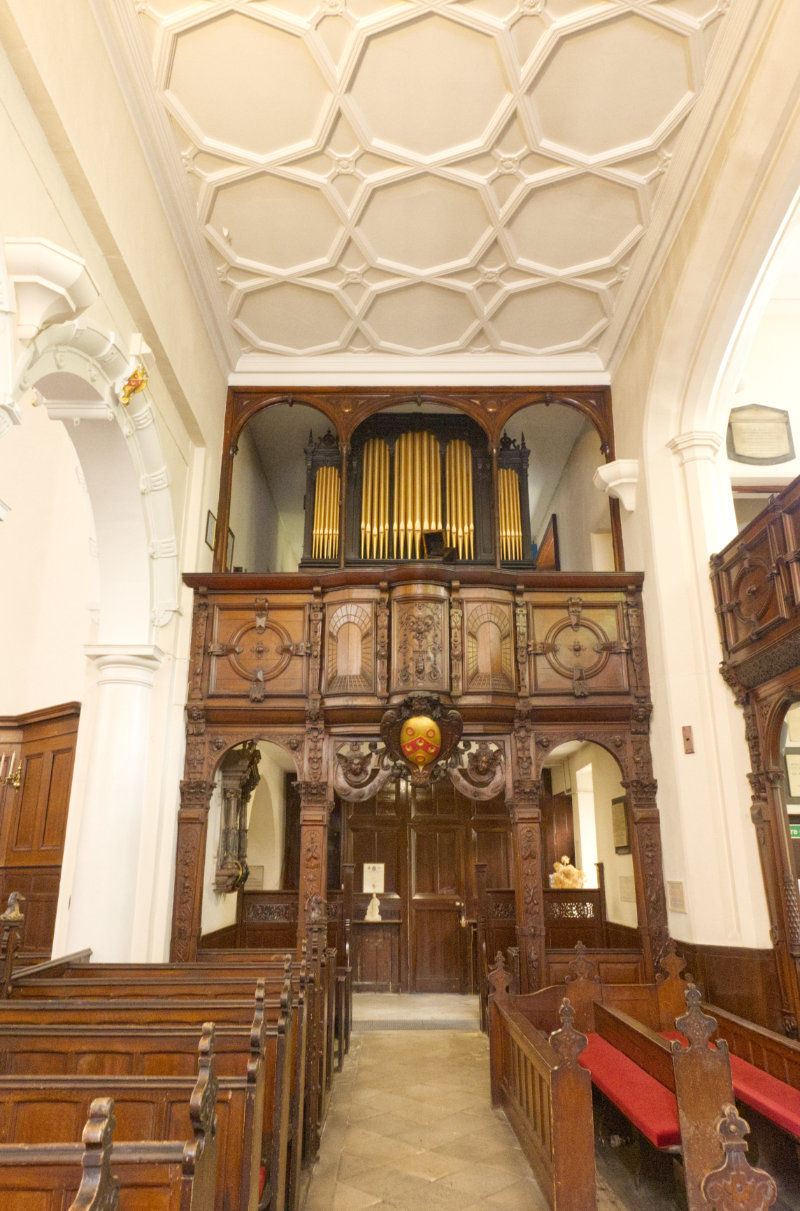
The interior of the chapel features a Jacobean carved wood screen, pulpit, and organ gallery some of which is the work of Master Carver John James.
Throughout the Charterhouse site you will see portrayed the Talbot, a breed of hunting dog, as it appeared on the Coat of Arms of Thomas Sutton. The talbot was a medium-sized white hound common in medieval England, known for a deep chest and drooping ears, though the breed is now completely extinct.

Nottinghamshire Weekly Express - Friday, 25 January 1907
JOHN WESLEY AT THE CHARTERHOUSE
John Wesley was ten and a half years old when he became a pupil of this famous school. It was through the friendly services of the Duke of Buckingham, then Lord Chamberlain of the Royal Household, that the son of the Epworth rector gained admission to the school.
"Wesley entered the school as the poor child of an impoverished parish priest and had to endure wrongs and insults neither few nor small, but though he was only sixteen years of age when he left, he had by his energy of character, his unconquerable patience, and his progress in learning, acquired a high position among his fellows.
Horncastle News - Saturday, 5 June 1937
CHARTERHOUSE MEMORIAL TO JOHN WESLEY
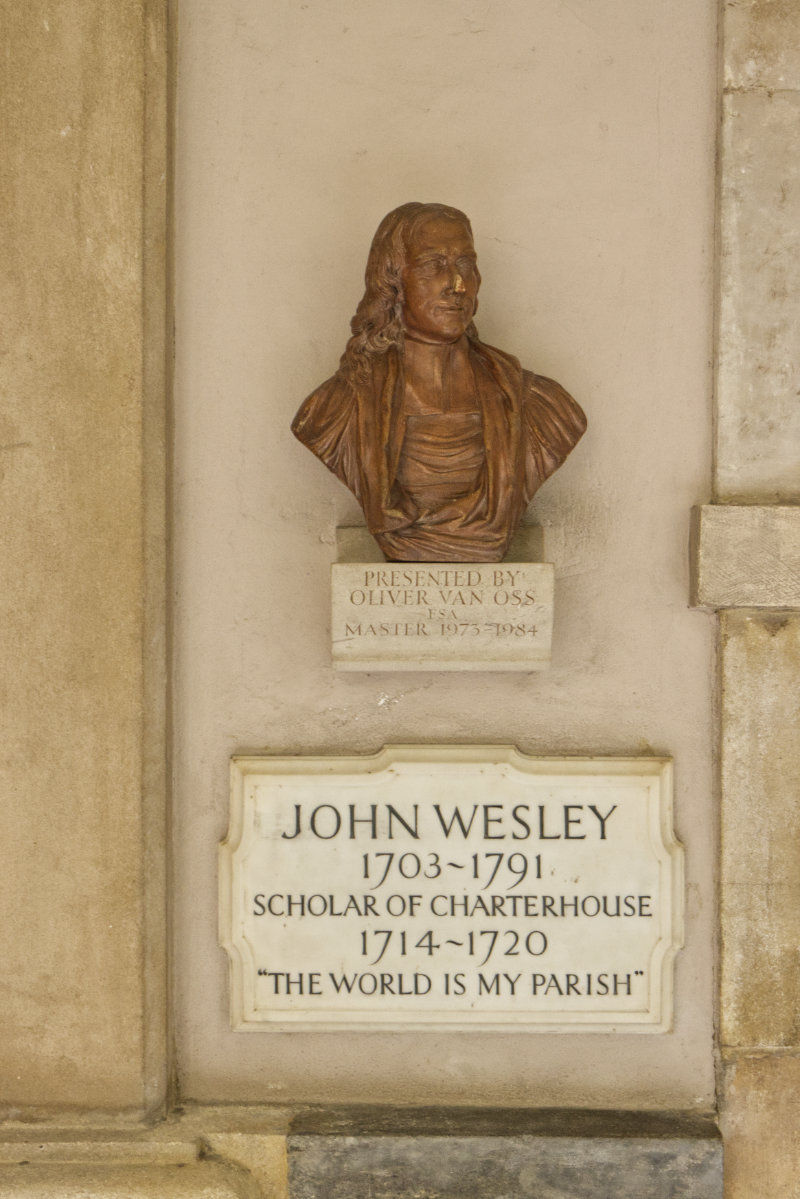
In the peaceful cloisters of Charterhouse Chapel, only a stone's throw from busy Smithfield Market, London, the Archbishop of Canterbury on Tuesday dedicated a marble tablet to the memory of John Wesley.
The tablet, inscribed, "John Wesley, 1703-1791, Scholar of Charterhouse, 1714-1720. 'The world is my parish,'" was presented and unveiled by Mr. E. S. Lamplough, a former vice-president of the Methodist Conference and a member of Lloyd's.
The cloister leading into the Chapel is a wide airy space where you will find a variety of memorials to some of the early famous alumni of Charterhouse School and former Brothers of the almshouse. The Charterhouse


Comments